






Zhaohui Su, VP of Biostatistics at Ontada, shared a post on LinkedIn, about a paper by Martin O’Donnell et. al published in the Journal of Clinical Epidemiology:
“I recently revisited one of my favorite papers, which makes a compelling case for moving beyond the traditional RCT versus RWE debate.
While RCTs are considered the gold standard for establishing causal effects, their strict eligibility criteria and controlled environments can limit generalizability.
RWE, derived from everyday clinical practice, complements RCTs by capturing treatment performance across diverse populations, routine settings, and longer time horizons.
Notable examples, such as anticoagulation therapy and COVID-19 research, demonstrate how RWE can refine, extend, and contextualize RCT findings.
Declan Devane and colleagues advocate for a contextual evidence ecosystem where RCTs and RWE are complementary and mutually reinforcing and highlight priorities for a modern evidence ecosystem:
- Regulatory alignment.
- Advanced causal inference methods.
- External control arms.
- Pragmatic and adaptive trial designs.
- Robust data infrastructure and governance.
Table 1 of their paper lists integration strategies for RCT and RWE in contemporary health care. Enjoy the read. Please share your perspectives.”
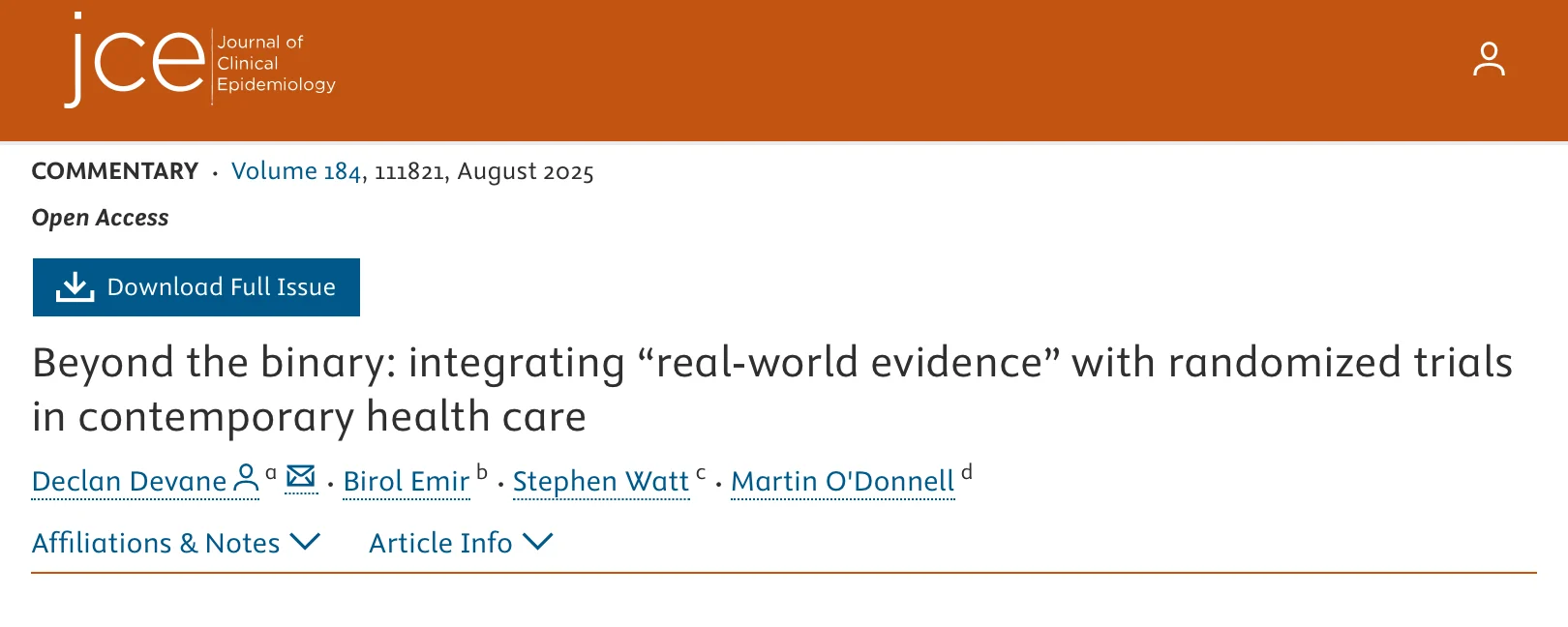
Title: Beyond the binary: integrating ‘real-world evidence’ with randomized trials in contemporary health care.
Authors: Declan Devane, Birol Emir, Stephen Watt, and Martin O’Donnell.
You can read the full article in the Journal of Clinical Epidemiology.
More posts featuring Zhaohui Su.