Zacharoula Sidiropoulou, Senior Consultant Breast Surgical Oncologist at Hospital São Francisco Xavier, shared on LinkedIn:
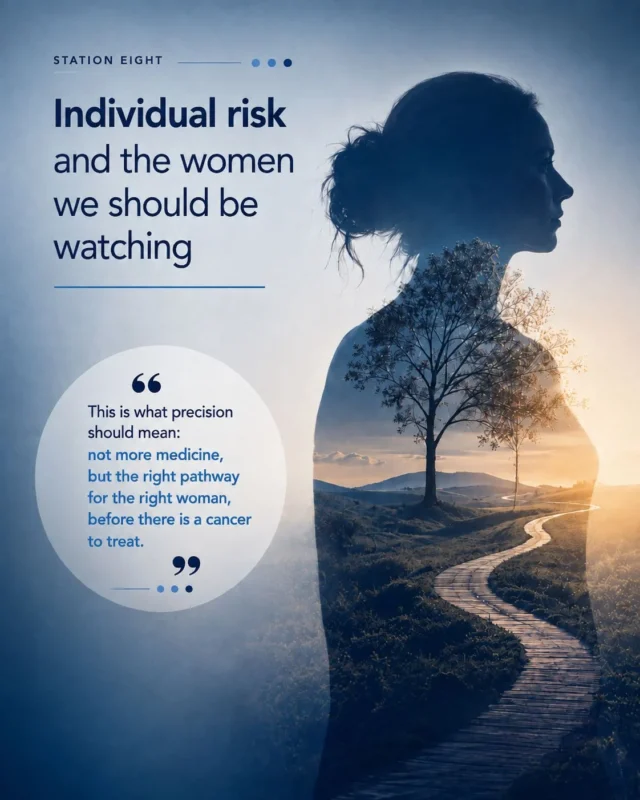
“Station eight: Individual Risk and the women we should be watching
Till now, everything was about a woman who already has a symptom, or an invitation.
Yet there is another group: women whose risk is high enough that average risk creening may not be the right pathway.
A strong family history. A pathogenic variant such as BRCA1 or BRCA2. Chest radiotherapy at a young age. A calculated lifetime risk high enough to change surveillance.
Other factors, such as atypical breast lesions or extreme mammographic density, can also change the risk, but not all have the same level or type of risk.
Risk stratification is not calling more women ‘high risk’. It is matching surveillance to the nature and extend of the risk.
For women at high risk, European Society of Breast Imaging (EUSOBI) recommends screening beginning as early as 25 with annual breast MRI, with mammography from around 35–40.
For women with extremely dense breasts, the recommendation is different, with MRI considered at a different interval.
Through the value lens, risk stratification becomes:
Who already has enough information in her history, genetics, or imaging to justify doing something differently?
The opportunity is not only earlier detection.
For some women, knowing their risk creates options before cancer:
Enhanced surveillance, Risk – reducing surgery, Risk – reducing medication, Reproductive counselling, Cascade testing across a family (one pathogenic variant identified in one person can lead to testing of relatives who may also be at increased risk). But identification is not enough.
Across 30 studies, only about one-third of at-risk relatives completed cascade genetic testing.
So the policy problem appears again:
- Identification without follow-through creates less value than it could.
- A high-risk pathway needs more than a genetic test.
- It needs counselling.
- A registry that knows whom.
- A recall system that knows whom.
- A route from genetic result to imaging, prevention and family testing.
- And someone accountable for making sure the chain does not break.
A cost we should not hide: Telling a healthy woman in her thirties that her cancer risk is substantially elevated changes how she thinks about her body, her children and her future. That information can be empowering and can also create anxiety and difficult choices. A well – built risk pathway includes informed, non – directive counselling and psychological support.
Here is another nuance in family testing: Relatives who test negative for a known familial variant may avoid gene – carrier surveillance, unless their family history or other risk factors independently justify enhanced follow-up.
Precision should mean: the right pathway for the right woman, before there is a cancer to treat.
Now we are the unit door; by Monday, we go inside.
Disclosure: The knowledge, perspective, thinking, and final voice are mine; GPT created the image.”
You can also read: Breast Cancer Treatment Sequencing 2026: Powerful New Insights for Better Outcomes