
The rapid expansion of effective systemic therapies has transformed metastatic breast cancer into a disease in which treatment sequencing increasingly matters as much as individual drug efficacy. Antibody–drug conjugates, endocrine therapies, targeted agents, and immunotherapy are now available across multiple lines of treatment, creating an important clinical question: when a highly active therapy works in several settings, does moving it earlier actually improve long-term outcomes, or does it simply change when patients receive the same effective treatment?
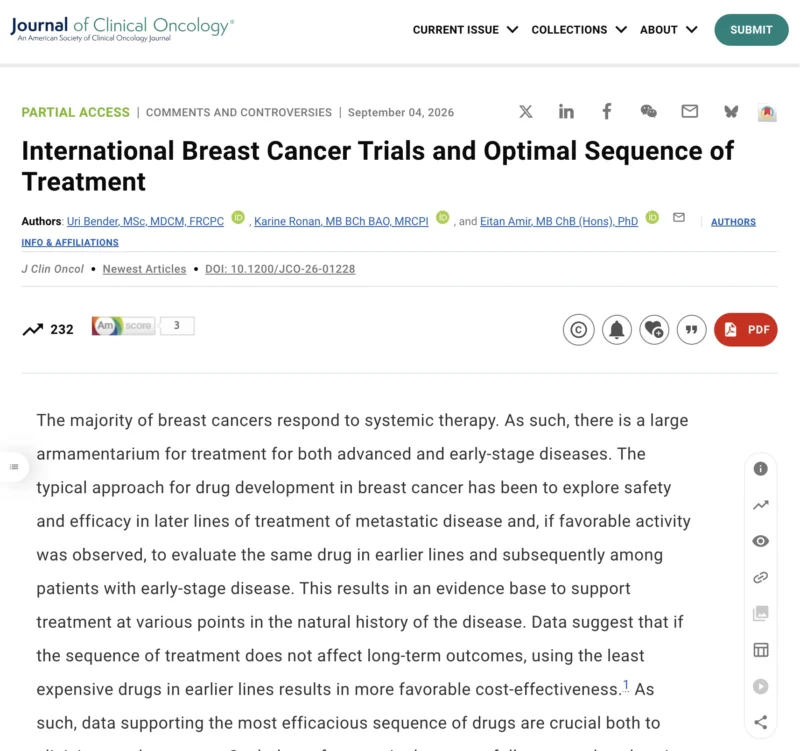
A new Journal of Clinical Oncology commentary by Uri Bender, Karine Ronan, and Eitan Amir argues that answering this question has become increasingly difficult in multinational breast cancer trials. Their central concern is that overall survival can be influenced not only by the randomized intervention but also by what happens after patients leave study treatment. When access to subsequent therapies differs substantially across countries, an apparent survival advantage from earlier use of a drug may partly reflect the fact that patients in the control arm never had meaningful access to that drug later.
This is particularly relevant in the current antibody–drug conjugate era, where several agents have demonstrated activity across multiple treatment lines. The debate is therefore no longer simply whether these therapies work. It is whether available trials can reliably determine the optimal point in the treatment sequence at which they should be used.
Overall Survival Is Influenced by More Than the Randomized Treatment
Overall survival remains one of the most important endpoints in oncology because it captures the complete therapeutic course rather than the effect of a single treatment interval. Clinical-value frameworks from ASCO and ESMO assign greater value to therapies that improve survival, which makes confidence in the generalizability of OS findings particularly important.
However, OS in a modern metastatic breast cancer trial is not determined exclusively by first-line or second-line therapy. It reflects everything that happens afterward, including crossover, commercially available treatment, compassionate access, geographic reimbursement policies, and the availability of newly approved therapies.
That creates a fundamental interpretive challenge in international trials. If patients randomized to an experimental drug receive a highly active therapy immediately, while patients in the control arm are treated in regions where that same drug is difficult or impossible to obtain after progression, the survival comparison may partly reflect access to the drug at any point, rather than proof that receiving it earlier is biologically superior.
This distinction is especially important in breast cancer, where patients may move through several effective treatment lines over the course of metastatic disease.
Geographic Variation in Treatment Access Can Change the Meaning of OS
Access to modern cancer treatment varies substantially between health systems. The authors cite the VENUSCANCER study, in which exposure to HER2-targeted therapies varied from 59% to 93% even among high-income countries. They also note major international differences in five-year breast cancer survival, ranging from approximately 66% in India to more than 90% in the United States, with treatment access contributing to these disparities.
When a multinational trial enrolls large numbers of patients from regions with very different access to postprogression therapy, those differences can become embedded in the OS result. A control patient treated in a health system with broad access to contemporary ADCs may have a very different postprogression course from a patient randomized to the same control arm in a region where those drugs are not available.
The problem is not international enrollment itself. Global trials are essential for efficient drug development, broader representation, and equitable research participation. The challenge is ensuring that postprogression treatment opportunities are sufficiently comparable that the randomized comparison remains interpretable.
DESTINY-Breast09 Illustrates the Sequencing Problem
The authors use DESTINY-Breast09 as a prominent example.
In HER2-positive advanced breast cancer, trastuzumab deruxtecan plus pertuzumab produced an approximately 14-month improvement in progression-free survival compared with standard first-line chemotherapy plus HER2-targeted therapy. However, fewer than one-quarter of trial participants were enrolled in North America or Europe, while approximately 49% were recruited in Asia across countries with markedly different levels of healthcare resources.
More importantly, the trial did not mandate crossover to trastuzumab deruxtecan for patients in the control arm after progression. Among control patients who subsequently received another therapy, fewer than half received an ADC and fewer than one-quarter received trastuzumab deruxtecan.
For Bender and colleagues, this limits what the trial can establish about sequencing. DESTINY-Breast09 demonstrates that first-line trastuzumab deruxtecan plus pertuzumab is superior to the trial’s control strategy for PFS. What it does not necessarily establish is that giving trastuzumab deruxtecan in first line is superior to a strategy in which essentially all eligible patients receive the drug in second line after conventional first-line HER2 therapy.
Those are not identical questions.
This distinction is particularly relevant in health systems where trastuzumab deruxtecan is routinely available after progression.
The Same Question Extends to Triple-Negative Breast Cancer
The sequencing problem is not confined to HER2-positive disease.
The commentary highlights the phase III TROPION-Breast02 trial, which evaluated first-line datopotamab deruxtecan in patients with advanced TNBC who were not candidates for immunotherapy. Fewer than 40% of participants came from North America or Europe. More importantly, the OS subgroup analysis showed a significant interaction according to geography: there was no apparent OS benefit in North America or Europe, with a reported HR of 1.22, compared with an HR of 0.60 in other regions.
One potential explanation is subsequent access to ADC therapy.
Among patients enrolled in North America or Europe, approximately 70% later received a topoisomerase I–based ADC, compared with only 17% of patients enrolled elsewhere.
This raises an important hypothesis: part of the apparent survival advantage from earlier ADC use may diminish when patients in the control arm have reliable access to an effective ADC after progression.
Again, this does not prove that geography caused the differential OS result. Subgroup analyses require caution, and multiple factors may contribute. But the magnitude of the difference in postprogression treatment exposure makes the issue difficult to ignore.
ASCENT-03 Offers a Different Trial Design
The ASCENT-03 trial provides an informative contrast because crossover was built into the study design.
The trial compared first-line sacituzumab govitecan with chemotherapy in TNBC patients who were not eligible for immunotherapy. Importantly, control-arm patients were allowed to receive sacituzumab govitecan in second line, and 82% ultimately crossed over.
At an interim analysis, OS remained immature, but there was no meaningful early survival advantage from giving sacituzumab govitecan in first line rather than allowing broad access in second line; the difference in median OS was approximately 1.3 months.
The authors acknowledge that longer follow-up is necessary and that cross-trial comparisons have important limitations. Nevertheless, they argue that ASCENT-03 provides a useful example of what happens when access to the active ADC is nearly universal regardless of initial randomization.
In that setting, the question becomes a genuine sequencing question: first line versus second line, rather than early access versus uncertain or absent access.
Attrition Between Treatment Lines Complicates the Argument
One of the strongest arguments for using highly effective drugs earlier is that not every patient reaches the next line of therapy. In TNBC, real-world studies suggest that approximately 13%–49% of patients may not transition from first-line to second-line treatment.
This is clinically important. If a patient deteriorates rapidly or dies before receiving second-line therapy, reserving the most effective drug for later may mean that the patient never receives it.
The authors do not dismiss this issue, but they challenge how it should be interpreted. If attrition is sufficiently common and early use of a superior therapy truly prevents that loss of opportunity, one might expect a corresponding improvement in overall survival. In settings where almost all control patients eventually receive the active ADC, early survival data have not yet consistently demonstrated such a benefit.
The implication is not that treatment should always be delayed. Rather, PFS improvement alone may be insufficient to establish that earlier sequencing produces the best lifetime therapeutic outcome when effective subsequent therapy is reliably available.
PFS and Optimal Sequencing Are Different Questions
This distinction becomes increasingly important as ADCs move into earlier treatment lines.
A therapy can clearly improve PFS when used earlier without proving that earlier exposure improves total survival compared with later exposure. Moving an active agent forward often delays first progression, but this can also reduce the therapeutic options available later and expose patients to the drug’s toxicity for a longer period.
If two sequencing strategies ultimately produce similar survival, the clinically preferred strategy may depend on additional factors such as toxicity, quality of life, treatment duration, cost, and patient preference. The authors therefore emphasize the importance of distinguishing between drug efficacy and sequence efficacy.
A trial asking whether drug A is superior to treatment B in first line may establish the former. Determining whether drug A should be given before or after another active strategy requires a design that ensures comparable access to drug A later.
Without that condition, conclusions about sequencing can become much less secure.
The Ethical Dimension of Postprogression Therapy
The issue is not only statistical.
When an experimental drug has already demonstrated substantial efficacy in later-line disease, enrolling patients in a control arm without reliable postprogression access to that treatment raises an ethical question.
Patients participating in international trials should not provide the contrast necessary to demonstrate an OS benefit simply because their local healthcare system cannot subsequently provide an effective therapy that is routinely available elsewhere.
Protocol-mandated crossover can help address this problem. If participants in the control arm are guaranteed access to the experimental treatment after progression when clinically appropriate, the trial becomes more capable of testing the timing of treatment rather than the consequences of unequal drug availability.
Such designs may make it more difficult to demonstrate OS differences, but that is precisely the point: they ask whether the sequence itself matters.
Regulatory Standards May Need to Evolve
The authors connect this issue with the FDA’s 2024 draft guidance on multiregional oncology trials, which emphasized greater representation across major geographic regions and encouraged consideration of whether standards of care at international sites are sufficiently aligned with those in the United States.
They argue that regulatory review may need to become particularly rigorous when a sponsor seeks to move an already approved later-line therapy into an earlier setting. A new indication should ideally demonstrate that earlier exposure provides meaningful additional benefit rather than simply ensuring that patients receive a drug they might otherwise never access.
Greater enrollment from North America and Western Europe
could improve applicability to those healthcare environments, although it may slow recruitment and increase trial costs. The authors also propose that protocol-defined crossover should be considered when uniform access to the experimental therapy after progression cannot otherwise be ensured.
The principle extends beyond geography. What matters is whether postprogression therapy in the control arm reflects the contemporary standard of care in the population for whom the result will ultimately be applied.
Cost-Effectiveness Becomes More Important When Survival Is Similar
Treatment sequencing also carries major economic implications.
Earlier-line therapy is generally administered for longer periods, particularly when disease control is durable. If two sequences yield similar long-term survival, starting with the more expensive treatment may produce substantially greater costs without necessarily improving lifetime outcomes.
The authors therefore argue that when evidence does not demonstrate that one sequence is superior, decisions may reasonably incorporate differences in safety, tolerability, and cost-effectiveness.
This is particularly relevant as ADCs move into first-line treatment. Their efficacy can be impressive, but widespread earlier use also substantially increases cumulative drug exposure and healthcare expenditure.
The question of value therefore cannot be separated completely from the question of sequence.
A More Rigorous Standard for Interpreting International Trials
The commentary should not be interpreted as an argument against international clinical research or against moving effective therapies earlier. Rather, it calls for greater precision in what trial results are claimed to prove.
A multinational study may convincingly demonstrate that an experimental strategy improves PFS relative to its control. It may also show an OS advantage within the specific treatment environment of the study. What requires greater caution is extrapolating that result into a statement that earlier use is superior to later use when access to the same active therapy after progression was inconsistent or limited.
The authors summarize the problem particularly clearly: when control patients have inconsistent access to topoisomerase I–based ADCs, apparent benefit may reflect “ever versus never” exposure rather than “early versus late” exposure.
That distinction may become one of the most important methodological issues in metastatic breast cancer trials over the next several years.
The Bottom Line
The rapid development of ADCs and other highly active therapies has made metastatic breast cancer sequencing substantially more complex. The key question is increasingly not whether these therapies work, but whether administering them earlier produces better lifetime outcomes than ensuring their use later.
Bender, Ronan, and Amir argue that international differences in access to subsequent therapy can substantially influence overall survival and complicate interpretation of trials such as DESTINY-Breast09, DESTINY-Breast03, and TROPION-Breast02. In contrast, trials with high levels of protocol-permitted crossover, such as ASCENT-03, may provide a cleaner test of treatment timing because patients in both groups ultimately have access to the active ADC.
The clinical lesson is not that highly effective therapies should automatically be reserved for later lines. It is that a PFS advantage from earlier treatment does not necessarily establish that earlier sequencing is superior.
Future metastatic breast cancer trials will need to report postprogression treatment carefully, ensure representative enrollment, and provide equitable access to effective subsequent therapy whenever possible. Without those elements, overall survival may reflect differences in healthcare access as much as differences in biology.
As the number of active therapies increases, the next major challenge in breast oncology may therefore be less about discovering another effective drug and more about generating the evidence needed to determine when each effective drug should be used.
Reference
- Bender U, Ronan K, Amir E. International Breast Cancer Trials and Optimal Sequence of Treatment. Journal of Clinical Oncology. Published online September 4, 2026. doi:10.1200/JCO-26-01228.