






William Dale, Professor and Vice Chair for Academic Affairs and Director, Center for Cancer and Aging at City of Hope, shared on LinkedIn:
“Geriatric assessment-guided management (GAM) has become the standard of care for older adults with cancer. This is based on the RCTs showing GAMs benefits that have influenced guidelines from American Society of Clinical Oncology (ASCO), National Comprehensive Cancer Network (NCCN), SIOG – International Society of Geriatric Oncology and others. Now, how can we make it better?
However, one of the open questions, and the next frontier for Geriatric Oncology, is HOW does it work? What are the specific pathways or mechanisms for the ‘M’ component of GAM that lowers toxicity, increases function, improves QOL, and assists goal-concordant care?
This work let by Cris Bergerot, and in collaboration with Ryan Nipp, Areej El-Jawahri, Enrique Soto Perez de Celis, Marianne Razavi, and others, shines light on this question.
We found that the benefits of GAM are mediated by the psychology of patients. Specifically, a particular kind of psychological coping (approach-oriented) accounts for the benefits for improvement of depressive symptoms and QOL.
Also, WHERE can this approach work. Can it be implemented outside of centers in high-resource environments? In this case, a lower resource location in Brazil was able to implement.
Love this work in Brazil applying the GAIN-S framework with their Supportive Care multidisciplinary team!”
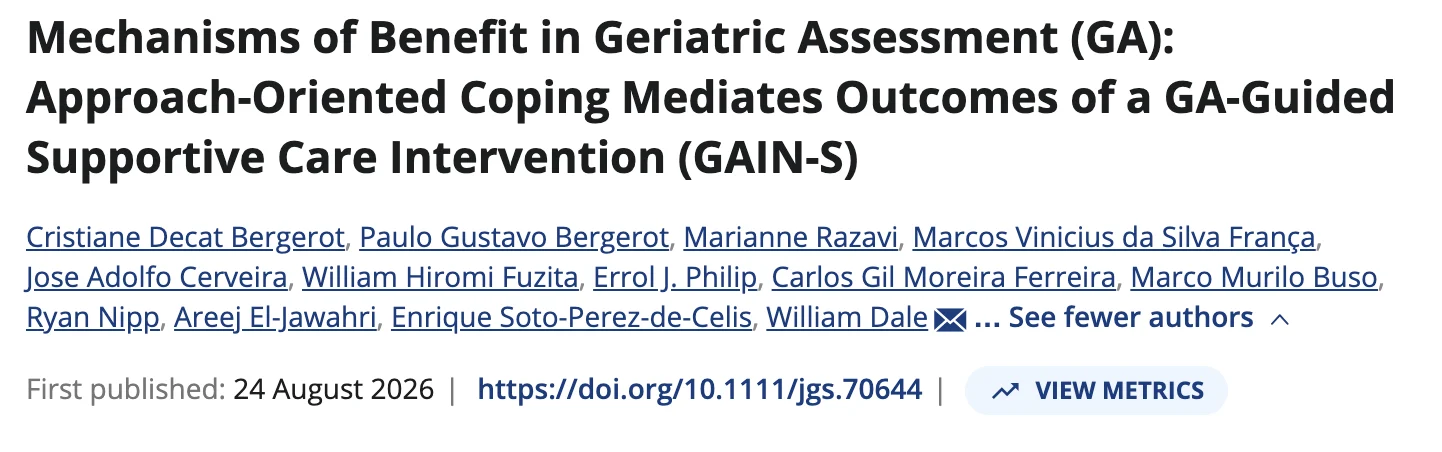
Title: Mechanisms of Benefit in Geriatric Assessment (GA): Approach-Oriented Coping Mediates Outcomes of a GA-Guided Supportive Care Intervention (GAIN-S)
Authors: Cristiane Decat Bergerot, Paulo Gustavo Bergerot, Marianne Razavi, Marcos Vinicius da Silva França, Jose Adolfo Cerveira, William Hiromi Fuzita, Errol J. Philip, Carlos Gil Moreira Ferreira, Marco Murilo Buso, Ryan Nipp, Areej El-Jawahri, Enrique Soto-Perez-de-Celis, William Dale
Read the Full Article on Journal of the American Geriatrics Society
Other posts featuring William Dale on OncoDaily.