The Babak Lab shared a post on LinkedIn:
“Spatiotemporal Cascade Targeting for Chemo-immunotherapy via Iridium-Fatty Acid Scaffold
A new study in JACS caught our eye because it approaches the well-known problem of tumor microenvironment reprogramming through a clever ‘spatiotemporal’ strategy
Key Focus
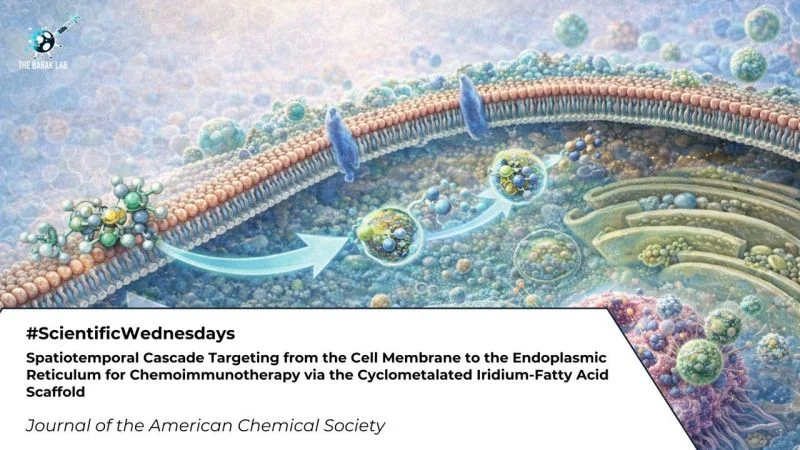
Wang et al. identified Ir-OA (an oleic acid conjugate) as a cascade agent. It is designed to first target the plasma membrane before migrating to the endoplasmic reticulum (ER) to trigger immune signaling.
Key Insights
Here is why this mechanism is significant:
- Ir-OA acts as a dual-action agent. It initiates damage at the cell membrane and sequentially targets the ER.
- It induces ER stress and specifically blocks the arachidonic acid-to-PGE2 signaling pathway.
- By cutting off PGE2 production, the agent effectively strips the tumor of its immune shield. This turns the «cold» immunosuppressive environment «hot,» enabling the body to launch a genuine systemic attack.
Conclusion
This study demonstrates that scaffold design using organelle targeting can enhance chemo-immunotherapeutic efficacy by rewiring lipid metabolism to reverse PGE2-mediated immunosuppression.
Image generated using Sora by OpenAI.”
Title: Spatiotemporal Cascade Targeting from the Cell Membrane to the Endoplasmic Reticulum for Chemoimmunotherapy via the Cyclometalated Iridium-Fatty Acid Scaffold
Authors: Meng-Meng Wang, Hong-Bao Fang, Xiu-Xiu Wang, Na Xu, Yan Su, Zhi-Rong Zhu, Zheng-Hong Yu, Xiao-Xiang Guan, Zhi Su, Wei-Hong Zhu
Read the Full Article in JACS.
More posts featuring The Babak Lab.