






Shikha Jain, Founder, Chair of the Board (Former CEO) at Women in Medicine and Associate Professor of Medicine at The University of Illinois Cancer Center, shared a post on LinkedIn:
“The System Isn’t Broken. It’s Working Exactly As Designed.
The RVU is not a measurement tool. It’s a values statement.
In the last issue, I argued that healthcare outcomes are not random. They are designed. Today I want to go inside the machine and show you exactly how.
A Patient I Think About
She was in her early forties when her physician ordered a colonoscopy. The reason was not subtle: unexplained weight loss and iron deficiency anemia with no other obvious cause. These are not ambiguous symptoms. They are on the short list of findings that warrant prompt colorectal evaluation with a colonoscopy. The physician didn’t deliberate. She ordered the test.
The prior authorization was denied.
What followed was weeks of work that the healthcare system does not pay for. Phone calls to the payer. Peer-to-peer reviews between the physician and a reviewer who had not examined the patient. Appeals paperwork. Documentation compiled, submitted, and resubmitted. Countless hours staff spent navigating a process designed to exhaust the people challenging it. None of this generated a single RVU. None of it was reimbursed. The physician and her team absorbed the full cost of fighting a denial. In time spent, in the increased administrative burden, in the cognitive load that doesn’t disappear when the next patient walks in.
The rationale for the denial was her age. Because she was under 45 and thus outside the standard screening window, the test was not indicated. Because she was still menstruating, her anemia must be due to her menses. A decision made by someone who never saw the patient, who may not even be an expert in this particular disease, but has taken the decision making out of the treating physicians hands.
While the appeal worked its way through a system built to delay it, the patient’s anemia worsened and she was subsequently hospitalized. The admission cost the system multiples of what the colonoscopy would have, and she spent weeks not knowing what was wrong with her. For weeks she carried the particular psychological weight of a body that was visibly failing while the people responsible for her care fought paperwork instead of treating her. The uncertainty, the fatigue, the loss of income during a hospitalization nobody planned for, none of that appears in a prior authorization calculus.
The denial was eventually overturned and the test was approved.
But the payer had denied a diagnostic colonoscopy and created a hospitalization, and the system saved nothing. It just moved the cost downstream and extracted a price from everyone in its path.
The patient paid in hospital bills she did not anticipate, in income lost during days she could not work, in the physical toll of an anemia that was allowed to worsen while paperwork moved through queues. She paid in the psychological weight of being told, implicitly, that her symptoms did not meet a threshold, that the system’s administrative logic outranked her physician’s clinical judgment.
The physician and her team paid in hours. Hours on hold, preparing documentation for a reviewer who had not examined the patient and would not be held accountable for the outcome. Hours that appeared nowhere on a balance sheet, generated no revenue, and will never be reimbursed. Staff who were hired to support patient care spent days managing a denial instead. That time did not come from nowhere, it came from every other patient in that practice who needed attention that week.
And the payer’s calculus contained none of this. It measured the cost of the colonoscopy it denied but it did not measure what the denial cost. That asymmetry is not an oversight, it is the architecture.
The Architecture of the Wrong Outcome
Healthcare in the United States is predominantly organized around fee-for-service reimbursement. The logic of that model is straightforward: the system pays for encounters, procedures, and interventions. It does not pay for continuity or for the follow-through that connects a first complaint to a pattern. And in most cases, it does not pay for the clinical suspicion that says this patient needs a different question, not another reassurance. The system was not designed to think longitudinally. It was designed to bill discretely. Those are not the same thing, and the gap between them is where patients fall through.
This is not a design flaw, it is the design. And it was built for a different era. One of acute episodic care, when the visit was the unit of medicine because it was the only unit we had. A system optimized for treating a broken leg or an infection made sense in that world, but we no longer live in that world. We can now identify a patient’s cancer vulnerability before a tumor forms, and then watch that patient fall through the gaps of a system that only pays for the visit, not the vigilance. We can tailor treatment to the molecular profile of an individual’s disease, but then lose the patient to fragmented follow-up because no one is reimbursed to hold the thread. The problem is not that someone built this system wrong for its time. The problem is that we are still paying for 21st century medicine with a 20th century reimbursement model, and the gap between what we can do clinically and what the system is structured to support has never been wider.
The unit that makes this concrete is the RVU, the Relative Value Unit, the metric by which physician work is measured and reimbursed under the dominant payment model. RVUs reward procedures and volume. While a colonoscopy generates RVUs, the fifteen-minute conversation that determines whether a colonoscopy is warranted generates far fewer. The follow-up call that catches an abnormal result before it becomes a missed diagnosis generates even less, if any. And the committee work that builds the retention infrastructure keeping experienced clinicians at the bedside generates none. The uncompensated hours spent on prior authorization appeals, fighting denials for tests that should never have required a fight, none. The longitudinal clinical reasoning that connects a young woman’s third visit for abdominal pain to a pattern worth investigating, the kind of thinking that might have changed my patient’s trajectory has no RVU code. It is, by the system’s own accounting, worthless.
This is not a metaphor, it is arithmetic. When you pay physicians in RVUs, you are making a precise and consequential decision about what kind of medicine you value and an equally precise decision about what you are willing to extract from your workforce without compensation. The downstream effects which include burned out clinicians, undertreated chronic disease, missed early-stage cancers, fragmented care, are not failures of that model, they are its outputs.
Yet, when we describe fee-for-service as “broken,” we let the architecture off the hook. The system reliably produces exactly what it is structured to reward: volume of intervention, not quality of longitudinal care. The gap between what gets reimbursed and what produces better outcomes is not incidental. It is the predictable output of deliberate structural choices made over decades.
Why Systems Behave the Way They Do
This is how systems produce outcomes. Not through individual decisions, but through a chain reaction that most leaders never fully trace.
Incentives drive behavior. When the unit of value is the RVU, physicians and health systems behave accordingly, toward volume, toward procedures, toward closed encounters. This is not a character failing, but a rational response to a rational signal.
Behavior shapes workflows and the systems, processes, and handoffs that constitute daily care are built around what the incentive structure rewards. Longitudinal follow-up has no workflow home because it has no reimbursement home. The referral that doesn’t get placed, the result that sits unactioned, the third visit for abdominal pain that doesn’t trigger a different question. These are not oversights, they are the natural shape of workflows built around a different objective.
Workflows determine outcomes. By the time a patient reaches a clinical endpoint, a stage IV diagnosis, a missed early detection window, a preventable complication, the outcome was largely determined upstream, at the level of incentive design.
The primary care physician is, in theory, the longitudinal anchor of this system, the clinician with the relationship, the history, the full picture. And in practice, they are among the most structurally undermined. Fifteen-minute slots with panels of over a thousand patients. Reimbursement rates that have not kept pace with the complexity of the population they are asked to manage. The role was designed for continuity, but the incentive structure was not. When the system’s most important longitudinal relationship is also its most economically precarious one, the outcomes that follow are not a surprise.
Where the Evidence Points
There was a time when the physician who ordered your test was the same person who owned the practice, reviewed the denial, made the call on the appeal, and saw you the following week. Not because that system was perfect, it wasn’t, but because the decision-maker had direct line of sight to the patient. The person setting the incentive structure was also the person living with its consequences. Private practice medicine had limitations, but it had that.
What replaced it was consolidated health systems, corporate ownership structures, administrative layers between clinical judgment and institutional decision-making. This created scale and in some cases, resources, but it also created distance. The people who understand what actually happens to a patient when a prior authorization is denied are rarely in the room where reimbursement structures are negotiated. The people in that room are often optimizing for metrics that have no row for “diagnostic delay” or “uncompensated appeal hours” or “clinician who left because the math stopped making sense.”
Physician-led organizations where clinicians hold genuine decision-making authority over care design, not just advisory seats consistently show what happens when that distance collapses. Not because physicians are inherently better administrators, but because they are structurally accountable to a different bottom line. They have seen the patient in the hospital bed that a denied colonoscopy helped create and that changes the calculus.
Health systems that have redesigned incentives around longitudinal outcomes like Accountable Care Organizations, value-based care models, integrated delivery networks with capitated arrangements, show measurable improvements in early detection rates. This is not theoretical and the data is consistent.
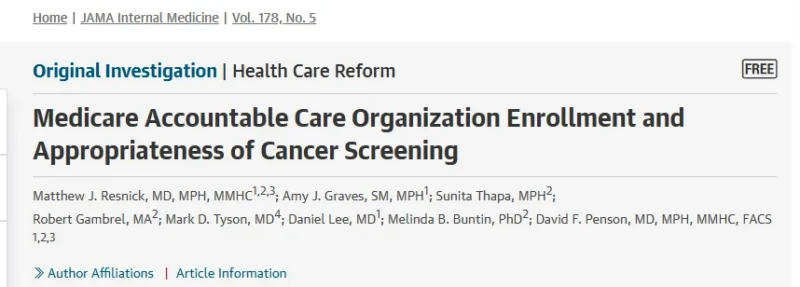
A peer-reviewed analysis of Medicare Shared Savings Program data found that ACO enrollment was associated with a statistically significant increase in appropriate colorectal cancer screening, modest in absolute magnitude, but meaningful at population scale. The mechanism wasn’t better physicians; it was a structure that made longitudinal accountability routine rather than heroic.
The pattern gets recognized. The follow-up gets scheduled. The accountable clinician exists.
Not because the physicians in those systems are more skilled or more attentive, but because the system around them is structured to make longitudinal accountability the path of least resistance rather than an act of individual heroism.
What is striking is not that this model works, it is that adoption remains slow. As of 2023, only 65% of adults aged 45 and older were up to date with colorectal cancer screenings. This is well below the National Colorectal Cancer Roundtable’s target of 80%. Among adults aged 45–49, the number drops to 37%. The recommendation exists. The infrastructure to follow through on it, systemically, does not.
The transition from volume-based to value-based reimbursement carries real financial risk for health systems, particularly in the near term, and that risk falls on the leaders who would have to authorize it. The incentive misalignment doesn’t only run through patient care, it runs through the boardrooms where transformation decisions get made. And it runs deepest in organizations where the people making those decisions have never had to make a peer-to-peer call to justify a test they already knew their patient needed, or explain to a patient why their care is being delayed.
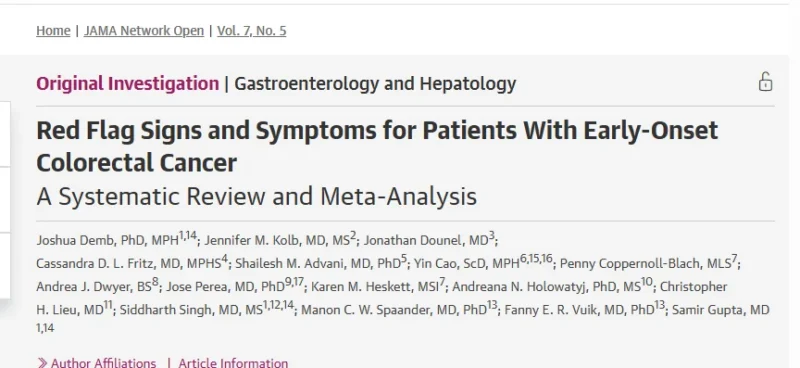
The woman in my clinic is not an outlier. A 2024 systematic review and meta-analysis published in JAMA Network Open, drawing on 81 studies and over 24.9 million patients, found that nearly half of individuals with early-onset colorectal cancer presented with rectal bleeding or abdominal pain and experienced a diagnostic delay of up to six months. Early-onset colorectal cancer now accounts for approximately 10% of all new diagnoses, patients more often present at advanced stage, and colorectal cancer is now the leading cause of cancer-related death in adults under 50. She is a predictable output of a system that was never designed to catch her.
The Hardest Version of This Problem: Oncology
It’s important to acknowledge that this is not a once sized fit all solution, and oncology is the perfect example of why. Value-based care is not a simple answer, and nowhere is that more apparent than in oncology.
Cancer care is inherently episodic and high-cost. The clinical decisions are complex, the drug costs are dominant and highly variable, and the timeframes over which outcomes are measured often exceed the contract cycles of most value-based arrangements. Attribution is genuinely difficult: when a patient survives early-stage colorectal cancer, how much credit belongs to the oncologist, the primary care physician who ordered the screening, or the patient navigator who kept the patient engaged in care? The models that work reasonably well in primary care and chronic disease management do not translate cleanly to oncology without significant redesign.
This is not an argument against value-based care in oncology. It is an argument for taking the hard version of the problem seriously.
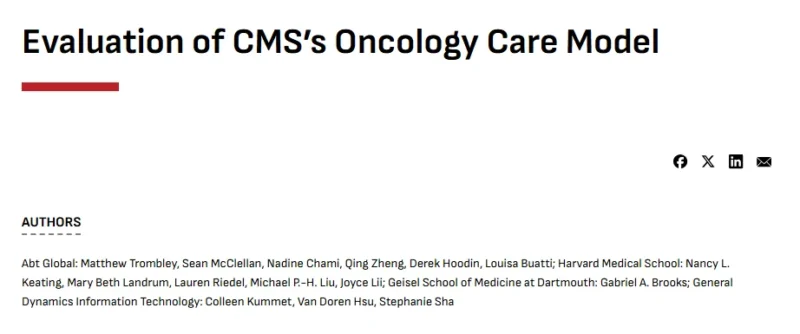
The CMS Oncology Care Model, which included more than 4,500 oncologists across 33 states serving over 600,000 people, reduced episode payments by an average of 2.1%, but did not achieve its goals of net savings or meaningful improvements in care quality relative to comparison groups. That is not a failure of ambition, it is evidence that applying value-based frameworks to oncology without redesigning them for oncology’s specific complexity produces limited results.
The question is not whether to move away from a reimbursement model that has no mechanism for catching a young woman’s cancer before it metastasizes. The question is what the right alternative model actually looks like when the clinical complexity is highest and the stakes are most consequential. That question deserves more rigorous attention from oncology leaders than it is currently receiving. The answer will not come from applying primary care models to cancer care. It will come from oncologists who understand both the clinical reality and the systems architecture, are willing to do the design work, and are at the table when decisions are being made.
To be clear, this is not an argument for more administrative burden on physicians, it is the opposite. The problem is not that clinicians lack accountability, it is that the current system holds them accountable for the wrong things, and extracts enormous uncompensated labor in the process. More paperwork, more prior authorization hoops, more quality metrics divorced from clinical reality, these are not redesign. They are the same misaligned incentive architecture wearing a different coat.
What redesign actually looks like is removing the friction between a physician’s clinical judgment and their patient’s care. It means building structures where the follow-up happens automatically, where the accountable clinician exists by design rather than by heroism, where the appeal that consumed three hours of uncompensated staff time last Tuesday simply doesn’t exist because the diagnostic test was never denied in the first place. The goal is not to add requirements to physicians. It is to build a system that stops requiring them to fight it.
What Leadership Requires Here
There is a version of healthcare leadership that is essentially managerial: it optimizes the system that exists, manages controllable variables, reports required metrics, and measures success by institutional stability. But that version of leadership is not adequate for this moment.
Understanding which outcomes your current incentive structure will reliably produce, and being honest about the gap between those outcomes and what your patients actually need, is not a detail within transformation. It is the precondition for it. It requires leaders willing to look directly at their architecture and name what it is producing, even when what it is producing is profitable.
This is the most important and least common capability in healthcare leadership today: institutional honesty about designed outcomes. Not blame or resignation, but honesty, followed by the more challenging work of redesign.
The system that failed my patient wasn’t run by bad people. It was run by people who are working within a system that has not yet been forced to grapple with the question: What is our system actually designed to produce? And who is it designed to miss?
The system isn’t broken. It’s working exactly as designed. The question is whether it’s designed for the outcomes patients need.
Before the Next Issue
In Issue 3, I want to go one layer deeper. Once you see that incentives drive the system, the next question is whether prevention actually has the infrastructure behind it to succeed, or whether we are still expecting it to happen organically within a structure that was never built to deliver it. The truth is, what a well-designed prevention system requires is far more concrete than most leaders realize.
Before then, one question:
What decision is being made in your organization right now about care design, reimbursement, or workflow by someone who has never had to make a peer-to-peer call? What would change if they had?
Reply and tell me. I read every response.”
Other articles featuring Shikha Jain on OncoDaily.