Olubukola Ayodele, Breast Cancer Lead at University Hospitals of Leicester NHS Trust, shared a post on LinkedIn:
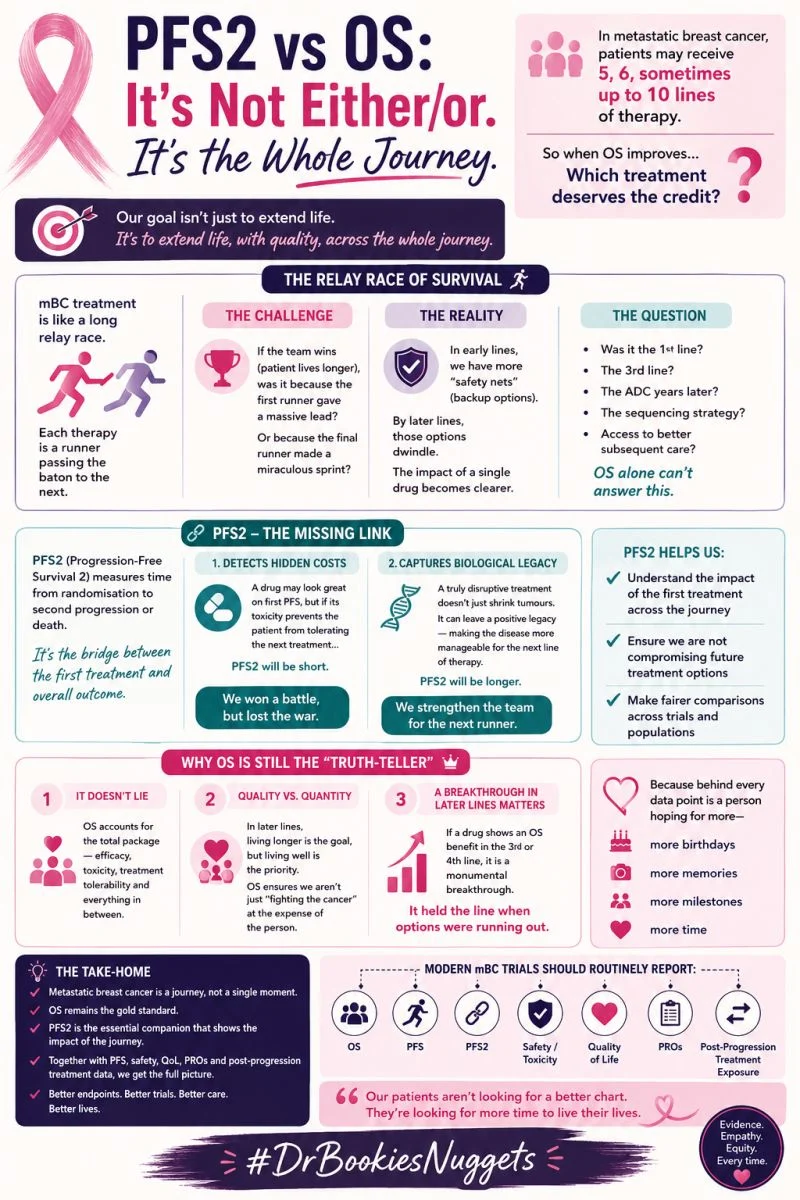
“One of the most talked-about methodological debates at ESMO Breast 2026 has been PFS2 vs. OS.
In metastatic breast cancer (mBC), this debate matters more than anywhere else. Our patients often receive multiple lines of treatments.
When we eventually see an OS benefit, the million-dollar question remains: Which treatment actually drove that survival advantage?
Was it the 1st line? The ADC given years later? The sequencing strategy? Or simply better subsequent care?
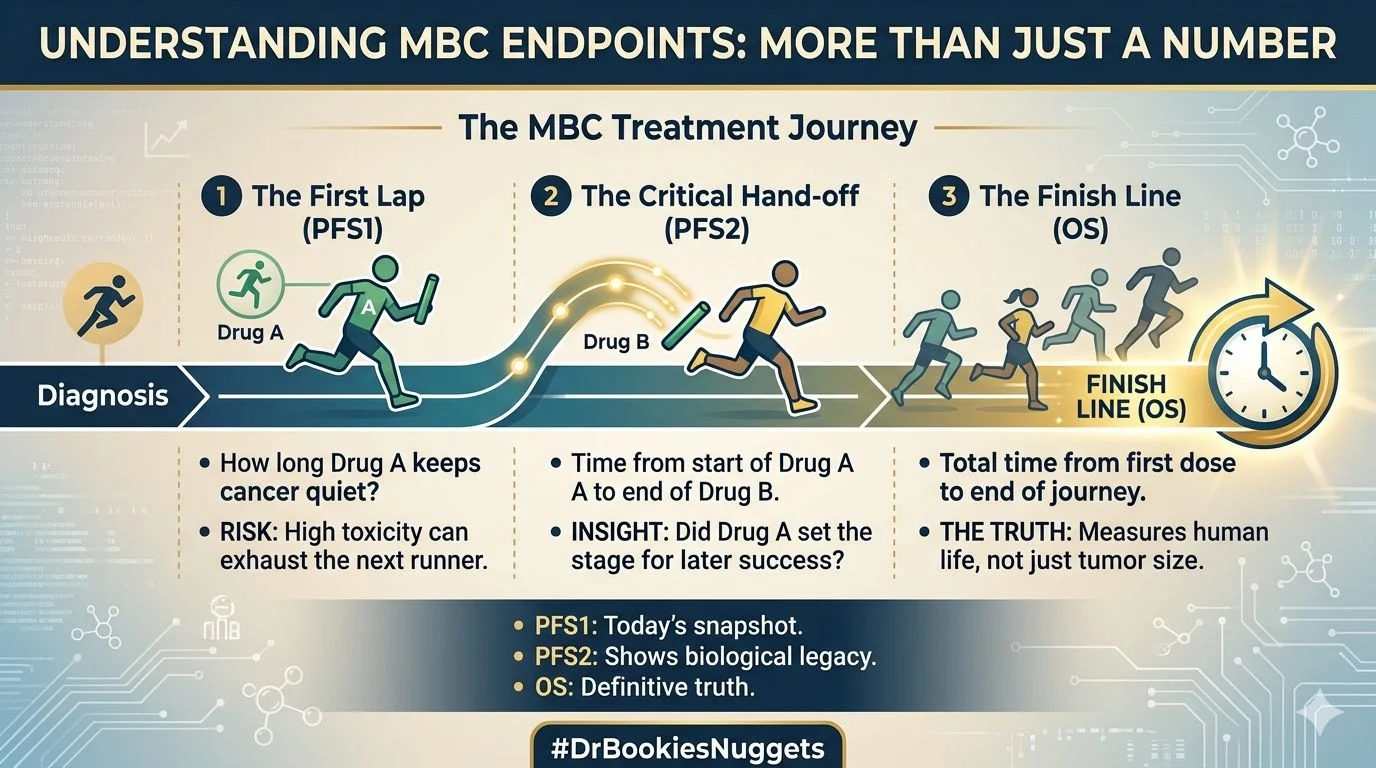
Think of mBC treatment like a long-distance relay race. Each drug is a runner passing the baton.
The Challenge: If the team wins, was it because the first runner gave them a massive lead or the final runner made a miraculous sprint?
The Reality: In the first line, we have ‘safety nets.’ By later lines, those options dwindle, making the impact of a single drug much clearer.
PFS2 measures the time from randomization to the second progression. It asks a critical, pragmatic question: Did the first treatment help patients without compromising what came next?
This is vital because we are managing an evolving disease over years, not treating isolated moments. It isn’t just about shrinking a tumour for a few months (PFS); it’s about proving that the drug is powerful enough to change the trajectory of the patient’s life.
OS remains the gold standard:
- It Doesn’t Lie: A drug might shrink a tumour, but if the toxicity is too high, it weakens the body’s ability to handle the next treatment. OS accounts for the ‘total package’: the efficacy and the side effects.
- The Biological Legacy: A truly ‘disruptive’ treatment doesn’t just kill cancer cells today; it changes the biological landscape of the disease, making the next ‘runner’ more likely to succeed.
- Quality vs. Quantity: In later lines, living longer is the goal, but living well is the priority. OS forces us to ensure that the balance between ‘fighting the cancer’ and ‘protecting the person’ is maintained.
However, OS alone may no longer fully capture the effect of the original therapy when:
- patients receive multiple subsequent therapies
- crossover is common
- drug access differs globally
- new agents emerge during follow-up
- healthcare inequalities influence survival itself
As a researcher and equity advocate, I believe PFS2 should routinely be required in mBC trials alongside OS, PFS, and Quality of Life.
Survival in breast cancer is rarely the story of one drug anymore; it is the story of sequencing.
If we want to understand if a strategy benefits patients across the whole journey, our endpoints must reflect the reality of modern practice.
We must continue to advocate for endpoints like OS and PFS2 that reflect the true human experience.
Our patients aren’t looking for a ‘better chart’ (Kaplan-Meier curve) they are looking for more birthdays, more milestones and more time.
Our patients deserve nothing less.”
More posts featuring Olubukola Ayodele.