






Olubukola Ayodele, Breast Cancer Lead at University Hospitals of Leicester NHS Trust, shared a post on LinkedIn:
“Cancer.
For many people, the word alone is enough to silence a room. Over the years, I’ve come to realize that much of the fear surrounding cancer is not just about the disease itself. It is about the unknown.
- The unknown of what it means.
- The unknown of what happens next.
- The unknown of whether life will ever feel ‘normal’ again.
And when something is unknown, it feels powerful. This is why cancer literacy matters so much.
When people understand what cancer is and what it is not, something shifts. It stops being a mysterious, uncontrollable force and starts becoming a medical condition that can be explained, treated, monitored and, in many cases, lived with.
Cancer literacy demystifies. It clarifies. It gives language to what feels overwhelming.
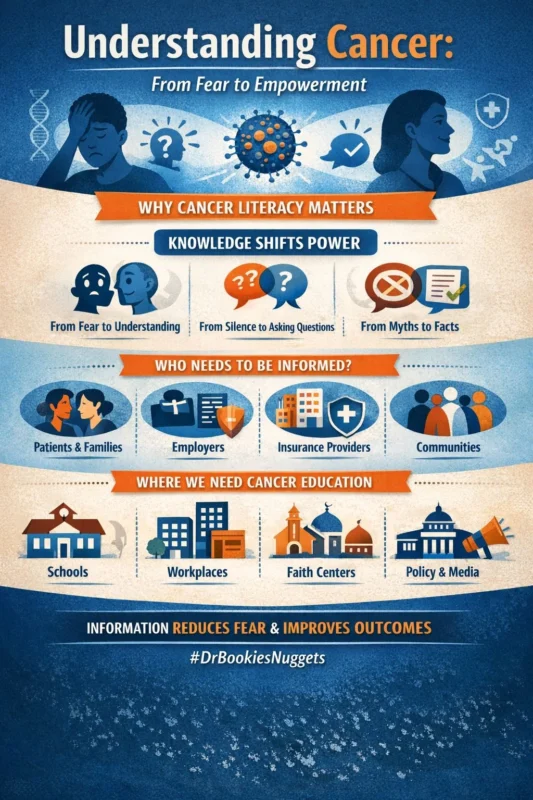
For the public, it means recognizing symptoms earlier and seeking help without shame or delay.
For patients and families, it means being able to ask informed questions, understand treatment options and participate meaningfully in decisions.
For employers, it means understanding that a diagnosis does not automatically mean incapacity. Many people continue to work during and after treatment. Flexible, informed workplaces can make the difference between isolation, stigma and dignity.
For insurance providers, it means moving beyond outdated assumptions and recognizing modern survival data and advances in treatment.
For communities, it means breaking myths that keep people silent. We often fear what we do not understand. But knowledge shifts power.
I have seen what happens when someone moves from ‘I am terrified‘ to ‘I understand what this means.’ The diagnosis may not change, but their posture does. Their questions change. Their confidence grows.
And here is the truth: cancer outcomes are not shaped by biology alone. They are shaped by awareness, beliefs, culture, access, and the information people receive before and after diagnosis.
If we want to reduce inequalities, improve early diagnosis, increase clinical trial participation and support survivorship, we must invest in cancer literacy at every level.
- In schools.
- In workplaces.
- In faith spaces.
- In boardrooms.
- In policy conversations.
Cancer literacy is not just a public health strategy. It is a social justice issue. When people are informed, fear reduces. When fear reduces, engagement increases. And when engagement increases, outcomes improve.
The question is not whether we can afford to prioritize cancer literacy. It is whether we can afford not to.
If you work in healthcare, education, HR, policy, insurance or community leadership, what are you doing to improve cancer literacy in your sphere of influence?
Let’s talk.”
Other articles featuring Olubukola Ayodele on OncoDaily.