






Nirmala Bhoo Pathy, Professor at the University of Malaya and Adjunct Professor at Kasturba Medical College, Manipal, shared a post on LinkedIn about a recent article she and her colleagues co-authored, adding:’
“As a clinical epidemiologist, I look at the numbers that define our ‘regular’ patients with cancer in Southeast Asia.
On the surface, they are often younger and maintain a high performance status i.e. the ‘well-appearing’ patient. However, our data reveals a different reality: a high prevalence of metabolic risk clusters (e.g. hypertension, diabetes, dyslipidemia, obesity) that create a baseline vulnerability.
As we move CDK4/6 inhibitors from advanced disease into the adjuvant setting for early breast cancer, the stakes for cardiovascular safety have never been higher.
In our latest meta-analysis published in Cancer Treatment Reviews, we analyzed the data to see if ‘class-wide’ monitoring is sufficient. The evidence says it is not.
The Epidemiological Reality:
- Ribociclib: We identified a near-doubling in the risk of severe (Grade 3/4) QTc prolongation (RR 1.95). In a patient with metabolic clusters, this “silent” electrical shift is a statistical hazard we cannot ignore.
- Abemaciclib: The risk of VTE is increased five-fold (RR 5.14).
The Perspective: Routine cardiovascular evaluation shouldn’t be reserved for those with overt disease.”
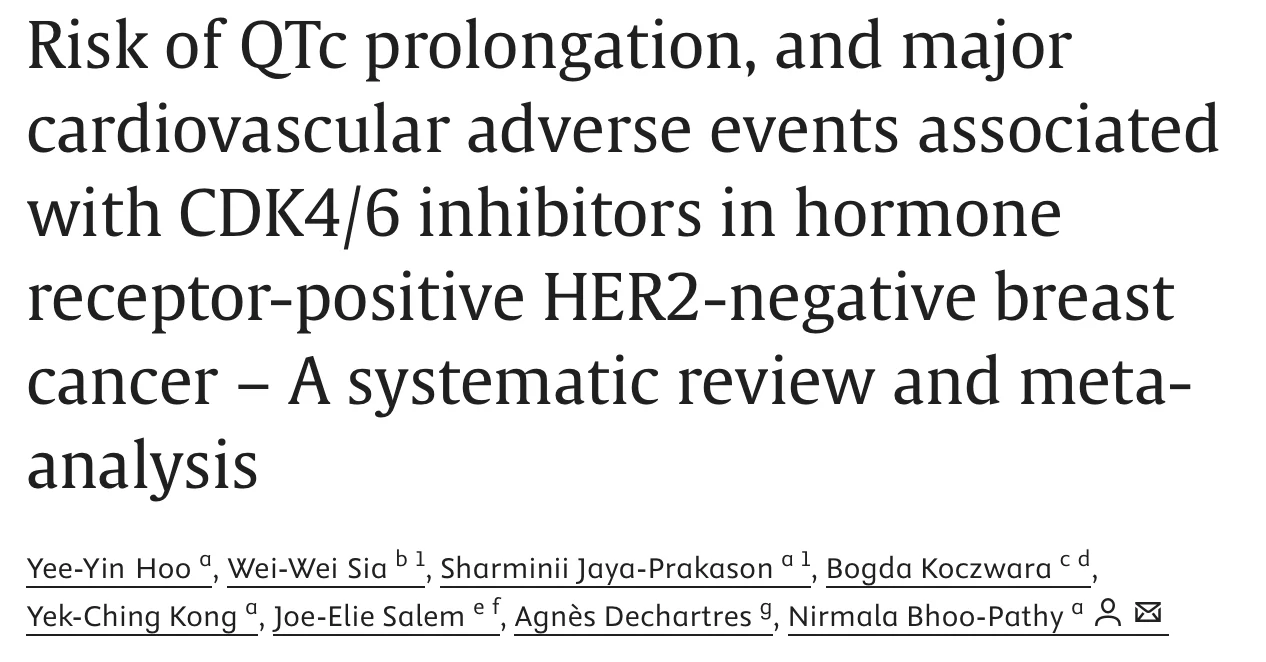
Title: Risk of QTc prolongation, and major cardiovascular adverse events associated with CDK4/6 inhibitors in hormone receptor-positive HER2-negative breast cancer – A systematic review and meta-analysis
Authors: Yee-Yin Hoo, Wei-Wei Sia, Sharminii Jaya-Prakason, Bogda Koczwara, Yek-Ching Kong, Joe-Elie Salem, Agnès Dechartres, Nirmala Bhoo-Pathy
Read the Full Article on Cancer Treatment Reviews
More posts featuring Nirmala Bhoo Pathy.