Nicola Ferrari, Director of Translational Science Lead for Respiratory and Immunology at AstraZeneca, shared a post on LinkedIn about a recent article by Mirco J. Friedrich at al, adding:
“Restoring youth to old immune cells: mRNA therapy turns back the clock
A twice-weekly cocktail of three messenger RNAs can rejuvenate the weary immune systems of aged mice and boost responses to vaccination and cancer treatments.
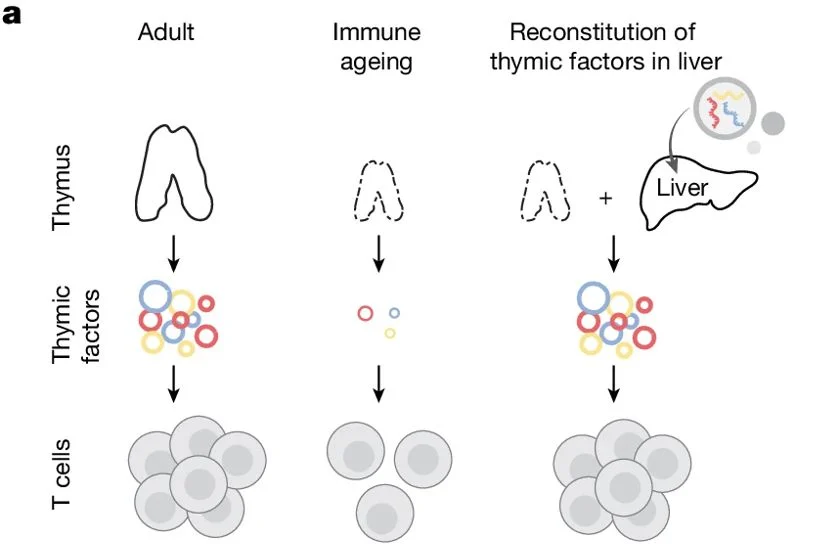
Ageing has a profound effect on the immune system, including the T cell repertoire, leading to reduced immune resilience. Central to this decline in humans and most other mammals is the involution of the thymus.
Efforts to counter immune ageing have primarily focused on reversing thymic involution and although these strategies have provided valuable insights into immune ageing, they have been limited by effect size, toxicity or clinical feasibility.
Here, the authors describe an approach for reconstituting thymus-derived factors in the liver to address age-related immune decline.
First they identified signalling pathways in the thymus and peripheral blood T cells that decline with age. Then they delivered mRNAs encoding these factors (DLL1, FLT3-L and IL-7) to the liver using lipid nanoparticles (LNPs).
Treatment with these mRNAs improved peptide vaccine responses and restored antitumour immunity in aged mice by increasing tumour-specific CD8+ infiltration and clonal diversity and synergizing with immune checkpoint blockade.
These effects were reversible after dosing ceased and did not breach self-tolerance, in contrast to the inflammatory and autoimmune liabilities of recombinant cytokine treatment.
These results highlight the potential of this approach to improve immune function and, more broadly, to use the liver as a transient ‘factory’ for replenishing factors that decline with age.”
Title: Transient hepatic reconstitution of trophic factors enhances aged immunity
Authors: Mirco J. Friedrich, Julie Pham, Jiakun Tian, Hongyu Chen, Jiahao Huang, Niklas Kehl, Sophia Liu, Blake Lash, Fei Chen, Xiao Wang, Rhiannon K. Macrae, Feng Zhang
Read the Full Article on Nature
More posts featuring Nicola Ferrari.