Nazik Hammad, Medical Oncologist and professor at St. Michael’s Hospital, University of Toronto, shared on LinkedIn:
“Africa accounts for roughly 40% of the world’s active armed conflicts and wars.
Africa is also the continent most severely vulnerable to and impacted by climate change while contributing less than 4% of global greenhouse gas emissions. Africa is home to the largest number of displaced people globally, including my own 92-year-old father, who is currently displaced to another African country. Cancer still happens during crises. We are seeing significant progress in the response to cancer in crises in Africa but a lot needs to be done.
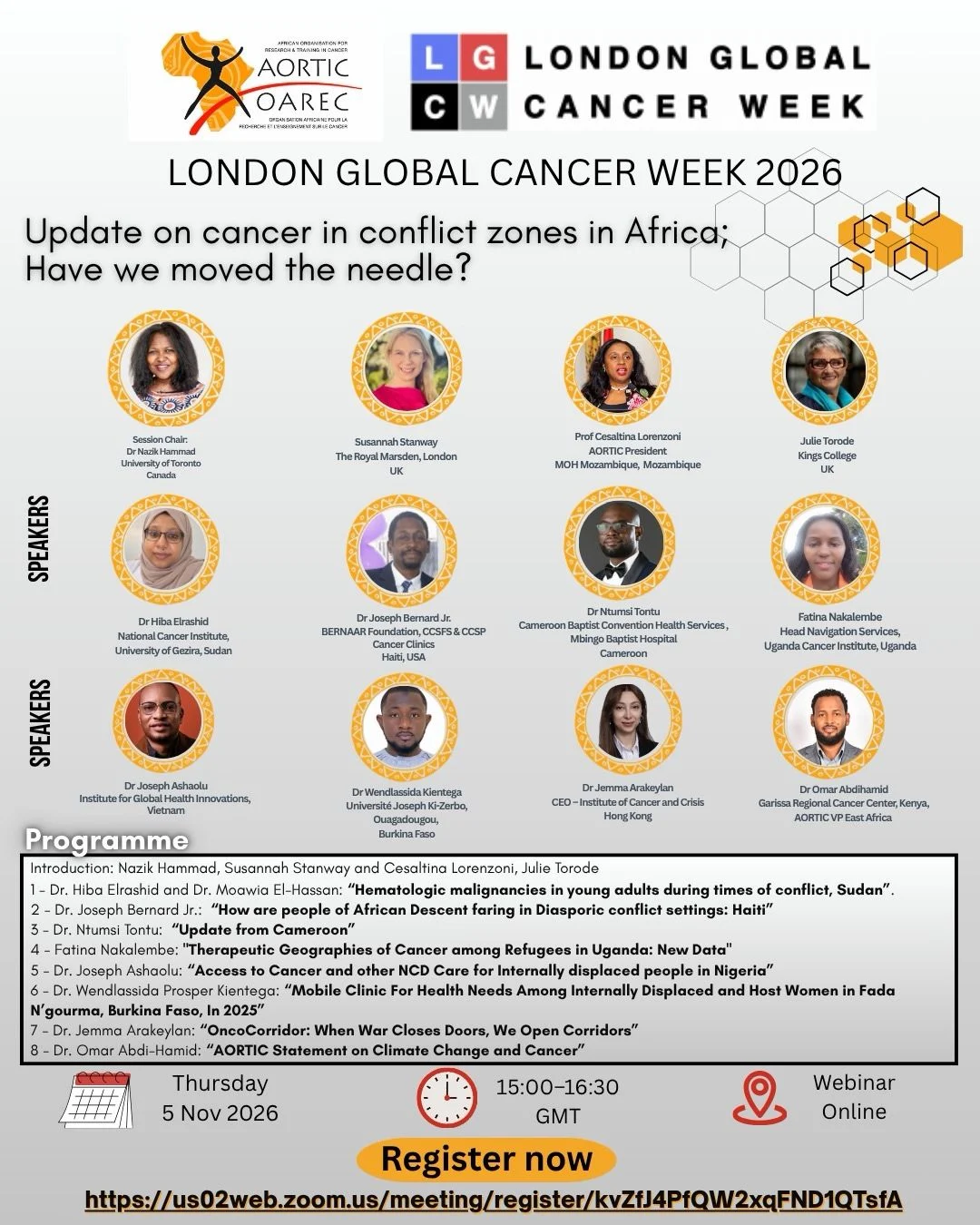
The AORTIC Significant Interest Group in Cancer in Conflict Zones and Emergencies is partnering again this year with the London Global Cancer Week to host this exciting virtual event ‘Update on Cancer in Conlfict Zones in Africa; Have we Moved the Needle’ on November 5th at 3 pm GMT.
Join me as we discuss young adults with hematologic malignancies in Sudan during the conflict, an update on cancer care in Cameroon conflict-affected areas, and new data on therapeutic geographies of cancer among refugees in Uganda which is the country hosting the largest number of refugees in Africa (approx 2 million). We have two presentations on access to care for internally displaced people (IDPs); data on a mobile clinic for women in Burkina Faso and access to NCD care for IDPs in Nigeria.
We will hear about cancer and climate change and about the OncoCorridors initiative. We have a special presentation on people of African in the Diaspora with a spotlight on Haiti.
Please join us as we move from describing the crisis to improved data, cancer intelligence, and action.”
You can also read: Paediatric Oncology Content at London Global Cancer Week (LGCW) 2026