Muna Al-Khaifi, GP Oncologist at Mount Sinai Hospital (Toronto), Sinai Health. This article summarizes the population-based retrospective cohort study by Dossa et al., which evaluated lifetime breast and ovarian cancer risk among women undergoing BRCA1 and BRCA2 genetic testing across different genetic test result categories, including pathogenic or likely pathogenic variants, variants of uncertain significance, negative results, and predictive negative results. The study examines how genetic test results and family history influence cancer risk, highlighting the substantially elevated breast and ovarian cancer risks associated with pathogenic BRCA1/2 variants, while also demonstrating that women with VUS or negative results may still have elevated breast cancer risk.
Interpreting Lifetime Cancer Risk Following BRCA1 and BRCA2 Genetic Testing
This study translates evidence from the recently published JAMA Network Open study by Dossa et al., (2026), Breast and Ovarian Cancer Among Individuals Undergoing BRCA1 and BRCA2 Testing, which examined lifetime breast and ovarian cancer risk among women undergoing BRCA1/BRCA2 genetic testing across all genetic test result categories
Approximately 5%–10% of breast cancers are caused by inherited BRCA1 or BRCA2 pathogenic variants. However, long-term cancer risk among women receiving a VUS or a negative BRCA test result remains less well understood.
What Was the Purpose of the Study?
- To estimate the lifetime incidence of breast and ovarian cancer among women undergoing BRCA1 or BRCA2 genetic testing, including those with:
- Pathogenic or likely pathogenic (P/LP) variants
- Variants of uncertain significance (VUS)
- Negative genetic test results
- To determine how family history modifies cancer risk across these different genetic testing groups.
Who Was Studied and How?
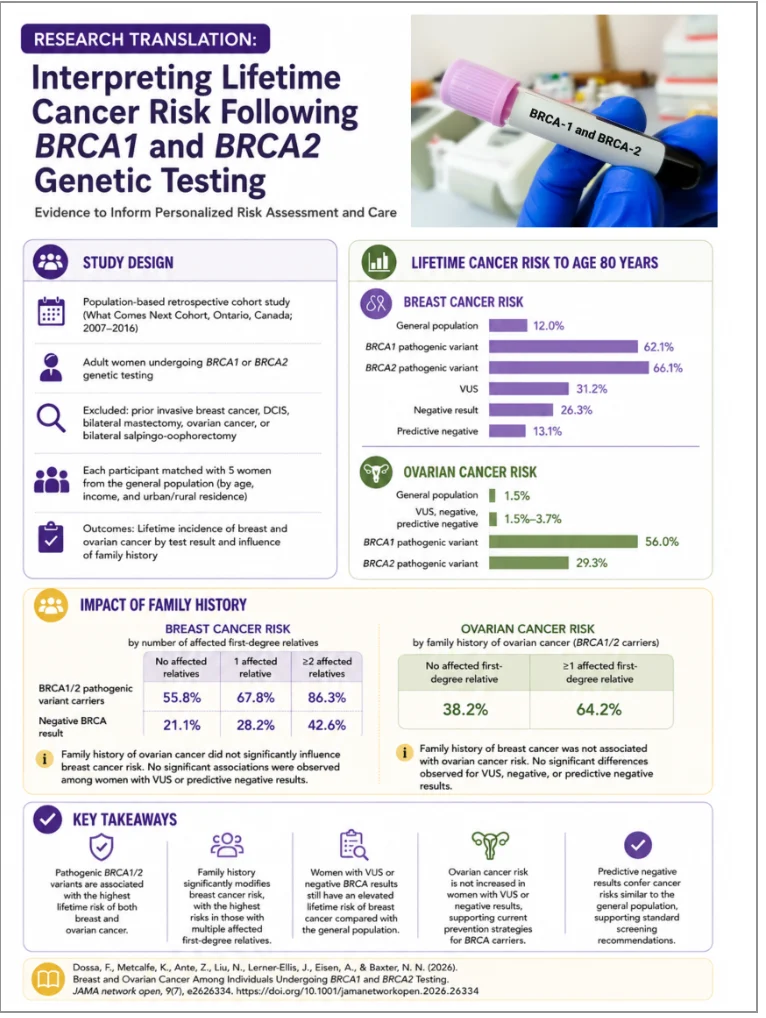
- Study design: Population-based retrospective cohort study using the What Comes Next Cohort in Ontario, Canada (2007–2016).
- Participants: Adult women who underwent germline BRCA1 or BRCA2 genetic testing at two regional laboratories performing approximately 70% of genetic testing in Ontario.
- Breast cancer cohort: Included women without prior invasive breast cancer, ductal carcinoma in situ (DCIS), or bilateral mastectomy before genetic testing.
- Ovarian cancer cohort: Included women without prior ovarian cancer or bilateral salpingo-oophorectomy before genetic testing.
- Comparison group: Each participant was matched with five women from the general population based on age, income, and urban/rural residence who had no prior history of the corresponding cancer or preventive surgery.
- Outcomes: Estimated the lifetime incidence of breast and ovarian cancer according to BRCA test result (pathogenic/likely pathogenic variant, variant of uncertain significance, or negative result) and evaluated the influence of family history on cancer risk.
What Did the Study Find?
What Was the Lifetime Risk of Breast Cancer?
During a median follow-up of 11 years, 1,462 breast cancer events were observed. Women with pathogenic BRCA1 or BRCA2 variants had the highest breast cancer incidence across all age groups, while those with VUS and negative test results also experienced higher rates than the general population. In contrast, women with a predictive negative result had breast cancer rates similar to population controls.
Lifetime breast cancer risk (to age 80 years):
- General population: 12.0%
- BRCA1 pathogenic variant: 62.1%
- BRCA2 pathogenic variant: 66.1%
- VUS: 31.2%
- Negative result: 26.3%
- Predictive negative: 13.1%
Did Family History Change Breast Cancer Risk?
Family history further increased lifetime breast cancer risk among women with pathogenic BRCA1/2 variants. Risk increased from 55.8% in those with no affected first-degree relatives to 67.8% with one affected relative and 86.3% with two or more affected first-degree relatives. A similar pattern was observed among women with negative BRCA test results (21.1%, 28.2%, and 42.6%, respectively). Family history of ovarian cancer did not significantly influence breast cancer risk, and no significant associations were observed among women with VUS or predictive negative results.
What Was the Lifetime Risk of Ovarian Cancer?
A total of 335 ovarian cancer events occurred during follow-up. Women with pathogenic BRCA1 or BRCA2 variants had substantially higher ovarian cancer incidence than all other groups, whereas women with VUS, negative, or predictive negative results had ovarian cancer risks similar to the general population.
Lifetime ovarian cancer risk (to age 80 years):
- General population: 1.5%
- VUS, negative, and predictive negative: 1.5%–3.7%
- BRCA1 pathogenic variant: 56.0%
- BRCA2 pathogenic variant: 29.3%
Did Family History Change Ovarian Cancer Risk?
Among women with pathogenic BRCA1/2 variants, a family history of ovarian cancer further increased lifetime ovarian cancer risk, rising from 38.2% in those without an affected first-degree relative to 64.2% in those with at least one affected first-degree relative. In contrast, family history of breast cancer was not associated with ovarian cancer risk, and no significant differences were observed among women with VUS, negative, or predictive negative test results.
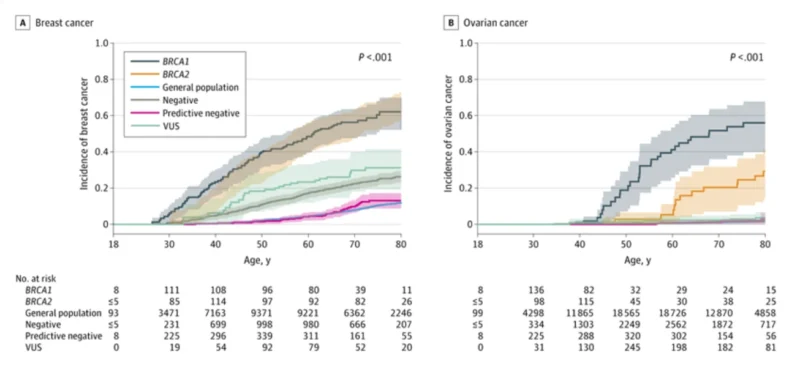
Fig. 1 Cumulative Incidence of Breast Cancer and Ovarian Cancer Stratified by Genetic Test Result (Dossa et al., 2026).
What Does This Mean?
This large population-based study provides updated estimates of lifetime breast and ovarian cancer risk across all BRCA1/BRCA2 genetic testing result categories, extending beyond individuals with pathogenic variants. While women with pathogenic BRCA1/2 variants continued to have the highest cancer risks, the study highlights that family history remains an important modifier of risk and should be considered alongside genetic testing results.
Importantly, women with variants of uncertain significance (VUS) or uninformative negative BRCA results had a substantially higher lifetime risk of breast cancer than the general population, whereas their ovarian cancer risk remained similar to population levels. These findings reinforce that genetic test results alone should not determine cancer risk or management.
What Are the Clinical Implications?
These findings support a more personalized approach to hereditary cancer risk assessment, integrating genetic test results, family history, and other clinical risk factors rather than relying on BRCA status alone.
Potential implications for clinical practice include:
- Individualized breast cancer risk assessment for women with VUS or negative BRCA results who have strong family histories.
- Consideration of enhanced breast surveillance (e.g., annual breast MRI in appropriate high-risk individuals) based on overall clinical risk rather than genetic testing results alone.
- Continued use of risk-reducing surgery and ovarian cancer prevention strategies primarily for women with confirmed pathogenic BRCA variants.
- Improved genetic counselling to help patients understand that a negative BRCA result does not always equate to average breast cancer risk.
What Research Is Needed Next?
Further research is needed to:
- Develop and validate comprehensive risk prediction models that combine genetic, familial, and clinical risk factors.
- Evaluate whether women with VUS or uninformative negative results who are at high clinical risk would benefit from intensified breast cancer screening or additional preventive strategies.
- Assess the contribution of other susceptibility genes beyond BRCA1 and BRCA2 through multigene panel testing.
- Better understand additional factors influencing cancer risk, including lifestyle, reproductive history, breast density, and other established clinical risk factors.
What are the Key Takeaways
- Pathogenic BRCA1/2 variants remain associated with the highest lifetime risk of both breast and ovarian cancer.
- Family history significantly modifies breast cancer risk, even among BRCA mutation carriers, with the highest risks observed in women with multiple affected first-degree relatives.
- Women with VUS or negative BRCA results still had an elevated lifetime risk of breast cancer, suggesting that clinical and familial risk factors remain important even when a pathogenic variant is not identified.
- In contrast, ovarian cancer risk was not increased among women with VUS or negative test results, supporting current recommendations that ovarian cancer risk-reducing strategies should primarily target women with confirmed pathogenic variants.
- Women with predictive negative results (negative for a known familial BRCA mutation) had cancer risks comparable to the general population, supporting standard population-based screening recommendations.
Reference
Dossa, F., Metcalfe, K., Ante, Z., Liu, N., Lerner-Ellis, J., Eisen, A., & Baxter, N. N. (2026). Breast and Ovarian Cancer Among Individuals Undergoing BRCA1 and BRCA2 Testing. JAMA network open, 9(7), e2626334.
You can also read: Muna Al-Khaifi: The Role of Sleep and Psychological Care in Colorectal Cancer