
Muna Al-Khaifi, GP Oncologist at Mount Sinai Hospital (Toronto), Sinai Health. This article summarizes the randomized controlled trial by Wang et al., which evaluated the effectiveness of integrated sleep and psychological interventions for improving sleep quality, pain, psychological adjustment, and health-related quality of life in patients with colorectal cancer. The study examines how combining structured sleep interventions with psychological support, including cognitive behavioral therapy, can influence postoperative recovery, symptom burden, psychological well-being, and patient-reported quality of life. It also discusses the feasibility of integrating these safe, non-invasive, and low-cost interventions into routine colorectal cancer care and Enhanced Recovery After Surgery protocols, while highlighting current evidence gaps and future directions for multidisciplinary and digitally supported survivorship care.
Integrated Sleep and Psychological Interventions for Colorectal Cancer Survivors
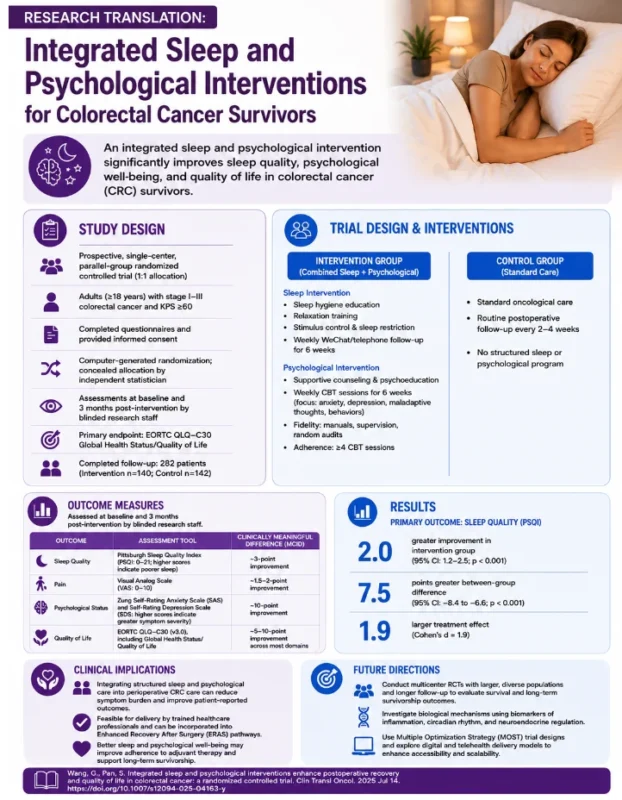
This article translates the evidence from the randomized controlled trial by Wang et al., which evaluated the effectiveness of a combined sleep and psychological intervention for improving sleep quality, pain, psychological adjustment, and health-related quality of life in patients with colorectal cancer (CRC).
What Was the Purpose of This Study?
Previous research has primarily examined sleep and psychological interventions separately, with limited evidence on their combined use. This study investigated whether integrating both approaches could provide greater benefits for postoperative recovery and quality of life.
How Was the Study Conducted?
This prospective, single-center, parallel-group randomized controlled trial enrolled adults (≥18 years) with stage I-III colorectal cancer and a Karnofsky Performance Status (KPS) ≥60, who were able to complete questionnaires, had complete clinical data, and provided informed consent. Participants were randomly assigned (1:1) to the intervention or control group using a computer-generated, age- and sex-stratified randomization sequence.
What Was the Intervention?
Combined Sleep Intervention
- Delivered by trained sleep specialists and oncology nurses.
- Sleep hygiene education: Optimizing bedroom environment, reducing light and noise, maintaining a comfortable temperature, and limiting caffeine and alcohol.
- Relaxation training: Progressive muscle relaxation, diaphragmatic breathing, and guided imagery.
- Stimulus control and sleep restriction: Implemented for participants with sleep efficiency <85%, calculated from 7-day sleep diaries.
- Follow-up support: Weekly WeChat or telephone reinforcement for 6 weeks after hospital discharge.
Psychological Intervention
- Supportive counseling and psychoeducation provided to all participants.
- Participants with moderate-to-severe anxiety or depression (SAS ≥50 or SDS ≥53) received weekly 60-minute cognitive behavioral therapy (CBT) sessions for 6 weeks, focusing on negative thought patterns, maladaptive behaviors, and resilience.
- Intervention fidelity was maintained through standardized manuals, weekly supervision, and random audits of approximately 10% of sessions.
- Adherence was defined as attendance at four or more CBT sessions.
Control Group
- Received standard oncological care and routine postoperative follow-up every 2–4 weeks.
- No structured sleep education, psycho-oncology counseling, or scheduled telephone/WeChat follow-up beyond usual care.
Outcome measures
Assessments were performed at baseline and 3 months post-intervention by blinded research staff.
| Outcome | Assessment Tool | Clinically Meaningful Difference (MCID) |
| Sleep Quality | Pittsburgh Sleep Quality Index (PSQI; 0–21, higher scores indicate poorer sleep) | ~3-point improvement |
| Pain | Visual Analog Scale (VAS; 0–10) | ~1.5–2-point improvement |
| Psychological Status | Zung Self-Rating Anxiety Scale (SAS) and Self-Rating Depression Scale (SDS); higher scores indicate greater symptom severity | ~10-point improvement |
| Quality of Life | EORTC QLQ-C30 (v3.0), including Global Health Status/Quality of Life as the primary endpoint and Summary Score as a sensitivity analysis | ~5–10-point improvement across most domains |
What Were the Key Findings?
- Participants: Of the enrolled patients, 282 completed follow-up and were included in the analysis (intervention: n=140; control: n=142).
- Baseline characteristics: Demographic, clinical, and patient-reported outcome measures were well balanced between groups, with no significant baseline differences (all p > 0.05).
Primary Outcome: Sleep Quality
- Sleep quality (PSQI) improved significantly in the intervention group (18.0 ± 2.5 to 10.0 ± 2.0) compared with the control group (18.1 ± 2.6 to 16.5 ± 2.5).
- The adjusted between-group difference was −7.5 points (95% CI: −8.4 to −6.6; p < 0.001), representing a large treatment effect (Cohen’s d = 1.9).
Secondary Outcomes
- Pain (VAS): Significantly reduced in the intervention group (7.1 ± 1.4 to 3.6 ± 1.1) compared with controls (7.2 ± 1.4 to 6.8 ± 1.3)
- Anxiety (SAS): Markedly improved (66.3 ± 7.9 to 48.1 ± 5.5) versus the control group (65.9 ± 7.9 to 62.1 ± 7.3)
- Depression (SDS): Significantly decreased (67.1 ± 8.0 to 48.7 ± 5.8) compared with controls (66.9 ± 8.0 to 62.3 ± 7.3)
- Quality of life (EORTC QLQ-C30 Global Health): Improved from 65.0 ± 7.9 to 78.0 ± 8.3 in the intervention group versus 65.1 ± 7.8 to 68.0 ± 8.0 in controls
Sensitivity and Subgroup Analyses.
- Linear mixed-effects models showed significant group × time interactions across all outcomes.
- Subgroup analyses demonstrated consistent benefits regardless of age, sex, or tumor stage, with no significant interaction effects.
What Do These Findings Mean for Clinical Practice?
- Integrating structured sleep and psychological interventions into perioperative colorectal cancer care may reduce symptom burden, accelerate postoperative recovery, and improve patient-reported outcomes.
- These interventions are safe, non-invasive, low-cost, and can be delivered by trained healthcare professionals, making them feasible for routine clinical practice and integration into Enhanced Recovery After Surgery protocols.
- Improved sleep and psychological well-being may also enhance adherence to adjuvant therapy and support long-term survivorship, although further long-term evidence is needed.
What Are the Next Steps for Research?
- Conduct multicenter randomized controlled trials with larger, more diverse populations and longer follow-up to evaluate survival and long-term survivorship outcomes.
- Investigate the biological mechanisms underlying treatment effects using biomarkers of inflammation, circadian rhythm, and neuroendocrine regulation.
- Evaluate the independent and combined effects of sleep, psychological, and nutritional interventions using Multiphase Optimization Strategy (MOST) trial designs.
- Explore digital and telehealth-based delivery models to improve accessibility and implementation, particularly in resource-limited settings.
Reference
Wang, G., Pan, S. Integrated sleep and psychological interventions enhance postoperative recovery and quality of life in colorectal cancer: a randomized controlled trial. Clin Transl Oncol 28, 1363–1373 (2026).
You can also read: Muna Al-Khaifi Explores How Exercise Improves Outcomes in Breast Cancer