
Muna Al-Khaifi, GP Oncologist at Mount Sinai Hospital (Toronto), Sinai Health presents this article focusing on cancer-related lymphedema as a common yet often under-recognized and under-managed complication across the cancer care continuum. Drawing on current evidence, clinical guidelines, and emerging preventive strategies, the piece outlines lymphedema as a progressive condition that can significantly impact physical function, quality of life, and psychosocial well-being. It emphasizes the importance of early identification through prospective surveillance, standardized risk assessment, and patient education beginning at baseline and continuing throughout survivorship. The article further highlights evidence-based preventive approaches, including compression therapy, lifestyle modification, and surgical techniques aimed at reducing lymphatic disruption, while underscoring the role of multidisciplinary care in minimizing risk, enabling early intervention, and improving long-term outcomes for patients at risk of cancer-related lymphedema.
Reducing the Risk of Cancer-Related Lymphedema: Prevention Starts Early
Lymphedema is a chronic, progressive condition that occurs when the lymphatic system is unable to adequately transport lymphatic fluid, resulting in fluid accumulation and swelling in the affected region. Beyond physical symptoms, lymphedema can significantly affect mobility, body image, emotional well-being, and quality of life.
Understanding Lymphedema
Lymphedema develops gradually and progresses through several stages:
- Stage 0 (Latent): No visible swelling, although lymphatic damage has occurred and symptoms such as heaviness or tightness may be present.
- Stage I: Mild swelling that improves with limb elevation.
- Stage II: Persistent swelling that no longer resolves completely with elevation and may begin to cause tissue fibrosis.
- Stage III: Severe swelling with significant tissue changes, fibrosis, and functional impairment.
How Common Is Cancer-Related Lymphedema?
A recent systematic review including 48 studies and 234,079 patients demonstrated substantial variation in lymphedema incidence across cancer types. Reported rates ranged from:
- Breast cancer: 2%-74%
- Gynecologic and urologic cancers: 8%-45%
- Head and neck cancers: 71%-90%
- Melanoma: 2%-29%
Although cancer-related lymphedema can occur across many malignancies, most research has focused on breast cancer-related lymphedema (BCRL) because it is among the most common forms. For example, longitudinal studies have shown that the prevalence of BCRL increases over time, with rates of 6.8% at baseline, 19.9% at two years, and 23.8% at seven years following diagnosis, highlighting the importance of long-term surveillance and prevention strategies.
Who Is at Risk?
Lymphedema is a chronic and progressive condition where the load of the lymphatic system exceeds its transport capacity, leading to accumulation of lymphatic fluid and edema in the area at risk.
Risk factors for breast cancer related arm lymphoedema
Risk When there are resource constraints, patients who received axillary radiation should be prioritised over patients who receive radiation to the breast/chest wall ± the supraclavicular fossa when selecting patients for prophylactic management of lymphoedema.
The timing of chemotherapy (neoadjuvant versus adjuvant) may impact the subsequent risks of lymphoedema but should not be a major determining factor on selecting patients for prophylactic management of lymphoedema until more studies are available.
Table 1. Risk Factors.
| Upper Extremity Lymphedema | Lower Extremity Lymphedema |
| Removal of axillary lymph nodes, particularly extensive nodal surgery | Inguinal or pelvic lymph node dissection |
| Radiation treatment involving the axilla, breast, supraclavicular, or internal mammary regions | Pelvic radiotherapy following surgery |
| Post-surgical scarring, fibrosis, or radiation-induced tissue damage | Recurrent infections affecting the lower limb |
| Postoperative complications such as seroma, wound infection, or prolonged drainage | Excess body weight or obesity |
| Axillary web syndrome (cording) | Venous disorders, including varicose vein procedures or vein harvesting |
| Advanced or metastatic disease | Family history or inherited predisposition to chronic swelling |
| Elevated body mass index (BMI) | Advanced-stage malignancy |
| Congenital abnormalities affecting lymphatic function | Tumours compressing or obstructing lymphatic vessels |
| Trauma or injury to the affected arm (e.g., repeated injections, blood pressure measurements, venipuncture) | Orthopaedic procedures involving the lower limb |
| Chronic inflammatory or dermatologic conditions | Poor nutritional status |
| Certain systemic therapies, including taxane-based chemotherapy | Chronic venous insufficiency or thrombophlebitis |
| Hypertension | Persistent unexplained limb swelling |
| Pacemaker implantation or vascular access procedures | Chronic skin disease or inflammatory conditions |
| Long-distance air travel | Coexisting medical conditions such as cardiac, renal, or thyroid disease |
| Residence in or travel to regions where lymphatic filariasis is endemic | Prolonged immobility or limb dependency |
| Long-distance air travel | |
| Residence in or travel to regions where lymphatic filariasis is endemic |
Prospective Lymphedema Screening
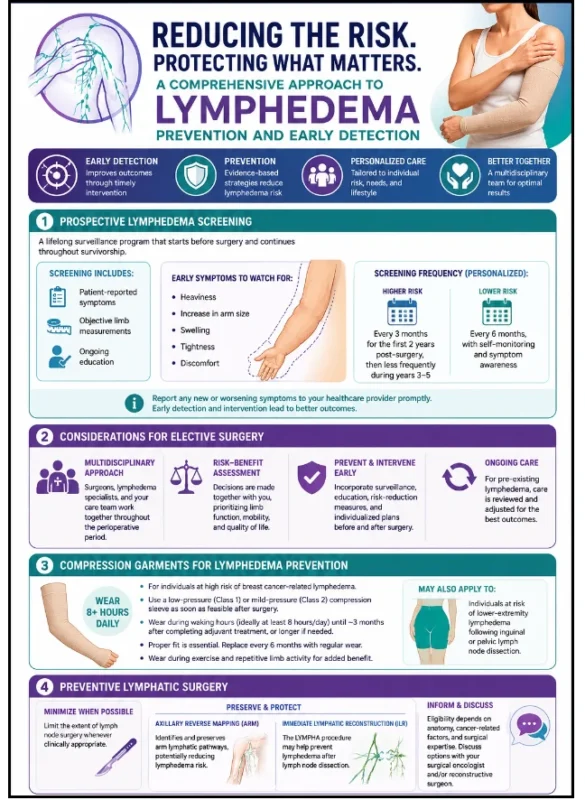
Individuals at risk for breast cancer-related lymphedema should receive personalized education regarding lymphedema risk factors from healthcare professionals with expertise in lymphedema management. Education should be incorporated into a prospective surveillance program that begins with a preoperative baseline assessment and continues longitudinally throughout survivorship. Screening should include patient-reported symptoms, objective limb measurements, and ongoing education, consistent with recommendations such as the National Lymphedema Network Position Statement on Screening and Measurement for Early Detection of Breast Cancer-Related Lymphedema.
A prospective surveillance approach is recommended, where feasible and resources allow, as it may reduce the risk of chronic lymphedema through earlier detection and intervention.
Surveillance Recommendations
- Baseline assessment: Perform preoperative limb measurements and symptom assessment before breast cancer surgery.
- Routine surveillance: Continue longitudinal monitoring throughout survivorship.
- Surveillance frequency:
- Every 3–4 months during the first year following treatment.
- Every 6–12 months thereafter, where feasible and resources allow.
Treatment trigger based on objective measurements:
- Initiate intervention when limb volume measurements demonstrate a ≥5% but <10% increase compared with preoperative baseline values.
Treatment trigger based on symptoms:
- Initiate assessment and management for any patient-reported symptoms, including:
- Swelling
- Heaviness
- Tightness
- Numbness
Patient Education and Symptom Awareness
Patients should be informed about early symptoms that may indicate the development of lymphedema, including sensations of heaviness, perceived increases in arm size, swelling, tightness, or discomfort. They should be encouraged to report these symptoms promptly, as early detection and intervention are associated with improved clinical outcomes.
Suggested Screening Intervals Based on Risk
Higher-risk individuals
- Screening as often as every 3 months during the first 2 postoperative years.
- Less frequent monitoring during years 3–5, based on clinical assessment and symptom burden.
Lower-risk individuals
- Screening approximately every 6 months.
- May supplement formal assessments with self-monitoring and symptom awareness between visits
Symptoms Patients Should Report Promptly
- Heaviness in the arm
- Perceived increase in arm size
- Swelling
- Tightness
- Discomfort or aching
- Numbness or altered sensation
Considerations for Elective Surgery
For individuals at risk for lymphedema or those with established lymphedema who are undergoing elective surgery, a multidisciplinary approach is recommended. Surgeons should be knowledgeable about lymphedema risk and collaborate closely with lymphedema specialists and other members of the healthcare team throughout the perioperative period. Decisions regarding surgery should involve a careful risk-benefit assessment conducted jointly by the multidisciplinary team and the patient, recognizing the importance of preserving limb function, mobility, and quality of life.
Preventive and early intervention strategies should be incorporated before and after surgery to minimize the risk of lymphedema development or exacerbation. These may include prospective surveillance, patient education, risk-reduction measures, and individualized lymphedema management plans. For patients with pre-existing lymphedema, ongoing care should be reviewed and adjusted as needed to support optimal postoperative outcomes.
Compression Garments for Lymphedema Prevention
For individuals at high risk of breast cancer-related lymphedema, prophylactic use of compression garments may be considered as part of a risk-reduction strategy. A low-pressure (Class 1) or mild-pressure (Class 2) compression sleeve may be initiated as soon as feasible after surgery and worn during waking hours (ideally at least 8 hours per day) until approximately 3 months after completion of adjuvant treatment, or longer if clinically indicated. Similar considerations may apply to individuals at risk of lower-extremity lymphedema following inguinal or pelvic lymph node dissection. Compression garments should be properly fitted, used according to manufacturer recommendations, and typically replaced every 6 months with regular wear. For individuals using prophylactic compression, wearing the garment during exercise and repetitive limb activity may provide additional benefit.
For patients using prophylactic compression sleeves, additional lymphedema treatment should be initiated if clinical lymphedema is detected through bioimpedance testing or if a relative arm volume increase of ≥10% is observed.
Preventive Lymphatic Surgery
Preventive surgical strategies may help reduce the risk of cancer-related lymphedema in selected patients requiring axillary management. Current approaches emphasize minimizing the extent of lymph node surgery whenever oncologically appropriate, as less extensive axillary treatment is associated with a lower risk of lymphedema.
For some breast cancer patients, axillary radiotherapy may be considered as an alternative to axillary lymph node dissection (ALND). Specifically, axillary radiotherapy can be considered for patients with clinical T1–T2, node-negative breast cancer who are found to have one to two positive sentinel lymph nodes and undergo mastectomy, as this approach may provide adequate regional control while reducing the risk of treatment-related morbidity, including lymphedema.
For patients who require ALND, techniques such as axillary reverse mapping (ARM) may be used to identify and preserve arm lymphatic pathways, potentially reducing the risk of postoperative lymphedema. Immediate lymphatic reconstruction (ILR), also known as the LYMPHA (Lymphatic Microsurgical Preventive Healing Approach) procedure, may also be considered at the time of lymph node dissection to help prevent lymphedema by restoring lymphatic drainage pathways.
Eligibility for these approaches depends on individual anatomy, cancer characteristics, planned treatment, and the availability of appropriately trained surgical teams. Patients undergoing axillary surgery should be informed about available lymphedema prevention strategies and encouraged to discuss these options with their surgical oncologist and, when appropriate, a reconstructive or plastic surgeon.
Lifestyle and Risk-Reduction Recommendations for Individuals at Risk of Lymphedema
- Maintain good skin care and hygiene through regular cleansing and moisturization to prevent skin breakdown and reduce infection risk.
- Recognize and promptly report signs of infection (e.g., redness, warmth, pain, swelling, fever, or chills), as early treatment can help prevent lymphedema development or progression.
- Avoid excessive heat exposure and skin injury, including saunas, hot tubs, sunburns, and burns, which may increase swelling and infection risk.
- Maintain a healthy body weight, as overweight and obesity are associated with an increased risk of lymphedema.
- Engage in regular physical activity, aiming for at least 150 minutes of moderate-intensity aerobic exercise per week and 2–3 resistance-training sessions per week, with gradual progression as tolerated.
- Compression garments are not routinely recommended for air travel, but individuals already prescribed compression therapy may continue using properly fitted garments during flights as part of their management plan.
Figure 1. Comprehensive approach to lymphedema.
References (Selected):
Letellier, M. E., Ibrahim, M., Towers, A., & Chaput, G. (2024). Incidence of lymphedema related to various cancers. Medical oncology (Northwood, London, England), 41(10), 245. https://doi.org/10.1007/s12032-024-02441-2
The National Lymphedema Network (NLN) has released its updated Position Paper on Evidence-Based Practices for Lymphedema Risk Reduction (March 2026),
Shahid, S., Moerahoe, A., Boldt, G., & Maciver, A. (2025). The Effectiveness of Prophylactic Compression Sleeves in Reducing the Risk of Lymphedema in Patients Who Receive Breast Cancer Surgery: A Systematic Review. Current oncology (Toronto, Ont.), 32(12), 660. https://doi.org/10.3390/curroncol32120660
Wong, H. C. Y., Wallen, M. P., Chan, A. W., Dick, N., Bonomo, P., Bareham, M., Wolf, J. R., van den Hurk, C., Fitch, M., Chow, E., Chan, R. J., & MASCC BCRAL Expert Panel and the Oncodermatology and Survivorship Study Groups (2024). Multinational Association of Supportive Care in Cancer (MASCC) clinical practice guidance for the prevention of breast cancer-related arm lymphoedema (BCRAL): international Delphi consensus-based recommendations. EClinicalMedicine, 68, 102441. https://doi.org/10.1016/j.eclinm.2024.102441
You Can Also Read: Muna Al-Khaifi: Translating Evidence Into Everyday Practice for Cancer-Related Fatigue