
Muna Al-Khaifi, GP Oncologist at Mount Sinai Hospital (Toronto), Sinai Health, presents this article examining how cancer survivorship is being redefined across the continuum of care. Drawing on key presentations from ASCO 2026, this piece explores the growing integration of survivorship principles from diagnosis through treatment, long-term follow-up, and metastatic disease. It highlights emerging advances in molecular surveillance, supportive care, lifestyle medicine, symptom management, and quality-of-life interventions, emphasizing the need to support not only survival outcomes but also the overall well-being of individuals living with and beyond cancer.
Redefining Survivorship Care: Reflections from ASCO 2026
For decades, success in oncology has largely been measured by tumor response, disease-free survival, progression-free survival, and overall survival. These outcomes remain essential. However, one of the strongest messages emerging from ASCO 2026 was that cancer care must extend beyond treating disease to supporting the whole person throughout the entire cancer journey.
This year’s meeting highlighted a growing recognition that survivorship does not begin when treatment ends. Rather, it starts at diagnosis and continues through active treatment, long-term follow-up, and even metastatic disease. The focus is shifting from simply helping patients survive cancer to helping them live well with and beyond cancer.
Redefining Survivorship Across the Continuum
ASCO 2026 also challenged the traditional definition of survivorship; cancer survivorship includes patients living with metastatic disease and recognizes the importance of quality of life, symptom management, and supportive care regardless of disease stage.
One example was the TROPION Breast02 trial, which evaluated the antibody drug conjugate datopotamab deruxtecan (Dato DXd) as a potential first line treatment option compared with standard chemotherapy in patients with locally recurrent inoperable or metastatic triple negative breast cancer (TNBC). This research is important from a survivorship perspective because TNBC has historically been difficult to treat and often associated with significant treatment related toxicity.
In the metastatic setting, survivorship is not only about extending life but also preserving quality of life. By establishing a more targeted and effective standard of care earlier in the treatment journey, researchers hope to provide patients with more time while reducing the burden of the widespread side effects often associated with traditional chemotherapy.
Personalized Surveillance: The Promise of ctDNA and Molecular Residual Disease
One of the most exciting areas discussed at ASCO 2026 was the expanding role of circulating tumor DNA (ctDNA) and molecular residual disease (MRD) monitoring. Multiple educational and scientific sessions explored how liquid biopsy technologies may transform survivorship care. MRD testing aims to identify microscopic traces of cancer DNA in the bloodstream months or even years before recurrence becomes visible on conventional imaging.
Research presented at the meeting included a systematic review and meta analysis evaluating postoperative ctDNA detected molecular residual disease in resected non small cell lung cancer. Across 38 studies, investigators found that postoperative ctDNA serves as a reliable biomarker for molecular residual disease in resected NSCLC. ctDNA positivity was associated with a higher risk of early recurrence, while ctDNA negativity predicted more durable remission, supporting its role in postoperative surveillance.
Additional data demonstrated how ctDNA guided treatment approaches may help clinicians escalate or de-escalate adjuvant therapies more effectively. For example, among patients with Stage III colorectal cancer, those who were ctDNA negative after treatment experienced significantly improved disease free survival, particularly when combined with healthy lifestyle modifications.
Weight Management and Metabolic Health
Several ASCO 2026 presentations explored obesity, metabolic health, and emerging evidence surrounding GLP 1 receptor agonists.Research presented at the meeting suggested that individuals with Stage I, II, or III lung, breast, colorectal, or liver cancer who were taking a GLP 1 medication may have a lower risk of disease progression to Stage IV compared with individuals taking gliptins.
Rates of metastasis were lower among individuals receiving GLP 1 medications:
- Lung cancer: 10% versus 22%
- Breast cancer: 10% versus 20%
- Colorectal cancer: 13% versus 22%
- Liver cancer: 19% versus 28%
For prostate, pancreatic, and kidney cancers, metastasis rates were also lower among those taking GLP 1 medications, although these differences did not reach statistical significance. Ongoing research is exploring several possible mechanisms by which GLP 1 therapies may influence cancer progression. These include direct effects on cancer cells and the surrounding tumor microenvironment, modulation of immune responses, reduction of chronic inflammation, and alterations in cancer cell metabolism and energy utilization.
Managing Menopause, Sleep, and Quality of Life
ASCO 2026 featured continued discussion regarding novel non hormonal treatment options aimed at improving quality of life for cancer survivors.
The latest results from the lidERA study demonstrated that giredestrant, an investigational oral selective estrogen receptor downregulator that has not yet received approval from the U.S. Food and Drug Administration, reduced the risk of recurrence more effectively than tamoxifen or an aromatase inhibitor in women with early stage hormone receptor positive HER2 negative breast cancer following surgery. The risk of developing metastatic disease was 42% lower among premenopausal women and 24% lower among postmenopausal women treated with giredestrant.
Researchers also presented findings from the OASIS 4 subgroup analysis evaluating the effects of elinzanetant on sleep disturbance and menopause related quality of life in women with breast cancer experiencing vasomotor symptoms while receiving endocrine therapy. In this analysis, elinzanetant consistently improved sleep disturbance and menopause related quality of life across all endocrine therapy subgroups.When considered alongside previous studies, these findings further support the effectiveness of elinzanetant in reducing vasomotor symptoms, improving sleep, and enhancing menopause related quality of life regardless of endocrine therapy type.
Lifestyle Medicine, Physical Activity, and Cancer Outcomes
Lifestyle interventions also received significant attention at ASCO 2026, further reinforcing the growing role of lifestyle medicine in survivorship care.
One study found that women with early stage hormone receptor positive breast cancer who followed a low glycemic index Mediterranean diet, incorporated 30 minutes of brisk walking into their daily routine, and took vitamin D supplementation experienced a 76% lower risk of recurrence compared with women who did not adopt these lifestyle modifications.
Participants also experienced weight loss and improved blood glucose levels, suggesting meaningful improvements in metabolic health. Investigators emphasized that these interventions are safe, relatively low cost, and accessible for many patients.
Beyond this study, multiple presentations highlighted the benefits of regular exercise and physical activity throughout the cancer continuum.
Growing evidence continues to demonstrate that physical activity can help improve physical functioning, reduce cancer related fatigue, support cardiometabolic health, preserve muscle mass, enhance quality of life, and potentially improve long term cancer outcomes. As survivorship care evolves, exercise is increasingly being recognized as an essential component of comprehensive cancer care rather than an optional add on.
Here Are My Thoughts
ASCO 2026 reinforced several important themes that will likely shape the future of survivorship care:
- Integrating Survivorship Into Cancer Care Models
The traditional view of survivorship as a post-treatment phase is becoming outdated. Survivorship should be integrated throughout the entire cancer journey, from diagnosis through treatment, long-term follow-up, and, for many patients, metastatic disease. Embedding survivorship principles within routine cancer care can help ensure that physical, psychological, social, and supportive care needs are proactively identified and addressed across the continuum of care, rather than only after treatment has ended.
- Importance of Treating the Whole Person
Cancer survivors continue to experience challenges that extend far beyond recurrence risk, including fatigue, anxiety, fear of recurrence, sexual dysfunction, menopausal symptoms, cognitive concerns, relationship difficulties, financial toxicity, and cardiometabolic complications.
Throughout ASCO 2026, experts emphasized that survivorship is not solely about monitoring for recurrence. Whether an individual has completed treatment, is receiving maintenance therapy, or is living with metastatic disease, the physical, emotional, social, and financial effects of cancer can persist for years. Supporting survivors requires a comprehensive approach that addresses symptom burden, mental health, functional well being, and overall quality of life alongside traditional cancer outcomes.
- More Research Is Needed on GLP 1 Therapies and Survivorship Outcomes
The emerging data on GLP 1 receptor agonists and cancer outcomes are promising, but many questions remain unanswered. As survivorship specialists increasingly focus on optimizing long term health after cancer, understanding the impact of GLP 1 therapies on treatment related toxicities, symptom management, physical functioning, body composition, recurrence risk, and overall quality of life has become an important area of investigation.
Future research should also explore whether GLP 1 therapies may help address common survivorship challenges such as cancer related fatigue, lymphedema, obesity, metabolic dysfunction, and other cardiometabolic complications. Additional studies are needed to better understand their long term benefits, risks, and role in survivorship care.
- Lifestyle Medicine Needs Stronger Integration Into Survivorship Care
The growing body of evidence supporting nutrition, exercise, weight management, sleep optimization, and other non pharmacological interventions is encouraging. However, additional high quality research is needed to strengthen evidence based guidelines and support broader implementation.
Healthcare professionals should receive more education and training on lifestyle medicine so they can confidently discuss evidence based dietary patterns, physical activity, behavioral interventions, and other supportive strategies with patients throughout survivorship.
- Cancer Care Should Move to Focus on Quality of Life
Cancer care cannot be defined solely by extending survival. It must also prioritize helping patients live as well as possible during and after treatment. Quality of life, symptom management, mental health, physical functioning, and long-term wellness should be viewed as fundamental outcomes alongside traditional clinical endpoints.
ASCO 2026 reinforced something many of us working in survivorship have believed for years: survivorship is not simply a phase of care that begins after treatment.
Cancer survivorship deserves the same level of attention, coordination, research investment, and clinical integration that we devote to other chronic health conditions.
The future of oncology will not be defined solely by how many years we add to life, but by how much life we add to those years.
Survivorship is not an afterthought. It is one of the next frontiers in cancer care.
Selected References
Medford, A. J., Moy, B., Spring, L. M., Hurvitz, S. A., Turner, N. C., Bardia, A. (2023). Molecular Residual Disease in Breast Cancer: Detection and Therapeutic Interception. Clinical cancer research : an official journal of the American Association for Cancer Research, 29(22), 4540–4548. https://doi.org/10.1158/1078-0432.CCR-23-0757
Soares C, Laapas K, Seitz C, et al. Effect of elinzanetant on sleep disturbance and aspects of quality of life in women with breast cancer experiencing vasomotor symptoms: OASIS-4 subgroup analysis by type of endocrine therapy. J Clin Oncol. 2026;44(16 Suppl):512. doi:10.1200/JCO.2026.44.16_suppl.512.
Orland MD, Mandala A, Unlu S, et al. Can GLP 1 receptor agonists mitigate cancer progression? A propensity matched analysis across seven solid tumors. J Clin Oncol. 2026;44(16 Suppl):3143. doi:10.1200/JCO.2026.44.16_suppl.3143.
Hundal J, Chen J, Russell KB, et al. Optimizing breast cancer survivorship: Addressing lifestyle, weight management, and psychological health. Am Soc Clin Oncol Educ Book. 2026;46(3):e517396. doi:10.1200/EDBK-26-517396.
TROPION-Breast02 Investigators. Datopotamab Deruxtecan (Dato-DXd) versus Investigator’s Choice Chemotherapy in Patients with Locally Recurrent Inoperable or Metastatic Triple-Negative Breast Cancer. ASCO Annual Meeting 2026 (Abstract 1002).
Thompson C, Riaz F, Dolezal MV. Circulating tumor DNA (ctDNA) monitoring of high-risk breast cancer patients: a retrospective descriptive analysis in a community setting. J Clin Oncol. 2026;44(16_suppl):e12606. doi:10.1200/JCO.2026.44.16_suppl.e12606
Elinzanetant Clinical Development Program and ASCO 2026 Presentations on Non-Hormonal Management of Vasomotor Symptoms.
National Cancer Institute Office of Cancer Survivorship. Cancer Survivorship Research and Survivorship Care Framework.
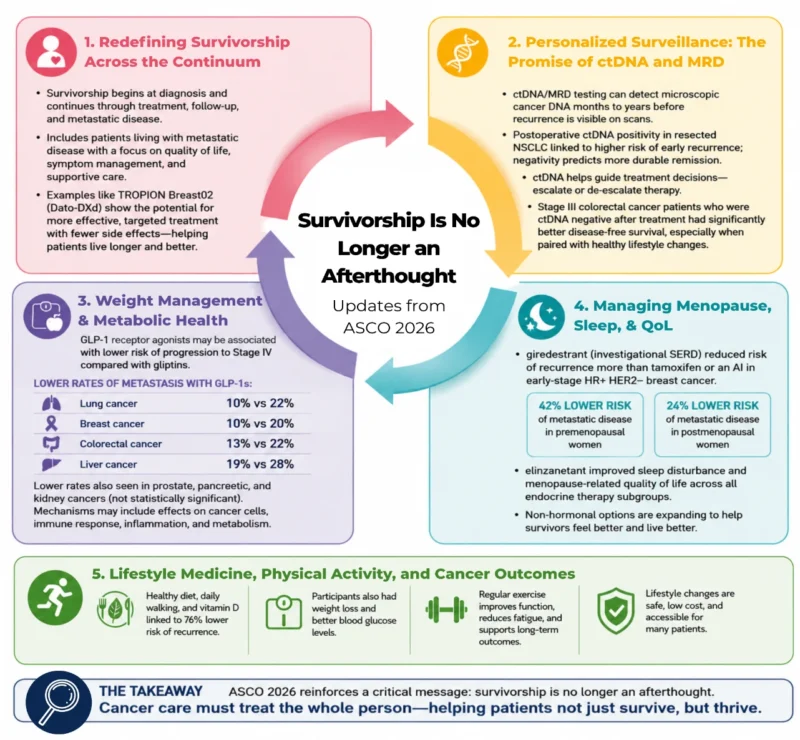
Figure 1. Overview of major survivorship-focused presentations at ASCO 2026, highlighting innovations in surveillance, supportive care, lifestyle medicine, and long-term health after cancer.
You Can Also Read: Muna Al-Khaifi: Integrating Survivorship Care Into Routine Oncology Care