
Muna Al-Khaifi, GP Oncologist at Mount Sinai Hospital (Toronto), Sinai Health, presents this article on integrating survivorship care into routine oncology practice beyond recurrence surveillance alone. This piece explores the need for survivorship care to become a continuous component of cancer care, emphasizing symptom recognition, quality-of-life management, psychosocial support, sexual health, and equitable access to comprehensive survivorship services for all cancer survivors.
Rethinking Survivorship Care Beyond Specialized Clinics: Integrating Survivorship Care Into Routine Oncology Care
A patient should not have to remain sexually inactive for years because treatment-related vaginal dryness was never addressed.
A survivor should not spend months or years unable to sleep because severe hot flashes, anxiety, or emotional distress went unrecognized and untreated.
No patient should wait years to finally hear:
‘This symptom is common.’
‘There are treatment options.’
‘You are not alone.’
Yet somewhere along the way, suffering became unintentionally normalized in survivorship care.
Many cancer survivors quietly struggle with symptoms that profoundly affect their quality of life, relationships, emotional wellbeing, and daily functioning. These symptoms may not be life-threatening, but they are undeniably life-altering.
For many patients, survivorship does not feel like a return to normal life. Instead, it can mean navigating fatigue, intimacy concerns, sleep disruption, fear of recurrence, body image changes, anxiety, depression, cognitive difficulties, and persistent physical symptoms long after treatment ends. Too often, these concerns remain underrecognized, undertreated, or are never discussed at all.
But survival alone is no longer enough.
Today, nearly 70% of patients across many cancer types survive at least five years after diagnosis. That progress is remarkable, but it also raises an important question: What is their quality of life during those years?
The next major challenge in oncology is not only extending survival, but improving the quality of survival.
Healthcare systems must move beyond viewing survivorship as simply the phase that begins after active treatment ends. Survivorship care should instead become an integrated, continuous component of cancer care itself.
Cancer Follow-Up Care Should Include More Than Recurrence Surveillance
Many cancer survivors continue to experience treatment-related toxicities and long-term effects that may significantly affect daily functioning and quality of life, including fatigue, menopausal symptoms, sexual dysfunction, sleep disturbances, anxiety, depression, chronic pain, fear of recurrence, cardiovascular and bone health risks, cognitive changes, and difficulties returning to work or normal life.
Yet cancer follow-up care provided by any physician should not only focus on recurrence surveillance.
Whether follow-up care is provided by oncologists, survivorship clinicians, primary care physicians, or other healthcare professionals, it should also include recognition and management of treatment-related toxicities, psychosocial support, sexual health, menopause symptoms, lifestyle counseling, rehabilitation, prevention strategies, and quality-of-life discussions.
Any Physician Providing Cancer Follow-Up Care Should Ideally Have Competencies in Survivorship Care
Although, this does not mean every clinician needs to become a survivorship specialist. Specialized survivorship clinics remain critically important for complex cases, refractory symptoms, multidisciplinary management, and advancing survivorship research and education.
However, comprehensive survivorship care should not depend entirely on specialized clinics. Whoever is providing cancer follow-up care should ideally have competencies in delivering comprehensive survivorship care, not solely recurrence surveillance.
In practice, this begins with routine screening for survivorship-related symptoms and concerns during follow-up visits. Clinicians can incorporate validated tools to help identify and monitor common survivorship issues, such as the Edmonton Symptom Assessment System (ESAS) for overall symptom burden, the PROMIS Fatigue Scale or Brief Fatigue Inventory for cancer-related fatigue, the PHQ-9 and GAD-7 for depression and anxiety, the Female Sexual Function Index (FSFI) for sexual health concerns, and the Distress Thermometer for psychosocial distress. Using standardized screening tools may help facilitate earlier recognition of symptoms, guide management, and improve discussions around quality of life during routine oncology care.
Importantly, screening alone is not enough.
Symptoms identified should be followed by:
- Acknowledgment and validation of the patient’s experience.
- First-line evidence-based interventions.
- Follow-up to assess response and symptom progression.
- Escalation to second-line therapies or specialist referral when needed.
For example:
- Vaginal dryness and dyspareunia may initially be managed with education, moisturizers, lubricants, pelvic floor therapy, or appropriate hormonal/non-hormonal therapies.
- Fatigue may improve with exercise interventions, sleep optimization, management of contributing medical conditions, and psychosocial support.
- Anxiety, depression, and insomnia may benefit from counseling, cognitive behavioral therapy, lifestyle interventions, pharmacologic treatment, or referral to psycho-oncology services.
Integrating Survivorship Care Into Routine Oncology Care May Improve Accessibility and Equity
Integrating survivorship care into routine oncology practice may help make survivorship care more accessible, equitable, and available to a broader population of cancer survivors. Not all patients have access to specialized survivorship clinics, multidisciplinary programs, or tertiary cancer centres, and access may be limited by geography, healthcare resources, wait times, socioeconomic factors, language barriers, and disparities across healthcare systems.
By embedding survivorship principles into standard oncology follow-up care, more patients may receive earlier recognition and management of common survivorship concerns regardless of where they receive care. This approach may help reduce gaps in care while improving access to symptom management, psychosocial support, sexual health discussions, lifestyle counseling, and quality-of-life interventions throughout the cancer continuum. Comprehensive survivorship care should not be limited to a small subset of patients with access to highly specialized programs; high-quality survivorship care should be accessible to all cancer survivors.
Here Are My Thoughts
-
Survivorship screening should become a routine part of oncology follow-up care.
Standardized screening tools for fatigue, anxiety, depression, sleep disturbance, sexual health, and overall symptom burden may help clinicians identify survivorship concerns earlier and initiate timely supportive care interventions.
-
Screening alone is not enough – symptoms should lead to action.
Survivorship concerns identified during follow-up visits should be acknowledged, validated, and followed by evidence-based first-line management, reassessment of symptom response, and escalation to second-line therapies or specialist referral when appropriate.
-
Oncology clinicians should develop core competencies in survivorship care.
Physicians providing cancer follow-up care do not need to become survivorship specialists, but they should be comfortable recognizing common survivorship issues, initiating basic management strategies, discussing quality-of-life concerns, and identifying when multidisciplinary referral is needed.
-
Integrating survivorship care into routine oncology practice may improve accessibility and equity.
Embedding survivorship care into standard oncology follow-up may help reduce disparities in access to symptom management, psychosocial support, sexual health care, and lifestyle counseling for patients who may not have access to specialized survivorship clinics or tertiary cancer centres.
-
Survivorship research should continue focusing on long-term wellbeing, not only survival outcomes.
Cancer survivorship research plays an important role in understanding and addressing the physical, psychological, social, and financial effects of cancer and its treatment, while also improving survivorship care delivery, supportive interventions, and quality-of-life outcomes for survivors and caregivers.
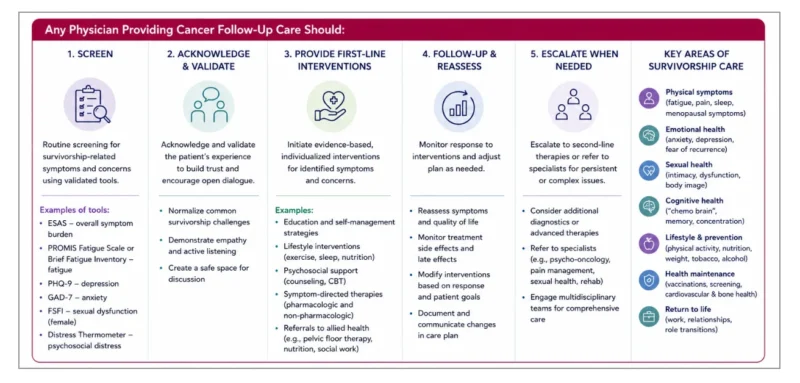
Figure 1. Framework for integrating comprehensive survivorship care into routine oncology follow-up, emphasizing symptom screening, patient-centered management, multidisciplinary support, and quality-of-life focused survivorship care beyond recurrence surveillance.
You Can Also Read: Muna Al-Khaifi: A Chronic Disease Model of Care for Cancer Survivorship