Muna Al-Khaifi, GP Oncologist at the Mount Sinai Hospital (Toronto), Sinai Health presents this article on rethinking cancer survivorship through a chronic disease model of care. This piece explores why survivorship should extend beyond recurrence surveillance alone and highlights the need for proactive, longitudinal, multidisciplinary, and patient-centered approaches that address the long-term physical, psychological, functional, and social consequences of cancer and its treatment.
Rethinking Survivorship Care as a Chronic Disease Model of Care
When a patient is diagnosed with diabetes, clinicians do not limit follow-up care to surveillance and monitoring alone. Instead, diabetes care is approached using a chronic disease model of care. Management includes prevention, long-term monitoring, lifestyle counseling, mental health support, cardiovascular risk reduction, screening for complications, patient education, multidisciplinary collaboration, and continuous follow-up over time.
Importantly, diabetes care is proactive rather than reactive. Clinicians do not wait for severe complications to develop before addressing prevention, symptom management, emotional wellbeing, or quality of life.
As such, cancer survivorship care deserves the same comprehensive and longitudinal approach. Survivorship should not be viewed merely as the absence of recurrence, but as an ongoing phase of health that requires proactive, multidisciplinary, and patient-centered care.
Today, more than 50 million people worldwide are living with and beyond cancer, and over 35 million new cancer cases are projected annually by 2050. At the same time, advances in screening, surgery, systemic therapies, immunotherapy, radiation therapy, and supportive care have significantly improved outcomes across many malignancies, with 5-year survival rates now approaching 65-70% in many regions. This represents one of the greatest achievements in modern oncology.
However, improved survival has also created a rapidly growing population of individuals living with the long-term and late effects of cancer and its treatment. Research demonstrates that most cancer survivors experience ongoing health consequences after treatment.
One large study found that 83% of survivors reported late or long-term effects of treatment. Frequently reported problems causing at least moderate burden include reduced physical functioning (36.3%), fatigue (35.1%), sexual dysfunction (34.7%), sleep disturbances (34.1%), arthralgia (33.8%), anxiety (28.0%), neuropathy (25.6%), memory problems (23.0%), and concentration difficulties (21.9%).
Importantly, survivors experiencing these burdens often report inadequate support, particularly for symptoms that may be perceived as medically ‘nonthreatening’ or for which effective pharmacologic treatments are limited. Yet survivorship care is still too often reduced to recurrence surveillance alone.
Perhaps it is time to rethink survivorship care through a chronic disease model.
The survivorship literature increasingly supports this shift. The landmark Institute of Medicine report, From Cancer Patient to Cancer Survivor: Lost in Transition, highlighted major gaps in long-term survivorship care and emphasized the need for coordinated survivorship care planning, prevention strategies, psychosocial support, and quality-of-life-focused follow-up.
The report also recognized a broader societal reality: with more than one in three individuals developing cancer during their lifetime, nearly everyone will either experience cancer personally or know someone affected by it. While some survivors emerge with a renewed appreciation for life, the report emphasized that the physical, emotional, psychological, financial, and functional consequences of cancer and its treatment are often underrecognized.
Many treatment effects may appear shortly after therapy ends, while others emerge years or even decades later. The transition from active treatment to survivorship represents a critical period that can significantly influence long-term health and wellbeing.
Long-term and late effects of cancer treatment are now well documented throughout the literature. Reviews consistently describe persistent physical, psychological, and functional consequences after cancer treatment, including fatigue, cardiovascular complications, sexual dysfunction, cognitive impairment, anxiety, depression, and reduced physical functioning.
Importantly, these effects may persist for years – and sometimes decades – after treatment completion.
Research also demonstrates that many survivors continue to experience unmet psychosocial and supportive care needs after treatment ends, particularly in symptom management, emotional wellbeing, lifestyle support, rehabilitation, and care coordination.
In addition, cancer survivors are at increased risk for chronic conditions such as cardiovascular disease, hypertension, dyslipidemia, osteoporosis, and diabetes, further reinforcing the need for longitudinal and multidisciplinary models of care.
For many individuals, cancer becomes a long-term health condition requiring ongoing support, prevention-focused strategies, and coordinated follow-up care. This does not mean that every survivor requires indefinite specialist survivorship care. Rather, survivorship principles should become integrated into routine oncology care, primary care, rehabilitation, mental health services, and broader healthcare systems.
In fact, a person with cancer may be disease-free while simultaneously struggling physically, emotionally, socially, psychologically, sexually, or financially.
Whoever is providing cancer follow-up care should ideally have competencies in recognizing and managing common survivorship concerns and treatment-related toxicities. This includes areas such as sexual health, menopausal symptoms, fatigue, sleep disturbances, anxiety and depression, physical functioning, lifestyle counseling, cardiovascular health, bone health, and the psychosocial impact of cancer and its treatment.
Importantly, a chronic disease model of survivorship care may also improve accessibility and equity.
Not all survivors have access to specialized survivorship clinics or tertiary cancer centers. Integrating survivorship principles into routine oncology and primary care may allow earlier recognition and management of survivorship concerns regardless of geography or healthcare resources.
We do not need to wait for more specialized survivorship clinics to begin improving survivorship care. We can begin integrating survivorship principles into routine cancer care now.
Achieving this shift will require meaningful investment in several areas, including: more specific what kind of training, education, conferences etc.. can u add any numbers in this
- Education and training: more survivorship education in medical school, residency, continuing education, and oncology conferences, particularly around late effects and quality-of-life issues.
- Multidisciplinary collaboration: better coordination between oncology, primary care, rehabilitation, mental health, and supportive care services.
- Healthcare infrastructure: survivorship care plans, symptom screening, referral pathways, integrated records, and telemedicine-supported follow-up.
- Prevention-focused care: greater emphasis on exercise, cardiovascular health, mental health, nutrition, smoking cessation, and early management of treatment toxicities.
- Expanded survivorship research: despite more than 50 million cancer survivors worldwide, survivorship research remains relatively underfunded.
- Healthcare policy: recognizing survivorship as a core part of cancer care and improving access to supportive and rehabilitation services.
As cancer survival continues to improve globally, quality of survival should become a central oncology outcome alongside survival itself.
Here Are My Thoughts
- Normalize survivorship care as part of routine cancer care.
Survivorship care should not begin only after treatment ends or when severe symptoms develop. Conversations about long-term and late effects, quality of life, mental health, physical functioning, and supportive care needs should begin early and continue throughout the cancer continuum.
- Move beyond recurrence surveillance alone.
A survivor may be disease-free while still struggling with fatigue, anxiety, cognitive changes, sexual dysfunction, chronic pain, cardiovascular risk, financial stress, or difficulties returning to normal life. Follow-up care should address the whole person, not only the cancer itself.
- Use a chronic disease and multidisciplinary model of care.
Cancer survivorship often requires long-term monitoring, prevention-focused care, rehabilitation, psychosocial support, and collaboration between oncology, primary care, rehabilitation, mental health, supportive care, and other specialties.
- Improve survivorship education and healthcare system integration.
Many healthcare professionals receive limited formal training in survivorship medicine and management of late effects. Improving education, survivorship pathways, research, and healthcare policy integration will be essential as the global survivor population continues to grow.
Surviving cancer should not simply mean being alive. It should mean living well – during, through, and beyond cancer.
Selected References
1. Siegel, R. L., Kratzer, T. B., Wagle, N. S., Sung, H., & Jemal, A. (2026). Cancer statistics, 2026. CA: a cancer journal for clinicians, 76(1), e70043. https://doi.org/10.3322/caac.70043
2. Institute of Medicine and National Research Council. 2006. From Cancer Patient to Cancer Survivor: Lost in Transition. Washington, DC: The National Academies Press.
3. Stein KD, Syrjala KL, Andrykowski MA. Physical and psychological long-term and late effects of cancer. CA Cancer J Clin. 2008;58(1):14–29.
4. Schmidt ME, et al. Late effects, long-term problems and unmet needs of cancer survivors. Int J Cancer. 2022.
5. Kristoffersen, A. E., Wider, B., Nilsen, J. V., Bjelland, M., Mora, D. C., Nordberg, J. H., Broderstad, A. R., Nakandi, K., & Stub, T. (2022). Prevalence of late and long-term effects of cancer (treatment) and use of complementary and alternative medicine in Norway. BMC complementary medicine and therapies, 22(1), 322. https://doi.org/10.1186/s12906-022-03790-z
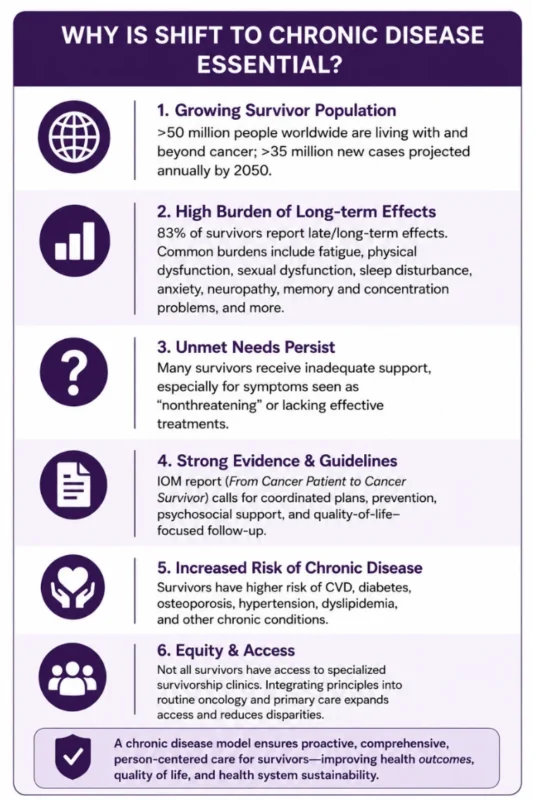
Figure 1. Key factors supporting the integration of a chronic disease model into cancer survivorship care, emphasizing the increasing survivor population, long-term treatment-related morbidity, unmet supportive care needs, chronic disease risk, and the importance of coordinated, longitudinal, multidisciplinary care.
You can also read: Muna Al-Khaifi: Managing Low Sexual Drive in Cancer Survivors – What the Latest Evidence Shows