Michelle Kirschner, Managing Director at International Cancer Rehabilitation Foundation, shared on LinkedIn:
“This week, I had the privilege of joining Amy Steinhour MMS, PA-C and Kristen Beck on the Let Me Know If You Need A Podcast to discuss a topic that affects millions of cancer survivors yet remains widely misunderstood: cancer-related cognitive impairment (CRCI). Throughout our conversation, we explored why the term ‘chemo brain’ often fails to capture the complexity of what survivors experience, how cognitive symptoms can emerge before treatment begins, and why many survivors continue to struggle long after active treatment has ended. We also discussed a reality that I have observed throughout my years in survivorship care: the gap between recognizing CRCI and effectively addressing it remains substantial.
If you have not yet listened, I encourage you to do so. The discussion highlights many of the themes explored in this article, including the challenges survivors face when seeking answers, the importance of validating lived experience, and the need for practical rehabilitation strategies rather than simply acknowledging that cognitive symptoms exist.
As I listened to discussions this week at the National Cancer Policy Summit 2026 and the NCCN Global Policy Webinar Series: Oncology Workforce Shortages and the Future of Cancer Care, I found myself reflecting on an important question: as we discuss the future of oncology, workforce development, innovation, and healthcare delivery, are we adequately preparing our clinical teams to address one of the most common and impactful survivorship concerns facing patients today?
Over the past decade, awareness of cancer-related cognitive impairment has grown significantly. More clinicians recognize the condition. More survivors are willing to talk about it. More research is being published. Yet awareness alone does not translate into meaningful clinical support. Many survivors are finally hearing the words, ‘Yes, your symptoms are real,’ but they still leave appointments without a clear understanding of why they are experiencing cognitive changes, what can be done about them, or who can help them manage these challenges over time.
One of the biggest misconceptions surrounding CRCI is that it is primarily a memory problem. In reality, many survivors describe something much more complex. While memory concerns are common, the challenge often extends beyond remembering names, appointments, or conversations. Many people find that their ability to sustain mental effort has fundamentally changed. Activities that once seemed automatic now require significant concentration. Survivors frequently describe needing to work much harder to accomplish tasks that previously required very little conscious effort. They may still complete the task successfully, but the cognitive price they pay is dramatically different.
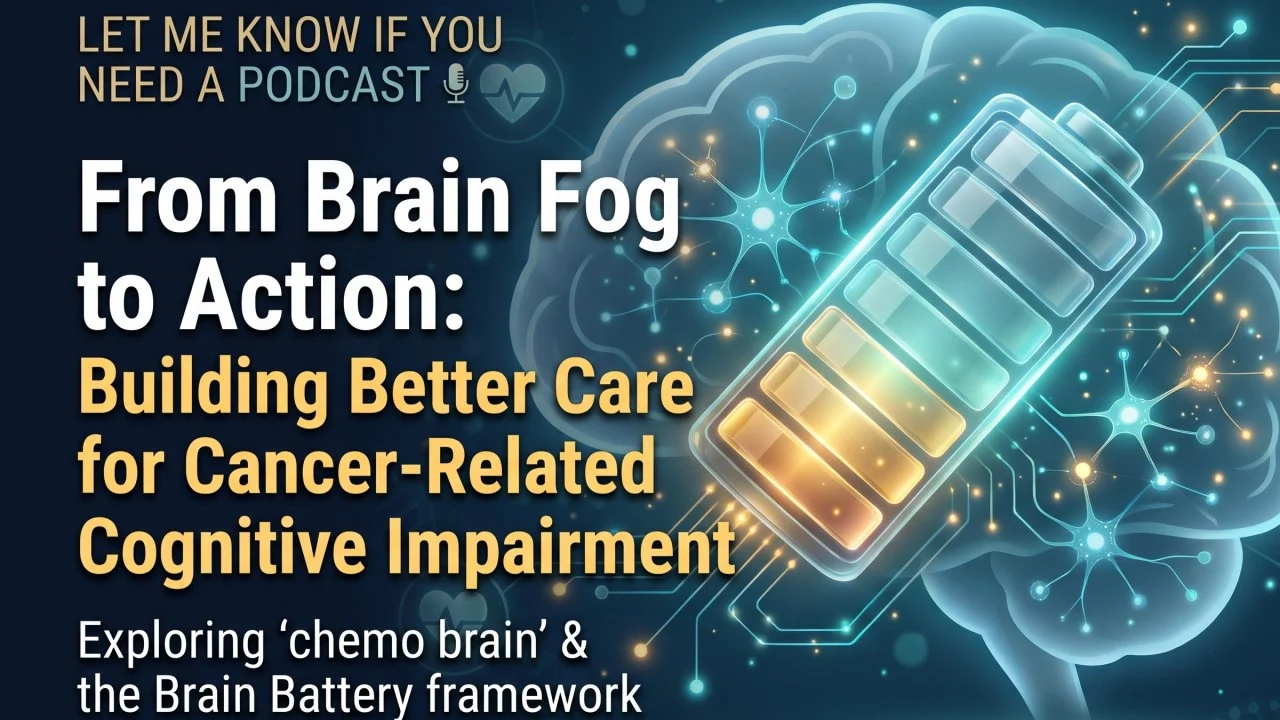
This is why I often describe cognition using what I call the ‘Brain Battery’ framework. Unlike a light switch that is either on or off, the brain functions more like a battery with a limited reserve of cognitive energy. Cancer, treatment-related effects, inflammation, fatigue, sleep disruption, pain, anxiety, and countless other factors influence how much charge that battery holds and how quickly it becomes depleted. The practical implications are enormous. A survivor may appear highly functional during a clinic visit, social engagement, or work meeting and then find themselves completely depleted afterward. The challenge is not necessarily whether they can perform the task. The challenge is how much cognitive effort is required to sustain that performance.
What is often overlooked is that many survivors become experts in hiding their cognitive struggles. They create elaborate systems to compensate. They rely on calendars, reminders, notes, routines, and repeated checking of information. They arrive at appointments having carefully prepared in advance. Family members, colleagues, and even clinicians may see the successful outcome without recognizing the tremendous cognitive effort required to achieve it. By the time a survivor says, “I don’t feel like my brain works the way it used to,” they have often spent months or years adapting to changes that those around them cannot see.
The science supporting these experiences is compelling. One of the most consistent findings in CRCI research is that subjective cognitive complaints and objective cognitive testing often do not align. Many survivors report substantial cognitive difficulties despite testing within normal limits. For years, this inconsistency created confusion for both patients and providers. We now understand that there are several reasons why this occurs.
Neuroimaging studies suggest that many survivors recruit additional neural networks in order to maintain performance. In practical terms, the brain is working harder to achieve the same result. From the outside, performance may appear preserved. Internally, however, the person experiences increased mental effort, greater fatigue, and reduced endurance. Survivors often describe this as “brain fog” or feeling mentally drained after activities they previously completed with ease. What the testing measures is performance. What the survivor experiences is the cost of maintaining that performance.
Equally important is the difference between testing environments and real life. Cognitive assessments are typically performed in quiet, structured settings that minimize distractions and interruptions. Daily life looks nothing like that. Survivors must manage work responsibilities, family obligations, healthcare appointments, financial concerns, caregiving duties, multitasking, emotional stress, interruptions, and fatigue, often all at the same time. The cognitive demands of daily living are significantly more complex than anything replicated during a formal assessment. This helps explain why a person may perform well for a brief period in a testing environment and yet struggle significantly throughout a normal day.
There is also a fundamental difference in how survivors and tests evaluate change. Survivors compare themselves to who they were before cancer. They notice subtle changes in speed, efficiency, organization, multitasking ability, and cognitive stamina. Standardized testing, by contrast, often compares performance to population norms. A highly functioning executive, physician, teacher, attorney, engineer, or business owner may experience a meaningful decline from their personal baseline while still performing within a statistically normal range. Both realities can be true at the same time.
This understanding has important implications for care. A normal neuropsychological evaluation should never automatically end the conversation. Cognitive testing and self-reported symptoms each provide valuable but different information. One captures aspects of performance under controlled conditions. The other reflects real-world functioning, participation, effort, and quality of life. Rather than competing with one another, these perspectives should be integrated to create a more complete understanding of the survivor’s experience.
Another important misconception is that CRCI represents a single problem located in a single area of the brain. In reality, thinking depends on highly interconnected neural networks that support attention, executive functioning, information processing, memory, language, organization, problem-solving, and self-regulation. Many survivors are surprised to learn that what they interpret as memory loss may actually reflect difficulties with attention or executive functioning. If attention is impaired, information may never be encoded effectively in the first place. If executive functioning is compromised, a person may struggle to organize, retrieve, or apply information efficiently.
This is why survivors frequently describe symptoms that extend far beyond forgetting things. They talk about losing the thread of conversations, rereading the same paragraph multiple times, struggling to follow complex discussions in noisy environments, needing additional time to process information, forgetting why they entered a room, becoming overwhelmed by multi-step tasks, experiencing word-finding difficulties, or feeling unable to organize their thoughts effectively. Many also describe difficulty transitioning between activities, prioritizing competing responsibilities, or maintaining focus during prolonged cognitive tasks.
Perhaps one of the most underrecognized symptoms is cognitive fatigue. Mental fatigue is not simply feeling sleepy. It is not resolved by taking a nap. Cognitive fatigue may appear as slowed thinking, increased irritability, difficulty concentrating, reduced frustration tolerance, increased errors, difficulty finding words, or a sudden inability to continue processing information effectively. Survivors often describe this experience as ‘hitting a wall’ or ‘crashing.’ One moment they are functioning adequately. The next, cognitive performance drops dramatically and recovery may take hours or even days.
Over time, I have become increasingly convinced that cognitive fatigue is one of the central features of CRCI and one of the least understood. Many interventions fail because they focus solely on memory while overlooking endurance. The question is often not whether someone can complete a task. It is whether they can complete the task repeatedly, consistently, and without exhausting their cognitive reserve.
The complexity of CRCI also highlights a significant challenge in healthcare education. While awareness has improved, specialized training has not necessarily kept pace. A recent National Cancer Institute survey found that most oncology providers, including medical, surgical, and radiation oncology professionals, have received little or no formal training related to CRCI causes, symptoms, assessment, or management. This should not be viewed as criticism of individual clinicians. Rather, it reflects a broader gap in our educational systems. We cannot expect providers to develop expertise in an area that has historically received limited attention during training.
This reality has important implications for survivors and caregivers. Asking whether a provider has specific experience with CRCI is entirely reasonable. It is not a criticism of the healthcare team. Like lymphedema, cancer rehabilitation, sexual health, neuropathy, or other specialized survivorship concerns, expertise matters. If cognitive concerns are repeatedly minimized, dismissed, or inadequately addressed, seeking consultation with a provider who has additional knowledge and experience in this area may be one of the most important steps a survivor can take.
Unfortunately, knowledge gaps are not the only challenge. Existing care pathways often emphasize assessment more than intervention. Survivors frequently undergo testing, receive recommendations, and then find themselves largely responsible for implementing those recommendations independently. Assessment is important, but assessment alone rarely improves outcomes. Meaningful improvements occur when recommendations are translated into practical strategies that support daily functioning.
This is where rehabilitation becomes essential. Occupational therapists, speech-language pathologists, physiatrists, neuropsychologists, behavioral health specialists, survivorship providers, and exercise professionals all have important roles to play. Their collective goal is not simply to identify impairment. The goal is to help individuals function more effectively, conserve cognitive energy, maintain meaningful roles, reduce distress, improve participation, and maximize quality of life. These outcomes are often far more meaningful to survivors than any cognitive test score could ever be.
One observation that continues to stand out in my conversations with survivors is how realistic their expectations often are. Most are not seeking perfection. Most do not expect to return entirely to life before cancer. What they want is acknowledgment, understanding, guidance, and support. They want clinicians who understand that a normal test result does not invalidate a difficult day. They want practical strategies that help them function more effectively. They want healthcare systems that recognize cognitive health as an important aspect of survivorship rather than an afterthought.
That message was at the heart of my recent podcast conversation. One of the most powerful things we can do as healthcare professionals, caregivers, advocates, and family members is validate the lived experiences of survivors. Validation is not the end of treatment, but it is often the beginning of it. When people understand that their symptoms are real, that there are biological explanations for what they are experiencing, and that support exists, they are far more likely to seek help and engage in meaningful interventions.
As we continue discussing the future of cancer care, I hope we expand the conversation beyond awareness. We need stronger workforce education, greater integration of rehabilitation into oncology care, more longitudinal survivorship programs, and increased recognition of the expertise required to effectively manage CRCI. We must continue to build systems that connect survivors not only with answers, but also with practical solutions.
The evidence supporting CRCI continues to grow. The awareness is increasing. The challenge before us now is ensuring that this knowledge translates into meaningful improvements in care. Survivors deserve more than recognition of their symptoms. They deserve access to clinicians, rehabilitation services, educational resources, and multidisciplinary support systems capable of helping them navigate the very real cognitive challenges that can accompany cancer and its treatment.
At the International Cancer Rehabilitation Foundation (ICRF), we are committed to helping close that gap through education, advocacy, collaboration, and resource development. We invite survivors, caregivers, clinicians, researchers, rehabilitation professionals, and healthcare leaders to join us in this work. The next chapter in CRCI is not proving that it exists. The next chapter is ensuring that every survivor experiencing cognitive challenges has access to the expertise, support, rehabilitation services, and practical tools needed to live fully after cancer.
Because survivorship is not simply about living longer. It is about being able to fully participate in the life you fought so hard to preserve.”
You can also read: Chemo Brain: Memory Loss and Concentration Problems During Cancer Treatment