






Mehak Trehan, Associate Consultant at Fortis Healthcare, shared a post on X:
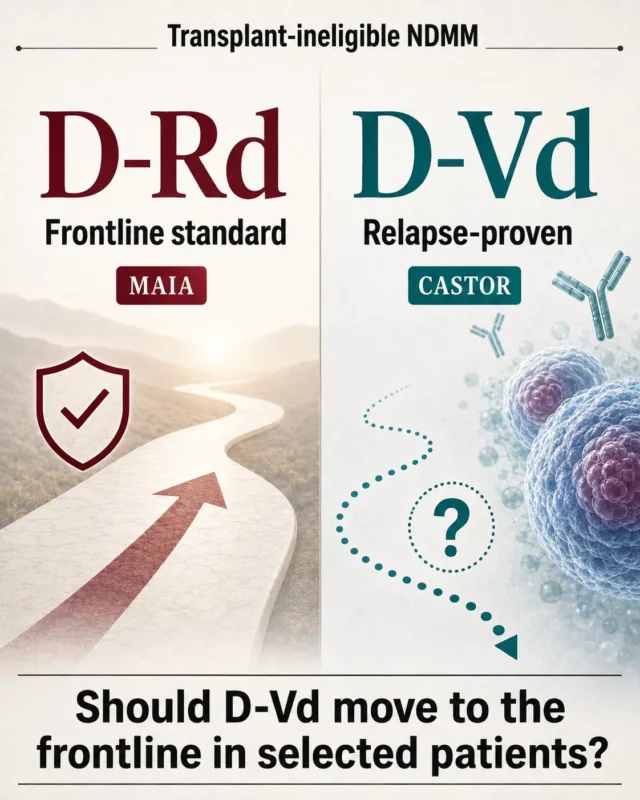
“Why is D-Rd frontline in transplant-ineligible newly diagnosed myeloma, but D-Vd is not?
This is not semantics.
In myeloma, a regimen does not become frontline because the drugs are active.
It becomes frontline when the population, backbone, duration, depth of response, toxicity and sequencing logic are proven together.
D-Rd has MAIA.
737 transplant-ineligible NDMM patients. At 64.5 months follow-up:
- PFS: 61.9 vs 34.4 months
- PFS HR: 0.55
- OS: NR vs 65.5 months
- OS HR: 0.66
- ≥CR: 51.1% vs 30.1%
- MRD-negative: 32.1% vs 11.1%
- Sustained MRD-negative ≥18 months: 16.8% vs 3.3%
That is not just response.
That is frontline disease control over years.
D-Vd has CASTOR, but CASTOR was relapse, not frontline.
In relapsed/refractory myeloma, D-Vd improved outcomes vs Vd:
- PFS: 16.7 vs 7.1 months
- OS: 49.6 vs 38.5 months
- OS HR: 0.74
- Excellent relapse data.
But a relapse regimen cannot simply be ‘promoted’ to frontline without testing the frontline question.
The field has already answered part of this question.
When daratumumab moved with a PI into frontline transplant-ineligible myeloma, it did not move as D-Vd.
It moved as:
- D-VMP in ALCYONE
- D-VRd in CEPHEUS
- Anti-CD38 + VRd strategy in IMROZ/CEPHEUS era
So the real question is not: ‘Can we give D-Vd upfront?’
It is: If D-Vd is relapse-proven but not frontline-tested, should we move it upfront in selected patients OR is first line too precious for extrapolated evidence?”
Other articles featuring Mehak Trehan on OncoDaily.