Cancer cells are defined not only by uncontrolled growth, but also by their ability to reshape the biological systems that normally keep cells functioning within strict limits.
They continue multiplying when they should stop, ignore signals designed to control their behavior, alter their surroundings, evade immune defenses, spread to distant organs, and develop resistance to treatment. Understanding how these changes occur requires scientists to look closely at the fundamental processes that sustain both normal and malignant cells.
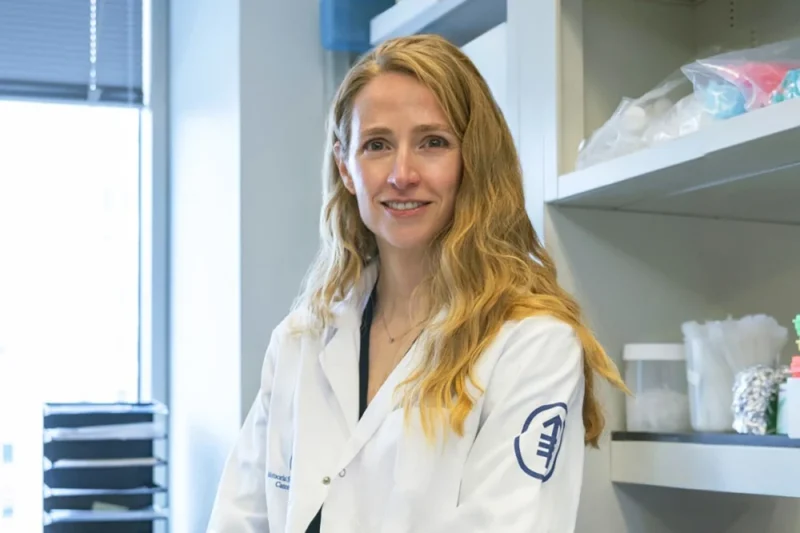
At Memorial Sloan Kettering Cancer Center, Lydia Finley, PhD, is investigating one of the most important of these processes: cell metabolism.
Dr. Finley, an associate member of the Cell Biology Program at MSK’s Sloan Kettering Institute, studies how cells convert nutrients into the molecules they need to grow, function, and survive.
“In simple terms, it’s how cells use food to grow,” she explained. “And without access to the right food, cancer cells won’t be able to survive.”
Her research is helping reveal how cancer cells obtain energy, use nutrients, respond to metabolic signals, and potentially become vulnerable to treatments that interfere with these essential processes.
Looking Beyond Cancer to Understand Cancer
Modern cancer therapies frequently target basic cellular functions that have become disrupted. These treatments may interfere with how cancer cells divide, repair themselves, generate energy, or remain alive.
For this reason, Dr. Finley believes that understanding cancer requires an equally detailed understanding of normal biology.
“To understand what happens in cancer, we first have to understand how normal cells are supposed to function and what makes things go wrong,” she said.
This approach is reflected across Sloan Kettering Institute, where laboratory scientists investigate fundamental questions in human biology alongside MSK’s clinical programs and advanced cancer trials.
The relationship between basic research and patient care is not always direct or immediate. A laboratory discovery may not initially appear to point toward a new appear to point toward a new treatment. However, fundamental research can reveal previously unknown drug targets, disease markers, biological pathways, and connections that later become central to cancer medicine.
Tobias Walther, PhD, Chair of the Cell Biology Program, studies how cells manage and store fats and how failures in these systems contribute to cancer, metabolic diseases, and neurodegeneration.
“There’s still a lot we don’t know about human biology,” Dr. Walther said. “And we won’t know what will unlock powerful new treatments until we ask the questions.”
Rewriting the Rules of Cellular Energy
One area of Dr. Finley’s work is challenging long-established assumptions about how cells produce energy.
For decades, scientists have understood the Krebs cycle, also known as the tricarboxylic acid cycle, as a central pathway through which cells burn sugars and generate energy. Dr. Finley and her colleagues, however, found that cells may have additional ways to produce the energy required for survival.
The traditional biological map remains important, but the routes available to cells can vary depending on their environment and biological state.
“We are learning that not all those roads are accessible at all times and in all contexts,” Dr. Finley said. “We also found that there were routes we didn’t know anything about.”
These alternative metabolic routes may have major implications for cancer. Tumor cells must constantly adapt to changing conditions, including limited oxygen, nutrient shortages, treatment pressure, and hostile immune environments.
Determining which metabolic pathways cancer cells rely on under these conditions may expose weaknesses that can be therapeutically targeted.
Finding Metabolic Vulnerabilities in Childhood Cancer
The close connection between MSK’s laboratory and clinical teams has allowed Dr. Finley to apply her expertise to pediatric rhabdomyosarcoma, a rare and aggressive soft tissue cancer that develops in muscle.
The disease presents a particular scientific challenge. Unlike many adult cancers, pediatric cancers have not generally developed after decades of accumulated genetic damage. Instead, severe biological disruption may occur much earlier in life.
“Kids shouldn’t get cancer,” Dr. Finley said. “Unlike with adults, there aren’t genetic changes that have built up over a lifetime. Instead, something has just gone horribly wrong in their cells. We thought there was a good chance cell metabolism played a role.”
Dr. Finley began collaborating with pediatric specialists at MSK Kids to investigate the nutrients required by rhabdomyosarcoma cells.
The research identified critical nutrients that the cancer cells needed to survive. The team also demonstrated that methotrexate, one of the oldest, most affordable, and most extensively studied cancer drugs, could slow tumor growth in mouse models.
Methotrexate works by targeting cellular metabolism. The findings therefore suggested that a better understanding of the tumor’s nutritional requirements could create opportunities to reconsider an established treatment in a new biological context.
The work also illustrates the value of close collaboration between laboratory researchers and clinicians.
“It’s wonderful how the doctors here are excited to collaborate with scientists to innovate and find new ways to improve patient care,” Dr. Finley said.
Metabolites Are More Than Cellular Fuel
Cell metabolism does more than generate energy.
When cells process nutrients, they produce metabolites, which provide fuel and building materials. However, metabolites can also act as biological signals, influencing how cells behave and what state they adopt.
Dr. Finley considers this signaling role to be one of the most promising areas of metabolism research.
In a study conducted with the laboratory of cancer biologist Scott Lowe, PhD, researchers examined the effects of a metabolite called alpha-ketoglutarate on pancreatic cancer cells.
The researchers found that exposing the cells to alpha-ketoglutarate could cause them to return to an earlier cellular state and become less malignant.
“To me, this is one of the most exciting areas of cell metabolism,” Dr. Finley said. “Here the idea is that metabolites are telling the cell something really important, sending a signal. And what we found is that certain metabolites can really change behaviors that drive cancer.”
The findings raise the possibility that cancer behavior may not always be permanently fixed. Instead, malignant cells may be responding to signals that reinforce their cancerous identity.
If those signals can be identified and altered, it may be possible to push cancer cells toward a more normal state.
“It also means that cancer cells aren’t necessarily permanently trapped in this malignant identity,” Dr. Finley said. “They’re receiving signals that are pushing them toward malignancy, and if you can know what those signals are, if you can undo them, then that cell can come back to a much more normal state.”
Cancer Research Shaped by Personal Experience
For Dr. Finley, the importance of cancer research is also deeply personal.
While working as a postdoctoral fellow at MSK, she was treated at the institution for thyroid cancer. Both of her parents have also received care at MSK. Her mother was treated for amyloidosis with a bone marrow transplant, while her father received treatment for a rare bladder cancer. In each case, treatment was successful.
These experiences have allowed Dr. Finley to see cancer care from several perspectives: as a patient, as a family member, and as a scientist studying samples provided by patients for research.
“I’ve seen this institution from the perspective of the patient and from the perspective of someone sitting next to the patient,” she said. “I’ve seen it from the standpoint of somebody in the laboratory looking at patient samples that have been generously provided for research.”
Across those experiences, she said, one feature remained consistent: a commitment to patient care.
“What I’ve seen in all of these different perspectives is an absolute commitment to patient care,” Dr. Finley said. “This is a place that finds excellence at every single moment, and I am very proud to be a part of it.”
Turning Basic Biology Into Future Treatments
Research into cancer metabolism is revealing that nutrients, energy pathways, and metabolites are not merely background processes supporting tumor growth. They may actively shape cancer behavior, determine treatment response, and create vulnerabilities that can be exploited.
By investigating how normal cells function and how those systems become disrupted, researchers may uncover new ways to starve cancer cells, redirect their behavior, or make them more sensitive to treatment.
Dr. Finley’s work demonstrates why basic science remains central to progress in oncology. A deeper understanding of what cancer cells consume, how they process it, and what metabolic signals they receive may ultimately influence how future treatments are designed.
Her research is supported by the MSK donor community, including The Pershing Square Foundation, Richard and Atlanta Warke, and The Edward Mallinckrodt, Jr. Foundation. Dr. Finley holds a Geoffrey Beene Junior Faculty Chair.
Written by Nare Hovhannisyan, MD
Stay informed with more articles like this on OncoDaily