Iryna Yaryhina, Research Engineer at Pharmaceutical company «Zdorovye», shared a post on LinkedIn:
“Organ-on-a-Chip for Bone Metastasis: Moving Beyond Animal Models
Bone is one of the most common metastatic sites in breast cancer, yet studying tumor-bone interactions remains challenging. Traditional mouse models often fail to fully recapitulate human bone physiology and show poor predictive power for drug responses.
In a recent Acta Biomaterialia study,
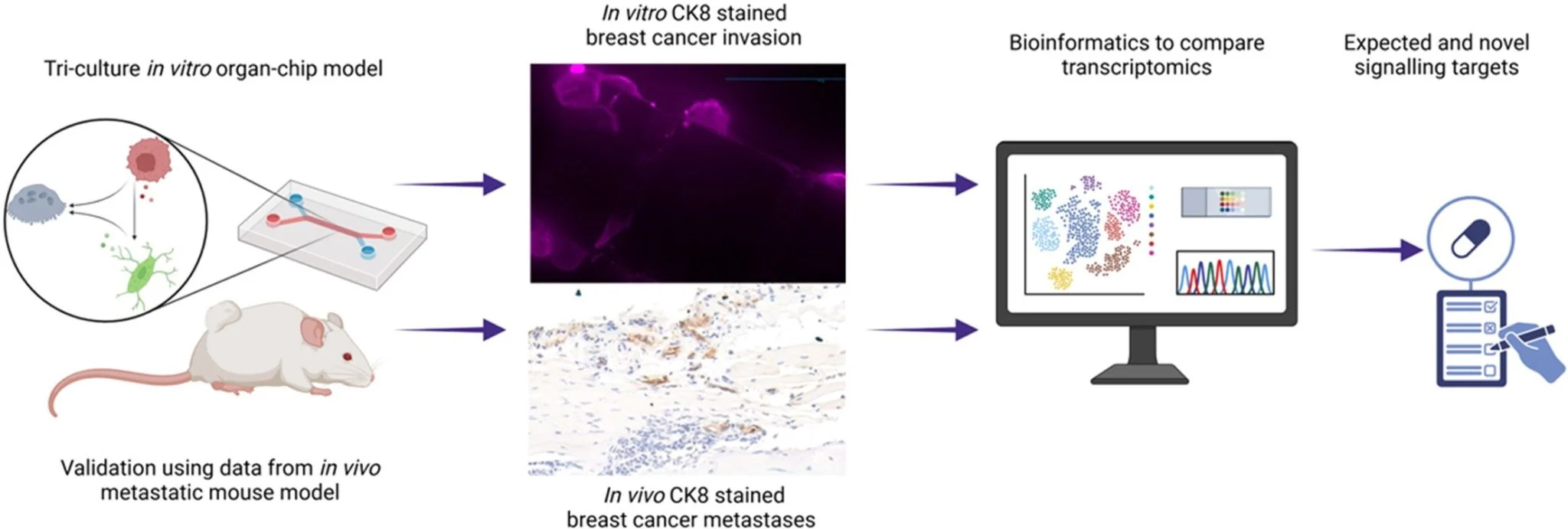
“Multi-omics qualification of an organ-on-a-chip model of osteolytic bone metastasis,” Natalia Muñoz Castro, Joanne Nolan, Eleni Maniati and colleagues developed a tri-culture organ-on-a-chip model that reconstructs the metastatic bone microenvironment.
The system combines breast cancer cells, osteocytes, and osteoclasts within a microfluidic chip, enabling the study of tumor–bone interactions in a controlled 3D environment.
Key highlights:
- Tri-culture architecture matters.
When osteocytes and osteoclasts were both present, cancer cell invasion increased significantly compared with chips containing only one bone cell type. - Synergistic signaling drives metastasis.
Co-culture induced strong upregulation of cytokines such as IL-6, TNF-α, MCP-1, and VEGF, reflecting inflammatory signaling observed in metastatic niches. - Transcriptomic validation against in vivo models.
RNA-seq showed that the tri-culture chip clustered closely with bone metastatic tissue from mouse models, confirming biological relevance. - Shared molecular pathways were identified.
Upregulated processes included calcium signaling and cation transport, while pathways related to ribosome biogenesis and DNA metabolism were downregulated. - Multi-omics enables deeper mechanistic insight.
Combining cytokine profiling, imaging, and RNA-seq revealed potential targets involved in osteoclast activation, tumor invasion, and bone degradation.
According to the authors, such validated organ-on-chip platforms could serve as scalable alternatives to animal models, enabling more predictive preclinical testing and improved understanding of metastatic microenvironments.
What role do you think organ-on-chip models will play in replacing animal models in oncology research?”
Title: Multi-omics qualification of an organ-on-a-chip model of osteolytic bone metastasis
Authors: Natalia Munoz Castro, Joanne Nolan, Eleni Maniati, Ayushi Agrawal, Valentine Gauthier, Oliver M.T. Pearce, Stefaan W. Verbruggen, Martin M. Knight
Read the Full Article.