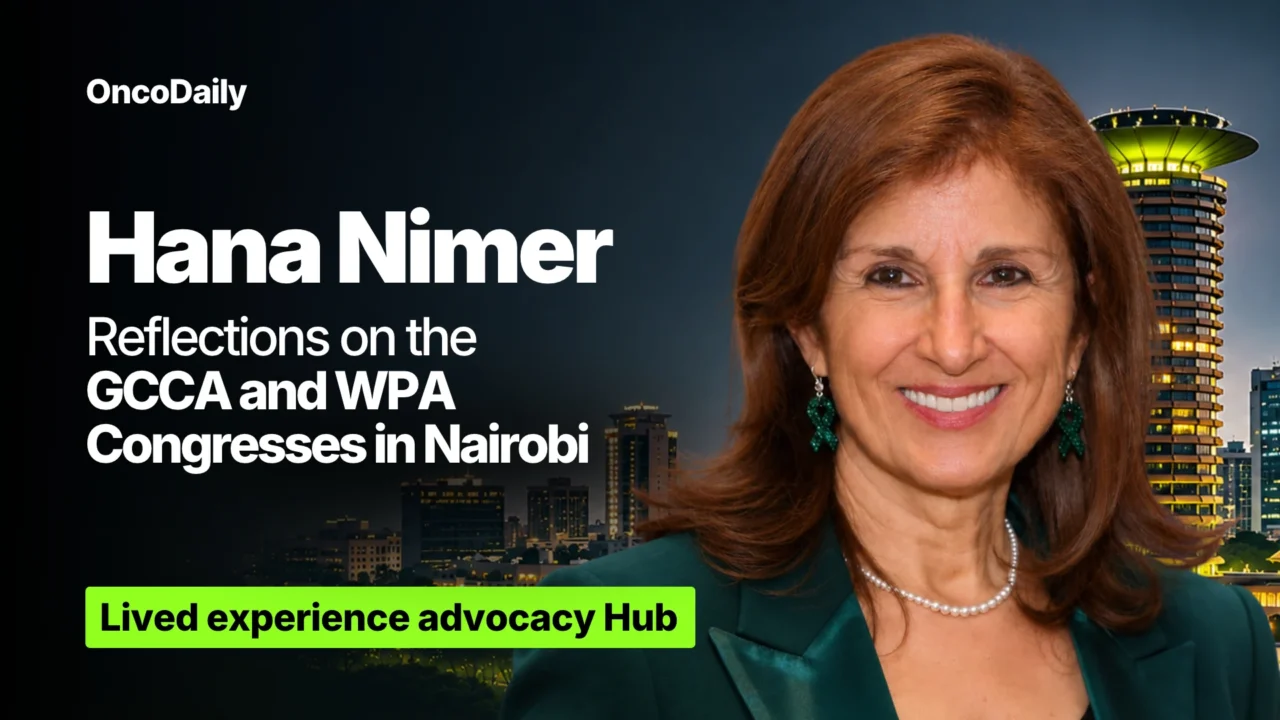
Hana Nimer | Lebanon | Founder and Executive Director, SAID NGO
Patient Advocate Events Insights is a series highlighting the experiences of patient advocates and people with lived cancer experience attending scientific conferences, training programmes, and international events. Through their perspectives, we explore the value of patient involvement, the barriers advocates face, and opportunities to make scientific spaces more inclusive.
In this edition, Hana Nimer, Founder and Executive Director of SAID NGO in Lebanon, reflects on her participation in the GCCA and WPA Congresses in Nairobi, Kenya.
From sharing SAID NGO’s work in colorectal cancer prevention and patient support to participating in international discussions on health equity and patient-centred care, Hana highlights why patient organisations should not only be present in scientific and policy conversations but actively contribute to shaping them.
What motivated you to attend the GCCA and WPA Congresses?
My motivation was to strengthen my knowledge, exchange experiences, build meaningful partnerships, and bring the patient advocacy perspective to regional and international discussions.
As Founder and Executive Director of SAID NGO, I wanted to share our experience in colorectal cancer awareness, early detection, screening access, and patient navigation in Lebanon.
At the same time, I was eager to learn from other organisations and experts, exchange knowledge, and explore opportunities for collaboration that could help us strengthen our impact.
How did you fund your attendance?
My attendance was supported by a grant.
What session had the biggest impact on you, and why?
The GCCA scientific sessions had a particularly strong impact on me, offering valuable insights into the latest developments in colorectal cancer prevention, early detection, treatment, and patient care.
Equally meaningful was my participation as a panelist in two sessions.
During the Equity Grant session, I had the opportunity to share how SAID NGO utilised its grant to provide essential stoma bags and supplies to patients in need in Lebanon.
The session also included patients sharing deeply moving personal experiences, reminding us of the human realities behind every diagnosis and the importance of addressing unmet patient needs.
At the WPA Conference, I also had the privilege of participating as a panelist, where I placed the power of prevention at the centre of the discussion.
The session brought together representatives from the World Health Organization (WHO), the International Committee of the Red Cross (ICRC), and fellow panelists who showed genuine interest in the work and impact of SAID NGO.
It was an important opportunity to bring colorectal cancer prevention, early detection, and our experience in Lebanon into a broader discussion about patient-centred healthcare, particularly during emergencies.
Both experiences reinforced my belief that patient organisations must not only be present at the table but must actively contribute, share their experiences, and help shape healthcare priorities and policies.
What surprised you the most?
I was most impressed by the willingness of healthcare professionals and international organisations to listen to patient advocates and engage with our experiences.
The powerful personal stories shared by patients reminded me that behind every statistic is a human life, and that meaningful change must start by listening to patients.
Did you feel that the patient perspective was well represented?
Yes, patient perspectives were represented, particularly through opportunities for patient advocates to participate as panelists and share real-life experiences.
However, I believe patient voices should be integrated more consistently into scientific discussions, policy decisions, and the design of healthcare programmes, rather than simply being invited as a separate perspective.
Meaningful patient involvement should be part of the conversation from the beginning.
If you could change one thing about the conferences for patient advocates, what would it be?
I would create more opportunities for meaningful involvement of patient advocates throughout the conferences.
This could include co-chairing sessions, contributing to scientific and policy discussions, and engaging directly with healthcare professionals and decision-makers.
Patient advocates should not only have a seat at the table; they should help shape the agenda and influence decisions.
Did you make any new collaborations or connections?
Yes, I made new connections during the congresses.
If another advocate is considering attending next year, what advice would you give them?
Absolutely attend!
Come prepared to share your experience, your organisation’s work, and the challenges faced by patients in your country.
Be curious, engage with other advocates, healthcare professionals, and decision-makers, and don’t underestimate the power of your voice.
You are not there simply to listen. You are there to contribute, connect, learn, and influence change.
Every patient advocate has a story and a perspective that deserves to be heard.
What would you like organisers to know about people with lived cancer experience and advocates who attend the conferences?
Patient advocates bring something that cannot be found in scientific presentations alone: the human reality behind the statistics.
We bring lived experiences, unmet needs, challenges within healthcare systems, and practical solutions grounded in the realities of patients and their families.
We are not simply attendees or beneficiaries; we are partners in shaping better healthcare.
Our participation should go beyond sharing personal stories. We should be involved in setting agendas, shaping policies, influencing research priorities, and evaluating outcomes.
Nothing about us should be decided without us.
What value do patient advocates and people with lived experience bring to researchers, healthcare professionals, and industry during scientific conferences?
Patient advocates bring the human perspective that is essential to meaningful scientific progress.
While researchers, healthcare professionals, and industry bring scientific expertise, clinical knowledge, and innovation, people with lived experience bring the reality of living with cancer: unmet needs, barriers to care, emotional and social impact, and gaps that statistics alone cannot capture.
We help ensure that research addresses real patient priorities, treatments and services are designed around patients’ needs, and healthcare policies translate into better outcomes.
We also challenge assumptions, encourage accountability, and bring a sense of urgency to discussions.
We are not just the voice of patients; we are partners in progress.
When science, clinical expertise, and lived experience come together, innovation becomes more meaningful, healthcare becomes more equitable, and patients become the true centre of care.
You can also read:
Lessons from ESMO Congress 2026: Elizabeth Awo-Ejeh on Equity and Patient Advocacy