






Hadi Mohamad Abu Rasheed, Scientific Advisor at the Qatar Cancer Society and Adjunct Lecturer at the University of Doha for Science and Technology, shared a post on LinkedIn:
“We’ve been talking about ‘patient-centred cancer care’ for years – this week The Lancet Oncology shows what it can actually look like in real life practice.
The IMPACT consortium’s E2C2 trial (Enhanced, EHR-facilitated Cancer Symptom Control) demonstrates that when we combine routine ePROM symptom surveillance with stepped collaborative care, we can really move the needle on symptom burden, quality of life and unplanned health-care use for people living with cancer.
In their accompanying Comment, ‘The promise of scalable symptom surveillance with stepped collaborative care in oncology’, Shaffer and Anderson highlight what many of us feel every day in clinic: after almost three decades of working with PROMs in oncology, it is no longer acceptable for symptom management to lag behind evidence and technology.
For me, working at Qatar Cancer Society and across the EMR, this paper is a strong reminder that:
- ePROMs must be fully integrated into the EHR, not sit in parallel systems.
- Care teams need structured, stepped pathways that translate scores into timely action, not just ‘alerts fatigue’.
- Scalability matters – models like E2C2 show how we can support tens of thousands of patients across academic and community settings, not only in pilot projects.
As we continue to strengthen survivorship care, digital health, and implementation science in our region, I see this work as a roadmap for embedding symptom surveillance into routine cancer care – from national cancer plans to day-to-day clinic workflows.
I’m keen to hear how others are using ePROMs and stepped collaborative care in oncology – especially colleagues working in low- and middle-resource settings and in the EMR. How close are we to making this the standard of care, not the exception?”
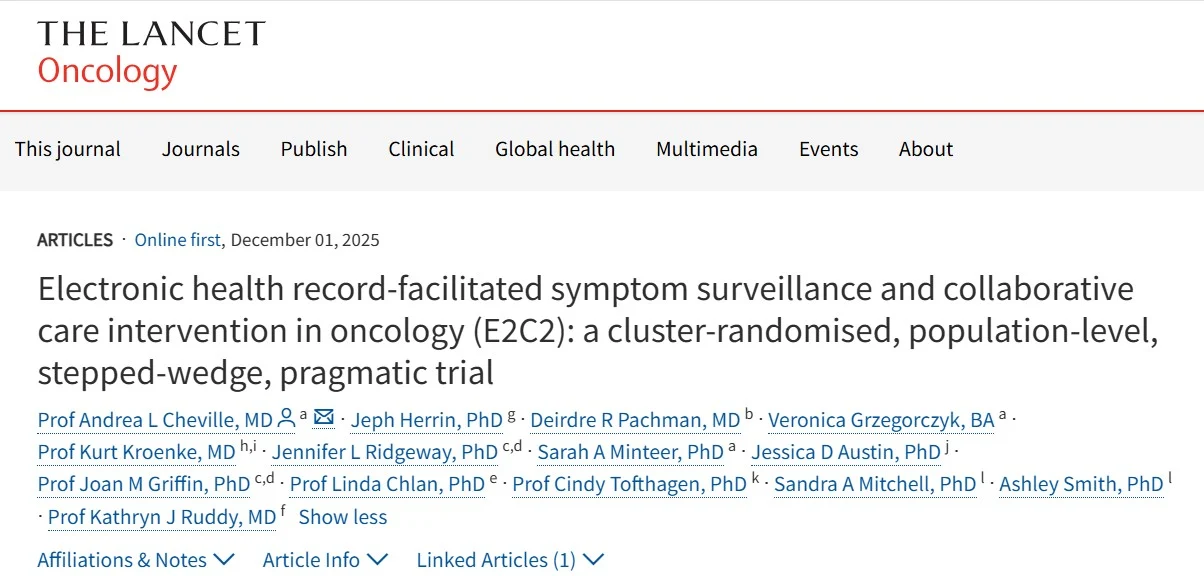
Title: Electronic health record-facilitated symptom surveillance and collaborative care intervention in oncology (E2C2): a cluster-randomised, population-level, stepped-wedge, pragmatic trial
Authors: Andrea L Cheville, Jeph Herrin, Deirdre R Pachman, Veronica Grzegorczyk, Kurt Kroenke, Jennifer L Ridgeway, Sarah A Minteer, Jessica D Austin, Joan M Griffin, Linda Chlan, Cindy Tofthagen, Sandra A Mitchell, Ashley Smith, Kathryn J Ruddy
You can read the full article in The Lancet Oncology.
More posts featuring Hadi Mohamad Abu Rasheed.