Financial Toxicity in Cancer – A Lived Experience Advocacy Hub Series
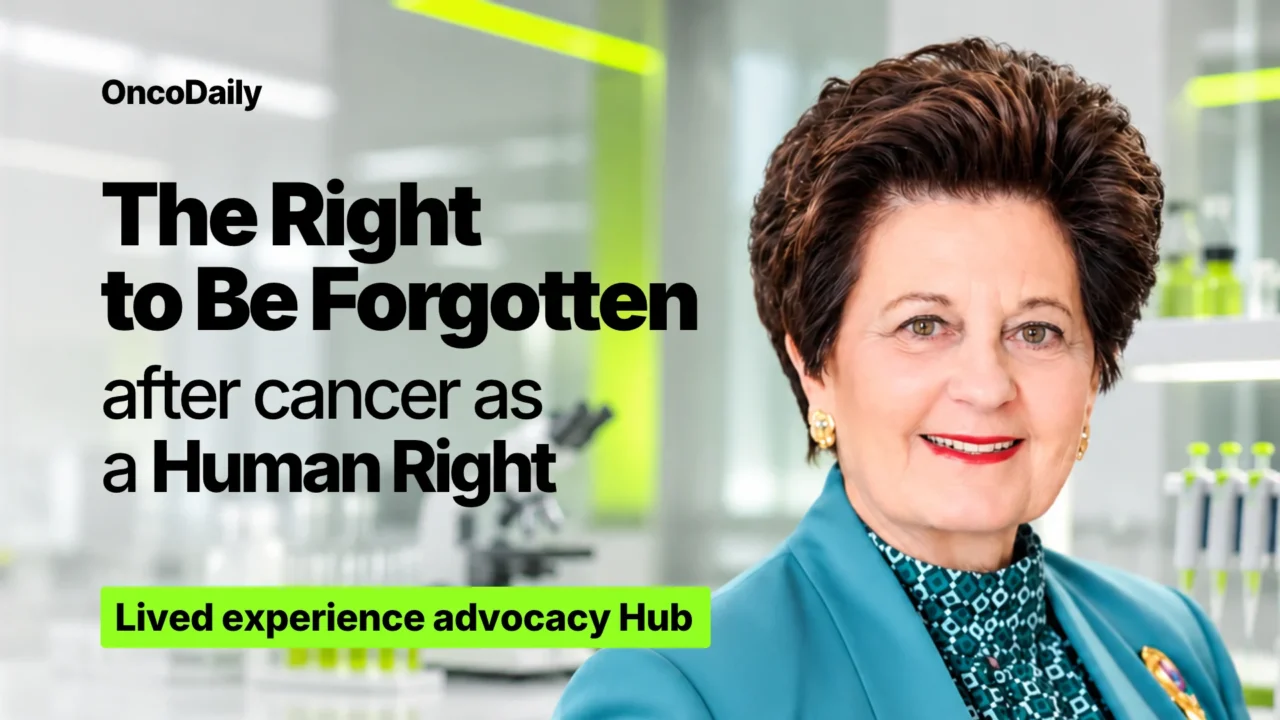
Chapter 1: The Right to Be Forgotten – Financial Discrimination After Cancer
Surviving cancer does not always mean leaving its consequences behind. For many people, a past cancer diagnosis can continue to affect their ability to obtain life insurance, secure a mortgage, or make important financial decisions, even years after treatment has ended.
As part of OncoDaily Lived Experience Advocacy Hub series Financial Toxicity in Cancer, we spoke with Professor Françoise Meunier, a leading advocate for the Right to Be Forgotten, about the progress made in Europe, the importance of recognising financial discrimination as a human-rights issue, and the need to involve cancer survivors in shaping meaningful protections.
The conversation follows the 2026 High-Level Conference in Brussels, “Ending Financial Discrimination Against Cancer Survivors: The Right to Be Forgotten as a Human Right.”
In this interview, Professor Meunier reflects on more than a decade of advocacy and explains why medical progress must also translate into opportunities for people to move forward with their lives after cancer.
1. You have been advocating for the Right to Be Forgotten for many years. What initially motivated your involvement, and how has your perspective evolved?
Throughout my career as an oncologist, and during my years at the European Organisation for Research and Treatment of Cancer (EORTC), my work focused on improving survival and quality of life. However, successful treatment does not necessarily mean that people can resume their lives without obstacles once cure is achieved. A past cancer diagnosis can continue to affect access to insurance, mortgages and other financial services long after treatment has ended.
This gap between medical progress and the realities of life after cancer motivated my involvement in the Right to Be Forgotten, which I have been pursuing since 2014. Cancer survivors should not have to “pay twice”: first through the experience of the disease, and then through financial discrimination.
Over time, my perspective has broadened. This is a question of survivorship and access to financial services, but also of equality, human rights, dignity and the opportunity to build a future. Scientific progress must be reflected in the way our societies treat people who have survived cancer particularly as there are more and more long-term cancer survivors thanks to the progress of medicine in the last three decades. Cancer is no longer a death sentence.
2. The 2026 High-Level Conference presented the Right to Be Forgotten as a human right. Why is this framing important, and how could it influence future policies and legislation?
Framing the Right to Be Forgotten as a human right places the individual at the centre of the discussion. Behind an insurance application is someone who may wish to buy a home, establish a business or make plans for their family. These are fundamental aspects of participation in society.
This framing also changes what we expect from public policy. Protection should be dependable and enforceable, rather than dependent on the goodwill of an individual institution. It should be grounded in equality, non-discrimination and respect for human dignity and throughout all EU Member States. Rehabilitation by the society should not depend upon your citizenship and it is a question of equality and non-discrimination.
Medical evidence remains essential. My argument is that a past cancer diagnosis should not create a lifelong financial penalty, and that rules must reflect advances in treatment and long-term outcomes.
My objective is clear: legally binding protection across financial services, with a general waiting period of no more than five years after the end of treatment without relapse. Presenting this as a human-rights issue strengthens the case for governments to act and for survivors to have effective remedies when their rights are breached.
3. What were the most important messages or conclusions from the Brussels conference? Were there any discussions or perspectives that you found particularly significant?
The central message I wanted to convey at the conference was that surviving cancer must also mean having the opportunity to move forward without unjustified financial barriers.
The event brought together survivors, clinicians, policymakers, researchers and legal and human-rights experts. Bringing these perspectives together is essential: medical evidence helps us understand long-term outcomes, legal expertise helps translate principles into enforceable protections, and survivors show us what those protections need to achieve in practice.
For me, three priorities follow from this discussion: extending protection to countries where it is still absent; ensuring that existing laws work in practice; and addressing gaps in the financial services covered.
The human-rights dimension also deserves sustained attention. A person’s opportunity to rebuild their life should not depend on where they live.
4. In 2022, the European Parliament called for all EU Member States to guarantee the Right to Be Forgotten by 2025. How do you assess the progress made so far, and what are the main challenges that remain?
There has been meaningful progress, but the ambition of protection throughout the European Union has not yet been achieved. This is the reason I initiated procedures to reach individual Members States bases on the French and Belgian experience where the law has been established without threatening the financial sustainability of insurers in these countries. More countries have introduced binding measures, and the issue is now firmly on the European policy agenda. Nevertheless, survivors continue to face different rules depending on their country of residence.
We must also look beyond whether a country has adopted legislation. Waiting periods, eligibility conditions, financial products covered and enforcement arrangements can differ and the existence of a law does not automatically mean that all survivors receive the same effective protection. However, these laws are based on the same basic principles of the RTBF which is different than the right to erase data such as within the framework of GDPR.
The revised EU Consumer Credit Directive represents an important step towards European protection. Its rules apply from 20 November 2026, but its scope does not resolve the wider problem, particularly access to mortgages and associated insurance.
The next priority must therefore be greater consistency and broader coverage. My position remains that survivors should benefit from binding protection across financial services five years after the end of treatment without relapse. We should assess progress by the barriers removed from people’s lives, as well as by the legislation adopted.
5. Several countries have introduced legal protections, but legislation does not always guarantee effective implementation. What is needed to ensure that banks and insurance companies apply these protections consistently?
A right must be understandable, usable and enforceable.
First, legislation and accompanying guidance must clearly explain who is protected, when protection begins and which products are covered. Ambiguity around the end of treatment, for example, can create unnecessary obstacles.
Second, banks, insurers and intermediaries must translate these rules into their everyday procedures. That means updating application forms, medical questionnaires, underwriting practices and digital systems, as well as training staff, and inform the applicants about these possibilities.
Third, survivors need accessible information and a straightforward route to challenge an incorrect decision. They should not have to become legal experts or undertake lengthy proceedings to obtain protection. The possibility of appeal should exist in all EU Member States and regular revision of the process should be available.
Finally, regulators must monitor compliance and have effective powers to address breaches. Evaluation should examine refusals, additional premiums, exclusions, complaints and whether eligible survivors can actually obtain the services they need.
Medical reference frameworks should be reviewed regularly so that protections keep pace with scientific progress.
6. As countries in Latin America and other regions consider similar legislation, what lessons from the European experience would you highlight? How can international collaboration help accelerate progress?
One important lesson is to design implementation alongside legislation. A legal principle needs clear eligibility rules, adequate coverage, supervision and accessible remedies from the outset. Ending discrimination is a universal right in the concept but practical modalities may differ however, it should be based on similar general principles.
A second lesson is to involve survivors, clinicians, legal experts, regulators and financial institutions early. Their contributions serve different purposes, but all are needed to develop workable protection. Dialogue must lead to increased awareness of the problem which is still too often overlooked and address clear responsibilities and effective rights.
Europe also illustrates the limitations of fragmented approaches. When countries adopt different waiting periods and cover different financial services, substantial inequalities remain. Other regions can learn from both our advances and the gaps we have yet to close. However, we should accept some national specificities as the cost of housing is very different between countries and various upper ceilings may indeed be justified.
International collaboration can help by sharing legislative models, medical evidence, implementation experience and methods for evaluating outcomes. Countries should adapt these lessons to their own legal systems and financial markets.
There is no need to reinvent the wheel.
7. How can we ensure that cancer survivors are meaningfully involved in developing, implementing, and evaluating Right to Be Forgotten protections?
Survivors should be involved from the beginning and throughout the life of a policy. Their role should extend beyond sharing a testimony at an event or commenting on an almost completed proposal.
During policy development, survivors and their organisations can identify barriers that might otherwise be overlooked: confusing medical questions, unaffordable premiums, unexplained refusals or the emotional burden of repeatedly disclosing a past diagnosis.
During implementation, they can help develop clear information and test whether application and complaints procedures are accessible. During evaluation, they can show whether the law has changed everyday experience.
This requires regular participation in advisory and monitoring bodies, with appropriate support and compensation for their time. Participation should include people with different cancer experiences, ages and socioeconomic backgrounds, including those who are less connected to established advocacy organisations.
Institutions should also explain how survivors’ contributions influenced decisions. The essential question is whether someone can move forward with their life without being unfairly held back by a past cancer diagnosis.
Looking Ahead: Bringing Survivors’ Voices Into the Conversation
Professor Meunier’s reflections highlight an important challenge: progress in cancer care must be accompanied by progress in how societies support people after treatment.
Legal recognition is an important step, but its impact depends on whether survivors can access financial services without unfair barriers.
In the coming articles of Financial Toxicity in Cancer, the OncoDaily Lived Experience Advocacy Hub will bring together perspectives from cancer survivors across different countries, exploring how financial discrimination affects their lives and what changes they believe are needed.
Surviving cancer should not mean spending the rest of your life paying for it.
You can also read:
- Lived Experience Advocacy Hub Webinar Opportunity: AI in Oncology
- Financial Toxicity in Cancer Care: A Global Call for Submissions