






Gareth Morgan, Director in Multiple Myeloma Research at Perlmutter Cancer Center and Professor of Medicine at NYU, shared Francesco Maura’s, Associate Director of Myeloma Research Institute at the University of Miami, post on X, adding:
“Great to have got this very informative paper out at last which sets the scene in many ways for how to explore differences in MM risk by ancestry.”
Quoting Francesco Maura’s post:
“Our new study from the Polyethnic-1000 initiative is out! We investigated how genetic ancestry relates to multiple myeloma biology and outcomes. Several interesting and potentially provocative findings. Great collaboration with Mayo Clinic, Memorial Sloan Kettering Cancer Center, NYU Langone Health, Sylvester Comprehensive Cancer Center.
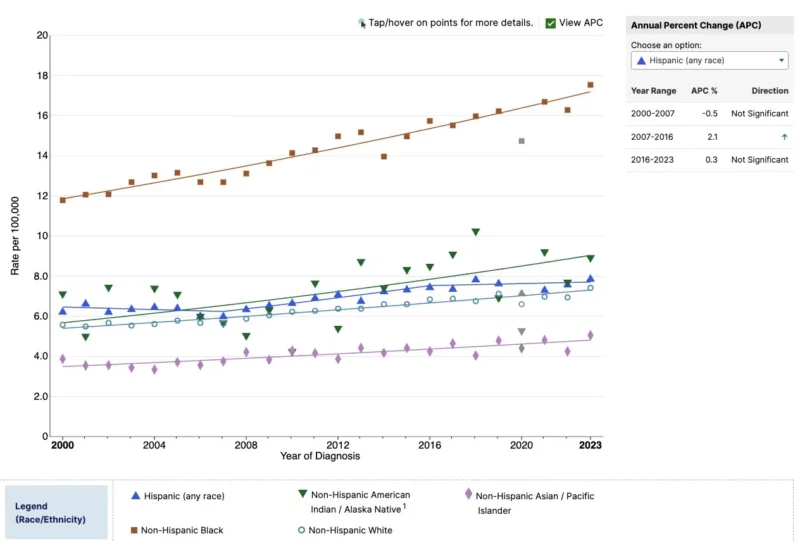
MM is reported to occur 2–3x more often in individuals who self-identify as non-Hispanic Black compared with non-Hispanic White individuals. However, the biological basis of this disparity remains unclear.
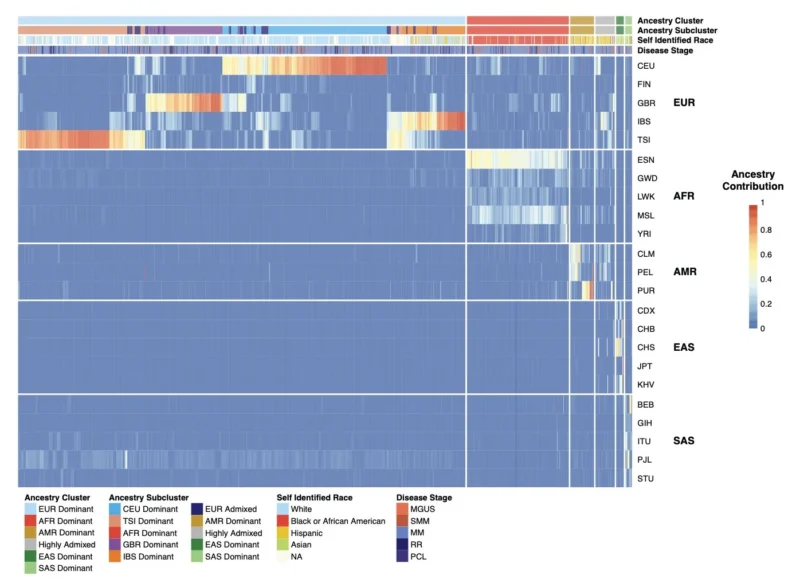
A key challenge: self-identified race/ethnicity is a social and cultural variable and does not always align with genetic ancestry. We therefore used WGS to define genetic similarity groups and study germline and somatic MM features.
We analyzed 1,245 patients with MM or precursor conditions, combining P-1000 with other WGS datasets processed through the same pipeline (more info on P1000).
Overall, ~5% of individuals who self-identified as Black/African American and >50% of those who self-identified as Hispanic were assigned to different groups based on WGS-inferred genetic ancestry.
Using our genomic classification, we found no consistent differences in major MM drivers between AFR and EUR genetic similarity groups, including t(11;14) and TP53 alterations.
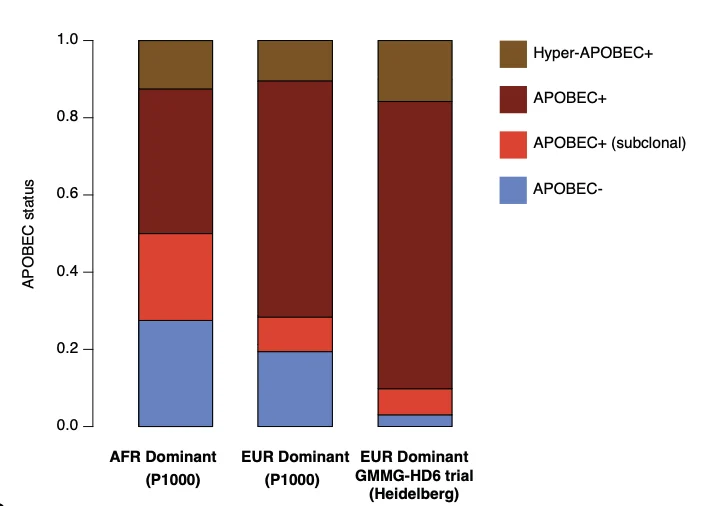
The only consistent somatic difference involved mutational processes: APOBEC and germinal center/AID signatures were more detectable/intense in EUR. In AFR, APOBEC appeared more often subclonal/later, suggesting different evolutionary trajectories.
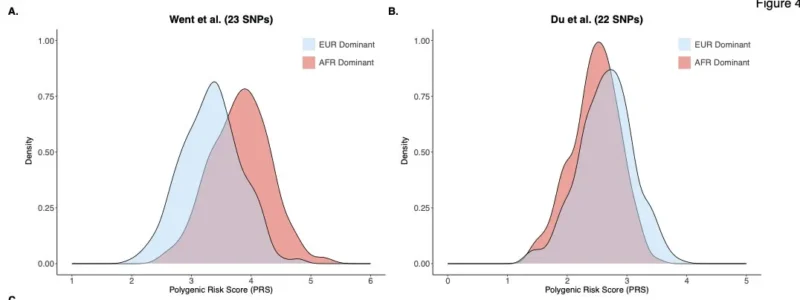
Several germline SNPs linked to MM risk were enriched in the AFR group. But many were also enriched in AFR healthy controls, suggesting ancestry-related enrichment rather than MM-specific risk. Key lesson: diverse control populations are essential!!
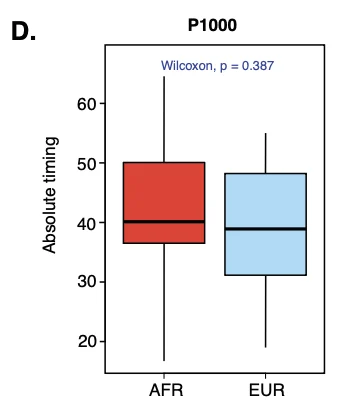
We also revisited the idea that individuals with African ancestry develop MM at a younger age. Using molecular timing analyses, we found no major difference in the timing of early initiating events between AFR and EUR groups.
SEER data show an approximately 5-year younger median age at MM diagnosis among self-identified Black patients. However, this may be confounded by population age structure, life expectancy, comorbidity burden, and other demographic factors (i.e. censoring bias).
When accounting for life expectancy, Linda B. Baughn showed that the age gap decreases substantially. This argues against a major difference in the biological timing of MM onset between AFR and EUR genetic similarity groups.
Nikhil C. Munshi and colleagues showed that, when access to care is considered, outcomes do not differ significantly for Black patients with MM. We confirm this also in patients treated with VRd + ASCT.
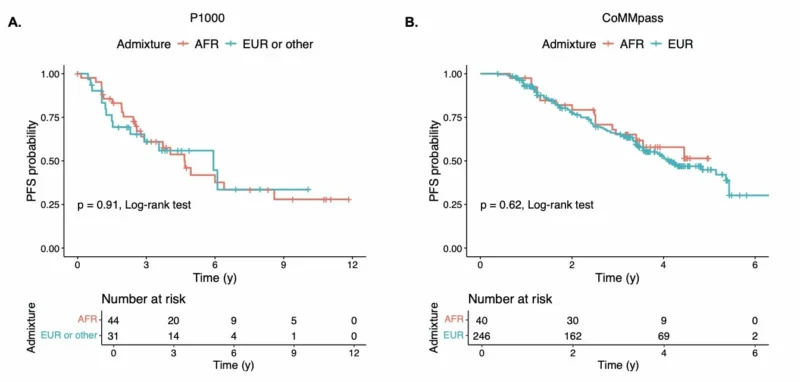
Overall, these data suggest that with adequate access to effective, high-quality care, patients in the AFR genetic similarity group can achieve outcomes at least equivalent to those in the EUR group.
In conclusion, the lack of major somatic or germline differences between AFR and EUR suggests that genetic ancestry may play a smaller role in MM biology than previously assumed.
This contrasts with other cancers where ancestry-associated differences in drivers have been reported, such as EGFR in lung cancer or PTEN in prostate cancer.
MM epidemiological differences are unlikely to be explained by germline or somatic genomics alone. They may reflect socio-economic/environmental factors and possibly immune surveillance, as proposed by Madhav Dhodapkar. More data and studies are needed.
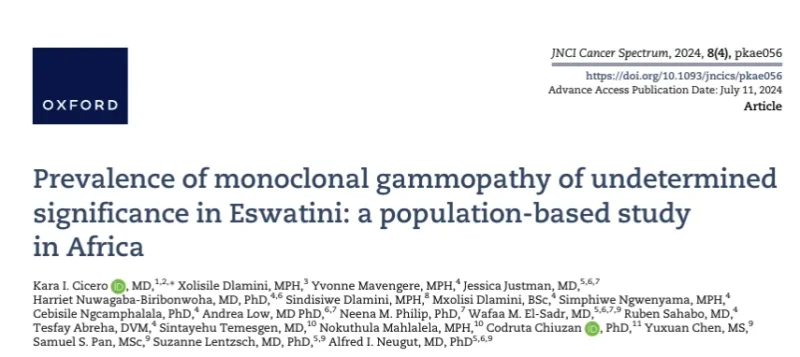
Our study also underscores the importance of accounting for bias in ancestry-based analyses. MGUS risk has historically been reported as higher in African American and African populations, but recent work from Suzanne Lentzsch challenges this view.
This has been an incredible multi-center effort. Huge thanks to all our patients, to NY Genome Center for their support, to Harold Varmus for his invaluable guidance, and to Saad Z. Usmani, Gareth Morgan, and Niels Weinhold for their leadership in the study design and supervision.
Finally, special recognition to Marios Papadimitriou, Kylee Maclachlan, Patrick Blaney and Linda B. Baughn for truly leading this effort. It has been a pleasure and a privilege to work with you all!”
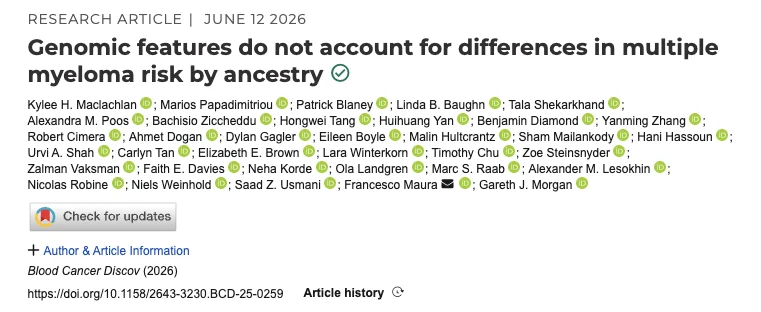
Title: Genomic features do not account for differences in multiple myeloma risk by ancestry Available to Purchase
Authors: Kylee H. Maclachlan, Marios Papadimitriou, Patrick Blaney, Linda B. Baughn, Tala Shekarkhand, Alexandra M. Poos, Bachisio Ziccheddu, Hongwei Tang, Huihuang Yan, Benjamin Diamond, Yanming Zhang, Robert Cimera, Ahmet Dogan, Dylan Gagler, Eileen Boyle, Malin Hultcrantz, Sham Mailankody, Hani Hassoun, Urvi A. Shah, Carlyn Tan, Elizabeth E. Brown, Lara Winterkorn, Timothy Chu, Zoe Steinsnyder, Zalman Vaksman, Faith E. Davies, Neha Korde, Ola Landgren, Marc S. Raab, Alexander M. Lesokhin, Nicolas Robine, Niels Weinhold, Saad Z. Usmani, Francesco Maura, Gareth J. Morgan
Other articles featuring Gareth Morgan and Francesco Maura on OncoDaily.