






E. Shyam P. Reddy, Professor and Director of the Cancer Biology Program, Department of Obstetrics and Gynecology at Morehouse School of Medicine, shared a post on LinkedIn about a paper by Linjie Luo et al. published in Nature Communications:
“A new preclinical study from researchers at The University of Texas MD Anderson Cancer Center, published in Nature Communications, identifies a powerful strategy to overcome drug resistance in breast cancer by simultaneously targeting two key cell-cycle regulators, CDK2 and CDK4/6.
CDK4/6 inhibitors, combined with endocrine therapy, are the standard first-line treatment for hormone receptor (HR)-positive, HER2-negative (HR+/HER2-) metastatic breast cancer, but resistance inevitably develops over time.
In triple-negative breast cancer (TNBC) – an aggressive subtype with limited targeted treatment options – the benefit of CDK4/6 inhibitors remains unclear.
Seeking to address both of these challenges, researchers led by postdoctoral fellow Linjie Luo, M.D., Ph.D., and Khandan Keyomarsi, Ph.D., professor of Experimental Radiation Oncology, found that combining the selective CDK2 inhibitor BLU-222 with CDK4/6 inhibitors produces strong, durable anti-tumor effects.
These effects were consistent across every preclinical model of breast cancer tested, including treatment-resistant and aggressive TNBC. Notably, this synergy was observed without exception, underscoring the broad translational potential of the approach.
‘This is an important and highly consistent finding. Across all resistant HR-positive models and all TNBC models we tested, the combination of BLU-222 with CDK4/6 inhibitors consistently outperformed standard-of-care therapies, producing durable tumor regression and prolonged survival.’ Keyomarsi said.
Why did the researchers target CDK2?
Cancer cells divide rapidly, relying on proteins called cyclin-dependent kinases (CDKs) to do so. CDK proteins control cell division and DNA replication, and many breast cancers become especially dependent on CDK2, CDK4, and CDK6 to survive.
While CDK4/6 inhibitors block part of this process, cancer cells often adapt by shifting their dependence to CDK2, allowing them to survive despite treatment. This study shows that targeting CDK2 effectively shuts down this escape route.
Although CDK2 has long been recognized as an important cancer driver, earlier CDK2 inhibitors were limited by toxicity. Newer and more selective drugs, such as BLU-222, have now made CDK2 inhibition a realistic and promising therapeutic strategy.”
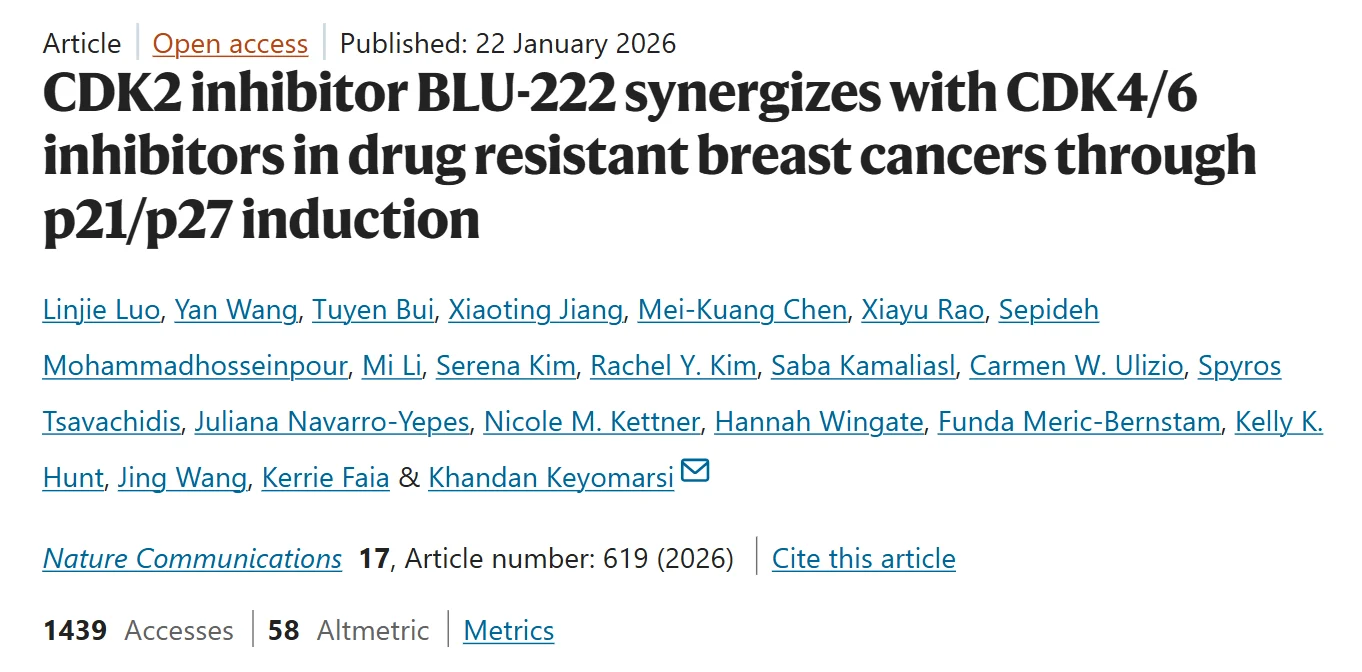
Title: CDK2 inhibitor BLU-222 synergizes with CDK4/6 inhibitors in drug resistant breast cancers through p21/p27 induction
Authors: Linjie Luo, Yan Wang, Tuyen Bui, Xiaoting Jiang, Mei-Kuang Chen, Xiayu Rao, Sepideh Mohammadhosseinpour, Mi Li, Serena Kim, Rachel Y. Kim, Saba Kamaliasl, Carmen W. Ulizio, Spyros Tsavachidis, Juliana Navarro-Yepes, Nicole M. Kettner, Hannah Wingate, Funda Meric-Bernstam, Kelly K. Hunt, Jing Wang, Kerrie Faia, and Khandan Keyomarsi
You can read the Full Article in Nature Communications.
More posts featuring E. Shyam P. Reddy.