National Cancer Institute (NCI) shared on LinkedIn:
“There is considerable and appropriate excitement about how AI will influence cancer research and care.
While I cannot pretend to predict the future of a technology that is advancing almost weekly, I can see where AI is making a difference and where it is likely headed.
In pathology and radiology, for example, AI is already identifying abnormalities with accuracy approaching or exceeding that of human experts. It is also capable of supporting diagnostic decision-making, robotic surgery, and clinical care. The FDA has approved more than 1,500 AI-enabled medical devices, many focused on imaging. In no way will these advances replace clinicians’ interactions with patients; however, its greatest near-term value will be augmenting human expertise, helping caregivers deliver faster, more accurate, and more efficient care.
AI also promises to transform clinical trials. It can help identify eligible participants, generate consent materials at appropriate reading levels, automate data collection, and streamline trial management. These applications have the potential to accelerate research while reducing administrative burden.
Basic research, too, is benefiting from AI tools. A now famous example is AlphaFold, which dramatically accelerated protein structure prediction. Computational approaches have long aided drug discovery by identifying promising compounds and repurposing existing therapies. More recently, AI has begun serving almost like a scientific collaborator, reviewing literature, analyzing data, and prioritizing experiments.
However, like clinical AI, these tools are likely to be most valuable as resources, rather than replacements for scientists.
As we look ahead, I think we should recognize that we are at the cusp of a major technological shift comparable to the adoption of rail travel or the telephone. To realize its full potential, benchmarking, standardization, and interoperability will be needed. It is essential that the cancer research community work together to maximize the impact of AI and minimize duplication. At a minimum, I would like to see that the 74 NCI-Designated Cancer Centers exchange data seamlessly through the help of AI.
Finally, a note of caution.
AI has inspired ambitious concepts such as ‘digital cells‘ and ‘digital twins‘ that aim to predict biological responses over time. Yet many complex systems remain fundamentally difficult to predict. The classic three-body problem demonstrates that even systems governed by simple physical laws can become unpredictable because tiny differences in starting conditions lead to dramatically different outcomes. Biology is vastly more complex.
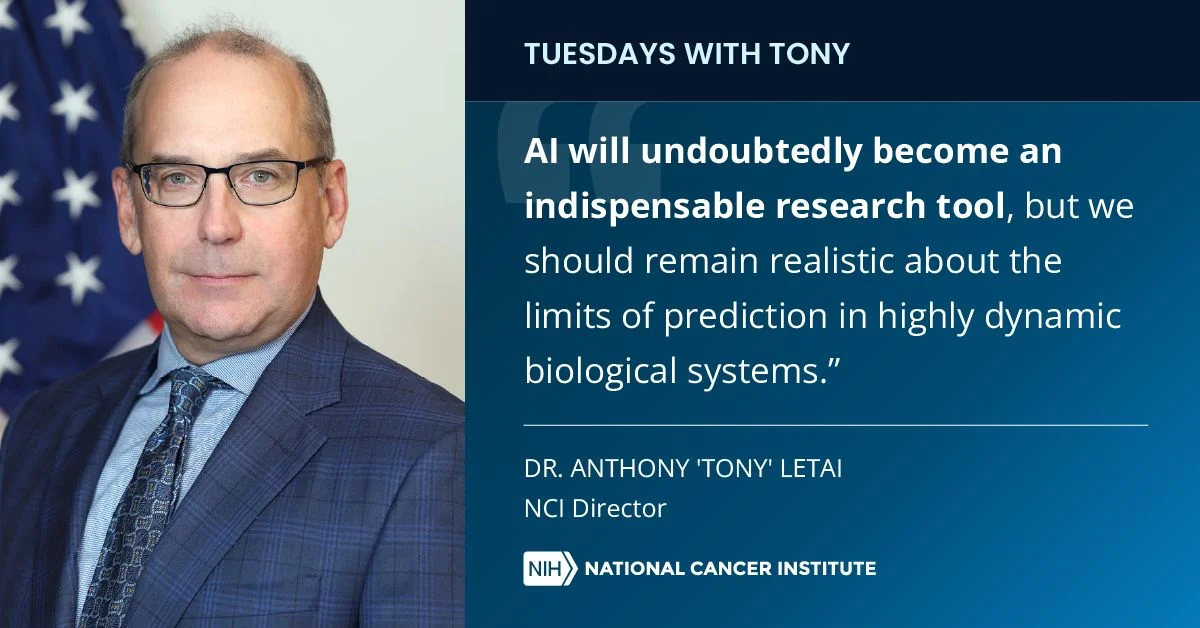
Ultimately, users want to know: ‘How will this make my work easier?‘ AI will undoubtedly become an indispensable research tool, but we should remain realistic about the limits of prediction in highly dynamic biological systems. – Tony.”
You can also read:
Artificial Intelligence in Cancer Immunotherapy