Cancer immunotherapy has redefined the treatment of many solid and hematologic malignancies, offering durable responses that were once considered impossible. Yet one of its greatest challenges remains unchanged: not every patient benefits from treatment. While some patients experience long-term disease control, others develop primary or acquired resistance, and a subset faces significant immune-related toxicities. Predicting these outcomes before treatment begins remains one of the greatest unmet needs in immuno-oncology.
Artificial intelligence (AI) is rapidly emerging as a powerful tool to address this challenge. By integrating clinical, molecular, imaging, and pathological data, AI can uncover biological patterns that are impossible to identify through conventional analyses alone. Instead of depending on individual biomarkers such as PD-L1, tumor mutational burden (TMB), or microsatellite instability (MSI), AI provides a more comprehensive understanding of tumor biology and the dynamic interactions between cancer and the immune system.
Recent reviews, including “Artificial Intelligence in Immunotherapy: Revolutionizing Diagnostic and Therapeutic Applications in Cancer and Autoimmune Diseases” by Jamal Alshorman and colleagues, “Artificial Intelligence for Optimization of Immunotherapy: Current Applications and Transformative Potential” by Ali Tarhini, Palak Dave, Shari Pilon-Thomas, and Issam El Naqa, and “Artificial Intelligence in Cancer Immunotherapy: Current Trends in Predicting Response and Personalizing Treatment” by Eloghosa Aisosa Nosa-Ihaza and colleagues, demonstrate how AI is moving beyond theoretical promise toward real clinical applications. These advances are reshaping biomarker discovery, response prediction, cellular immunotherapy, cancer vaccine development, and clinical decision-making.
In this editorial, we explore how artificial intelligence is transforming cancer immunotherapy—from improving response prediction and biomarker discovery to advancing CAR-T cell therapies, personalized cancer vaccines, and precision oncology. We also discuss the current barriers to clinical implementation and examine how emerging AI technologies may shape the next generation of immuno-oncology.
Why Does Immunotherapy Need Artificial Intelligence?
Despite remarkable advances in immunotherapy, accurately predicting treatment response remains one of the field’s greatest challenges. Although PD-L1 expression, tumor mutational burden (TMB), and microsatellite instability (MSI) are widely used in clinical practice, each has significant limitations. Patients with high PD-L1 expression may fail to respond, whereas others with low or even negative expression can experience durable clinical benefit. Likewise, TMB and MSI capture only part of the complex biology that determines therapeutic response.
According to Eloghosa Aisosa Nosa-Ihaza and colleagues in Artificial Intelligence in Cancer Immunotherapy: Current Trends in Predicting Response and Personalizing Treatment, tumor heterogeneity, dynamic changes within the tumor microenvironment, and inconsistent biomarker assessment continue to limit accurate response prediction. These limitations highlight the need for more comprehensive approaches capable of integrating multiple biological variables simultaneously.
Beyond PD-L1: AI Is Redefining Biomarker Discovery
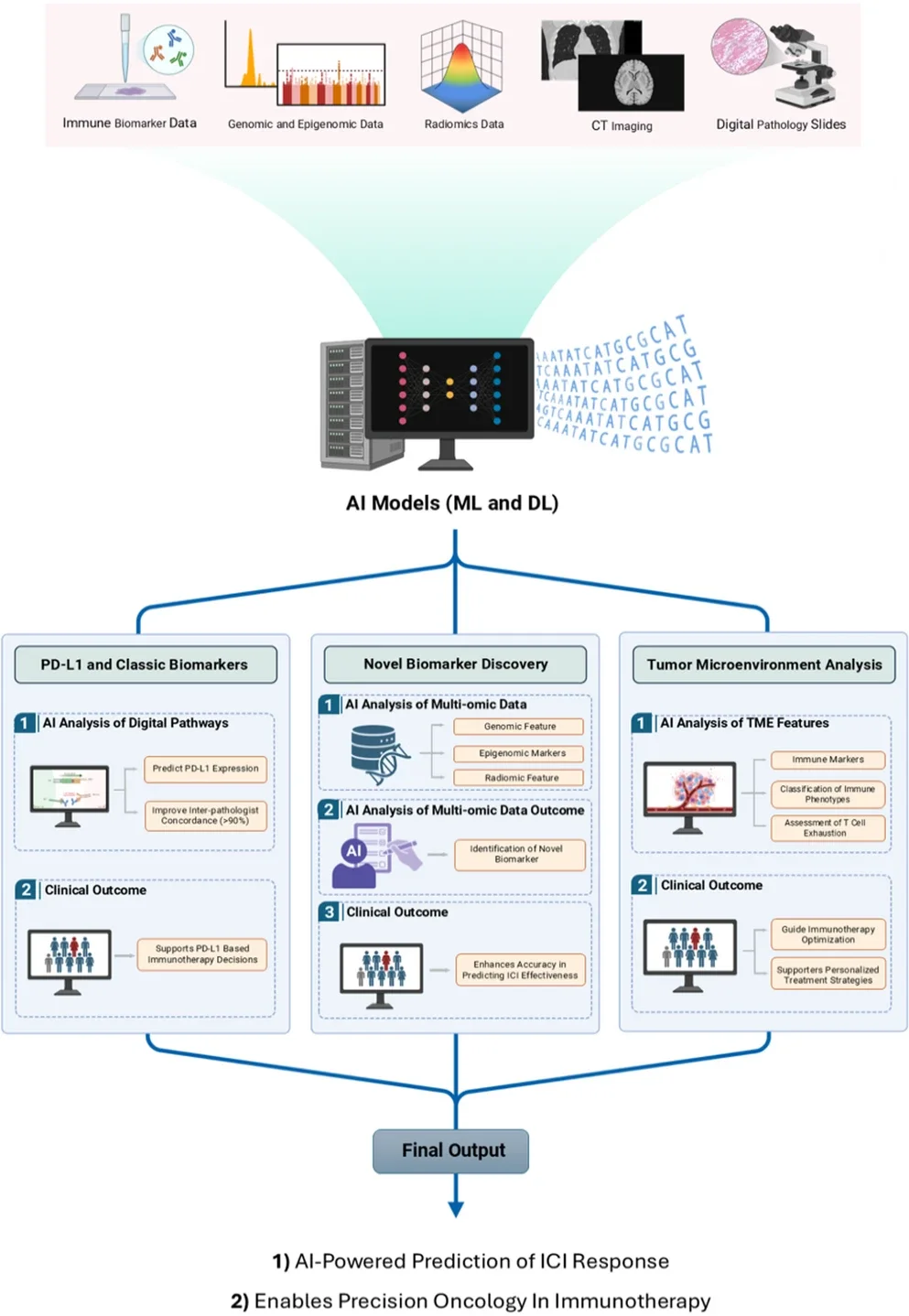
The search for reliable immunotherapy biomarkers is evolving from single-marker assessment toward multidimensional analysis. In “Artificial Intelligence in Immunotherapy: Revolutionizing Diagnostic and Therapeutic Applications in Cancer and Autoimmune Diseases,” Jamal Alshorman and colleagues describe how AI combines genomic, transcriptomic, proteomic, radiomic, digital pathology, and clinical data to generate predictive models that better reflect both tumor biology and the immune landscape.
One of the most promising applications is digital pathology. Deep learning algorithms can analyze whole-slide histopathology images to quantify immune-cell infiltration, characterize the tumor microenvironment, and evaluate PD-L1 expression with greater consistency than conventional manual assessment. Similarly, AI-driven radiomics extracts hundreds of quantitative features from CT, MRI, and PET imaging, identifying imaging signatures associated with immune infiltration, treatment response, and survival.
By integrating these diverse data sources into a single analytical framework, AI moves beyond the limitations of individual biomarkers. This systems-level approach has the potential to identify novel predictive signatures and support more precise therapeutic decision-making.
Can AI Predict Who Will Benefit From Immunotherapy?
Perhaps the most immediate clinical application of AI is predicting which patients are most likely to benefit from immunotherapy before treatment begins. As response rates remain highly variable across cancer types, machine learning models are increasingly being developed to improve therapeutic decision-making.
In “Artificial Intelligence for Optimization of Immunotherapy: Current Applications and Transformative Potential,” Ali Tarhini, Palak Dave, Shari Pilon-Thomas, and Issam El Naqa describe several AI models that are redefining response prediction. One example is LORIS (Logistic Regression-Based Immunotherapy Response Score), which integrates clinical, pathological, and genomic variables into a single predictive model, outperforming conventional biomarkers such as PD-L1 or TMB alone.
Another promising platform is SCORPIO (Standard Clinical and Laboratory Features for Prognostication of Immunotherapy Outcomes). Unlike many genomic-based approaches, SCORPIO relies on routine laboratory tests and readily available clinical information, illustrating how AI can enhance everyday oncology practice without requiring additional specialized testing.
The review also highlights foundation models such as COMPASS and MUSK, which integrate transcriptomics, digital pathology, and multimodal clinical data to predict immunotherapy outcomes. These next-generation systems represent an important step toward clinically applicable decision-support tools capable of guiding precision immunotherapy across multiple cancer types.
If prospectively validated, these models could help clinicians identify patients most likely to benefit from immunotherapy while reducing unnecessary treatment exposure for those unlikely to respond.
COMPASS: Can AI Predict Immunotherapy Response Across Multiple Cancers?
AI Beyond Prediction: Accelerating the Next Generation of Immunotherapies
Beyond predicting treatment response, AI is transforming how new immunotherapies are discovered, designed, and optimized. From cellular therapies to personalized cancer vaccines, computational models are accelerating nearly every stage of immunotherapy development.
According to Jamal Alshorman and colleagues, AI has become an essential tool in CAR-T cell therapy, assisting researchers in identifying optimal tumor-specific antigens, optimizing CAR construct design, improving manufacturing processes, and predicting treatment-related toxicities. Digital simulations and predictive algorithms are also helping standardize cell production while improving efficiency and product quality.
Another rapidly advancing application is neoantigen discovery. AI enables the integration of genomic, transcriptomic, and immunopeptidomic datasets to prioritize the most immunogenic neoantigens, substantially accelerating the development of personalized cancer vaccines. These computational approaches improve peptide-MHC prediction and help identify neoantigens capable of generating robust T-cell responses.
These advances are already influencing clinical research. As highlighted by Alshorman et al., AI-supported neoantigen prediction has contributed to individualized mRNA cancer vaccine programs developed by BioNTech and Moderna. Together, these innovations demonstrate that AI is no longer simply supporting immunotherapy research—it is becoming an active partner in designing the next generation of immune-based cancer therapies.
From Innovation to Clinical Practice: What Are the Remaining Challenges?
Despite its remarkable potential, AI has not yet become part of routine immunotherapy practice. Most predictive models remain investigational, and important scientific, technical, and regulatory challenges still need to be addressed.
According to Eloghosa Aisosa Nosa-Ihaza and colleagues, one of the greatest barriers is the lack of prospective multicenter validation. Many AI algorithms perform exceptionally well during retrospective development but demonstrate reduced accuracy when applied across independent institutions, where differences in imaging protocols, sequencing technologies, pathology workflows, and clinical data collection affect reproducibility.
Another important challenge is interpretability. Many deep learning models function as “black boxes,” making it difficult for clinicians to understand how predictions are generated. Building confidence in AI-assisted clinical decision-making will require explainable algorithms, transparent reporting standards, and rigorous regulatory oversight.
Similarly, Ali Tarhini and colleagues emphasize that successful clinical implementation depends on high-quality datasets, standardized data collection, ethical governance, and continuous human oversight. AI should not replace oncologists; instead, it should function as a clinical decision-support tool that complements physician expertise while supporting more informed and personalized treatment decisions.
Overcoming these challenges will determine whether AI remains a promising research technology or becomes an integral component of precision immuno-oncology. I think the next decade will not be defined simply by more powerful algorithms, but by the successful integration of AI into everyday clinical practice, where it can meaningfully improve outcomes for patients receiving cancer immunotherapy.
Expert Perspective: The Role of Artificial Intelligence in the Future of Immunotherapy
To complement the current evidence, OncoDaily IO invited Preeti Singh, Director of Competitive and Scientific Intelligence at PSTRIDE Solutions, to share her perspective on how artificial intelligence is transforming cancer immunotherapy and shaping the future of precision oncology.
Artificial intelligence is transforming many aspects of oncology. From your perspective, where is AI currently having the greatest impact in immuno-oncology drug development?
” AI is already reshaping many steps of cancer immunotherapy R&D. In drug discovery, machine learning (ML) and deep learning (DL) speed up target identification and molecule design. For example, biotechs like Insilico Medicine, Exscientia, and BenevolentAI use AI to mine literature and omics data for new immune-oncology targets. Insilico’s Pharma.
AI platform, adopted by GSK, has uncovered novel immune-pathway targets. Generative models and neural networks are also streamlining small-molecule and biologic design. AI can virtually screen millions of compounds and predict drug-target interactions much faster than lab tests. In short, AI excels at finding patterns in big biomedical data and proposing hypotheses that humans can test”
How has AI changed the way pharmaceutical companies conduct competitive intelligence and monitor the rapidly evolving immuno-oncology landscape?
“Competitive intelligence (CI) has become more data-driven and proactive. Pharma companies now use AI to monitor the immuno-oncology landscape continuously. NLP tools automatically scan scientific papers, patents, and trial databases to spot early signals of new science or pipeline shifts. AI models can detect patterns, for instance, noting if several groups publish on a novel mechanism, long before a competitor formally announces a program.
Advanced analytics even forecast outcomes: ML can predict a drug’s chance of trial success or likely approval timing by learning from historical trial and regulatory data. Integrated AI platforms create live “maps” of the field, flagging key updates (like trial results or FDA moves) in real time. Crucially, human experts review AI outputs to ensure they make sense in context. This human-AI collaboration means CI teams can cover far more data (papers, conference abstracts, social media) and spot strategic trends much earlier than before.”
Can AI help identify promising immunotherapy targets or predict which therapeutic approaches are most likely to succeed? Where do you see its greatest potential?
“AI is transforming target discovery and therapy design. Modern AI can sift through genomic, proteomic, and clinical datasets to nominate promising immunotherapy targets or drug concepts. For example, a Penn Medicine team built a human-in-the-loop AI pipeline that scanned thousands of single-cell tumor profiles with large language models to rank CAR-T targets. This system highlighted GPNMB as a top antigen, and a CAR-T against GPNMB showed strong anti-tumor effects in multiple mouse models. Similarly, AI was used to optimize bispecific CAR T cells: researchers screened many theoretical dual-target CAR designs and picked those with best predicted expression/function.
In antibody-drug conjugates (ADCs), AI models can integrate omics and protein data to pick tumor-specific antigens and design optimal antibody-payload-linker combinations. Generative AI also helps design molecule libraries (e.g. for cytokine mimetics or small-molecule checkpoint inhibitors) with desired properties. In short, AI’s greatest potential is in revealing “hidden” targets and therapy ideas that humans might miss, and rapidly generating optimized candidates for each immunotherapy modality.”
Clinical trials in immuno-oncology are becoming increasingly complex. How is AI influencing trial design, patient selection, and the identification of meaningful endpoints?
“AI is changing clinical trial design and patient matching. Trials in immuno-oncology often struggle with complex biomarker criteria and slow enrollment. AI offers tools to improve this. For trial design, ML can model historical trial data and real-world evidence to estimate success chances and suggest optimal endpoints or dosing strategies. Patient selection is a big area: AI-powered trial matching tools automatically scan a patient’s medical records (including genomics) against trial criteria, finding eligible candidates far faster than manual review.
Some tools use NLP to parse unstructured data and match complex profiles (e.g. PD-L1 status, tumor mutations) to trials. This can increase enrollment: one study found AI screening bumped up trial matching by ~72% in a cancer center. AI also refines inclusion criteria. By simulating virtual cohorts (digital twin models), AI can predict which biomarker combinations or patient features lead to higher response rates, guiding more precise enrollment criteria and thus more efficient trials. Finally, AI can help define meaningful endpoints: for example, analyzing past trial data to learn which early signals (like on-treatment biomarkers or imaging changes) best predict long-term outcomes, allowing trials to be designed with smarter early stopping rules.”
Biomarker discovery remains one of the biggest challenges in immuno-oncology. How do you see AI contributing to the development of more precise predictive biomarkers?
“AI is accelerating biomarker discovery and precision medicine. Finding the right biomarkers for immunotherapy response or toxicity is a key challenge. Here AI is proving invaluable. Modern ML algorithms can integrate “multi-omics” data from tumors and blood to generate composite biomarker signatures. For example, an AI model trained on broad blood proteomic data can produce a simple risk score that predicts how likely a patient will benefit from a checkpoint inhibitor.
In one study of NSCLC patients, such a plasma-based signature re-stratified about one-third of patients into a different treatment path and was linked to better survival outcomes. AI also drives next-gen composite biomarkers that combine tumor factors (like PD-L1) with host factors (immune proteins, genetics) to sharpen predictions. AI models are even being trained to predict the risk of severe immune-related side effects before starting therapy, by recognizing complex patterns in pre-treatment data. Overall, AI turns raw biomarker data into actionable scores, adding a “decision layer” on top of standard tests. As one expert put it, this makes cancer care “data-rich profile” and moves precision medicine toward reality.”
With the growing number of immunotherapy modalities including bispecific antibodies, cell therapies, antibody-drug conjugates, and cancer vaccines, how can AI help prioritize innovation and guide strategic decision-making?
“Guiding innovation across immunotherapy modalities. With many approaches (bispecific antibodies, CAR-T/NK cells, ADCs, vaccines, etc.), AI helps prioritize and de-risk projects. AI can model how novel bispecific designs will bind and function, as shown in the CAR-T example above, guiding engineers to the best candidates. In ADCs, AI integrates expression data and protein structure to predict the safest tumor antigen targets and optimal drug-linkers.
For cancer vaccines (neoantigen or peptide vaccines), AI predicts which tumor mutations yield the most immunogenic epitopes, optimizing vaccine sequences and delivery methods. In fact, AI tools can accelerate vaccine design by predicting patient-specific response to candidate peptides, enabling truly personalized vaccine strategies. By ranking targets and potential combos computationally, companies can focus lab resources on the most promising ideas. In CI terms, AI can also map the entire immuno-oncology pipeline landscape (from bispecific pipeline to CAR programs to vaccine trials) and flag which areas are underexplored or crowded, helping strategy teams decide where to innovate or partner.”
Despite its enormous potential, what are the biggest limitations or challenges of applying AI in immuno-oncology research and drug development today?
“Challenges and limitations of AI in immuno-oncology. Despite great promise, AI has pitfalls. One major issue is data. Reliable AI needs large, clean datasets, but immuno-oncology data are often scarce, noisy, or biased. For example, many models rely on public trial or screening data that may omit failures, leading to overly optimistic predictions. Similarly, most interaction databases focus on known targets like PD-1, so AI may struggle to generalize to novel immune pathways. Data privacy is another barrier: sharing patient genomics or outcomes across centers raises regulatory issues (HIPAA, GDPR).
Techniques like federated learning (training shared models without moving raw data) are emerging, but they require technical and legal workarounds. Interpretability is a challenge too: deep learning models can be “black boxes”, so clinicians may hesitate to trust an AI prediction unless it’s explainable. High-level summaries and visual dashboards can help make AI outputs more transparent at point-of-care. Finally, implementing AI systems has economic and cultural hurdles: hospitals need computing infrastructure and trained staff, and clinicians need digital literacy to use AI tools safely. In CI, AI outputs still need human verification to avoid mistakes from algorithmic bias or bad input data.”
Looking ahead, which emerging trends at the intersection of AI and immuno-oncology do you believe will have the greatest impact on cancer treatment over the next decade?
“Emerging trends and future prospects. The next decade will see even deeper AI integration. Large language models (LLMs) and graph neural networks are already aiding researchers to reason across literature and omics data (as in the CAR-T target study). We expect “foundation models” trained on multimodal medical data (text, images, genomics) to appear, enabling AI to correlate, say, radiology, pathology, and sequencing data for a patient. Physics-informed neural networks may simulate immune-cell or drug interactions to predict outcomes more accurately.
AI-driven digital twins of patients – virtual models that simulate an individual’s tumor and immune response – could help test therapies in silico before actual treatment. Reinforcement learning agents might design entire trial strategies or adaptive dosing regimens. On the CI side, “agentic AI” might autonomously monitor the field and draft reports for analysts. Importantly, AI platforms will increasingly incorporate real-world evidence (RWD) from post-marketing or registry data, refining predictions over time. In vaccines and cell therapies, AI-enabled rapid prototyping (e.g. mRNA vaccine design) may make personalized immunizations routine. Altogether, these trends point to highly personalized, adaptive immuno-therapies guided by AI models.”
What advice would you give to oncologists, researchers, and young professionals who want to embrace AI while continuing to drive innovation in immuno-oncology?
“Advice for oncologists, researchers and CI teams. Embracing AI means building skills and partnerships. Clinicians and scientists should learn AI basics (or team up with data scientists) to understand AI tools’ strengths and limits. Professional societies are already offering AI training – for example, ESMO and ASCO have created AI education hubs and Congresses covering AI outputs and biases. In practice, professionals should use AI as a “collaborative assistant”: verify AI suggestions with domain expertise. Setting up cross-disciplinary committees or including clinicians in AI development improves trust and relevance.
CI teams can leverage AI to scan broader data sources, but always vet the findings. It’s also crucial to demand high-quality data: labs and hospitals should aim to collect standardized, FAIR (findable, accessible, interoperable, reusable) data. Finally, stay curious. The field is evolving fast, so regularly explore new AI tools (even generative chatbots for literature reviews). By combining clinical insight with AI, young professionals can drive innovation responsibly – ensuring AI solutions translate into real improvements for cancer patients.”