Immune checkpoint inhibitors have transformed the treatment landscape for numerous malignancies, yet only a minority of patients experience durable clinical benefit. Despite the widespread clinical use of biomarkers such as PD-L1 expression, tumor mutational burden (TMB), microsatellite instability (MSI), and gene-expression signatures, accurately predicting which patients will respond to immunotherapy remains one of the greatest challenges in modern oncology.
Current biomarkers each capture only one aspect of the complex interaction between tumor cells and the immune microenvironment. PD-L1 expression is dynamic and heterogeneous, TMB does not always correlate with response, and many patients who fulfill biomarker criteria still fail to benefit from immune checkpoint blockade. Conversely, durable responses occasionally occur in biomarker-negative tumors. These limitations have created an urgent need for more comprehensive approaches capable of integrating the multiple biological processes that determine antitumor immunity.
Recent advances in artificial intelligence have opened new possibilities. Rather than relying on a handful of predefined biomarkers, large-scale AI models can analyze thousands of molecular features simultaneously, identifying complex biological patterns that may be impossible for conventional statistical methods to detect.
In this context, investigators developed COMPASS, a large foundation model trained on transcriptomic data from tens of thousands of tumors across multiple cancer types. Instead of focusing on a single malignancy or individual biomarker, COMPASS was designed to learn universal biological programs associated with immune activation, immune escape, stromal remodeling, metabolism, angiogenesis, and therapeutic resistance. The ultimate goal was to determine whether a single AI model could accurately predict immunotherapy benefit across diverse cancers while also providing biologically interpretable insights into why individual patients respond or fail treatment.
Why This Study Matters
Most existing predictive models are built for one tumor type and often perform poorly when applied to other malignancies. Likewise, many machine-learning algorithms function as “black boxes,” producing predictions without explaining the biological mechanisms behind them.
COMPASS attempts to overcome both limitations.
Rather than being trained exclusively on patients receiving immunotherapy, the model first learned the fundamental biology of human cancers from an enormous collection of transcriptomic datasets. This pretraining strategy is similar to the approach used by modern large language models, where broad knowledge is acquired before fine-tuning for specific tasks.
The investigators hypothesized that this strategy would allow the model to recognize conserved biological programs shared across different cancers, making its predictions more robust and more generalizable than previous approaches.
Importantly, COMPASS was also designed to remain interpretable. Instead of simply generating a probability of response, it identifies the biological pathways driving each prediction, allowing clinicians to understand the mechanisms associated with sensitivity or resistance.
Study Design
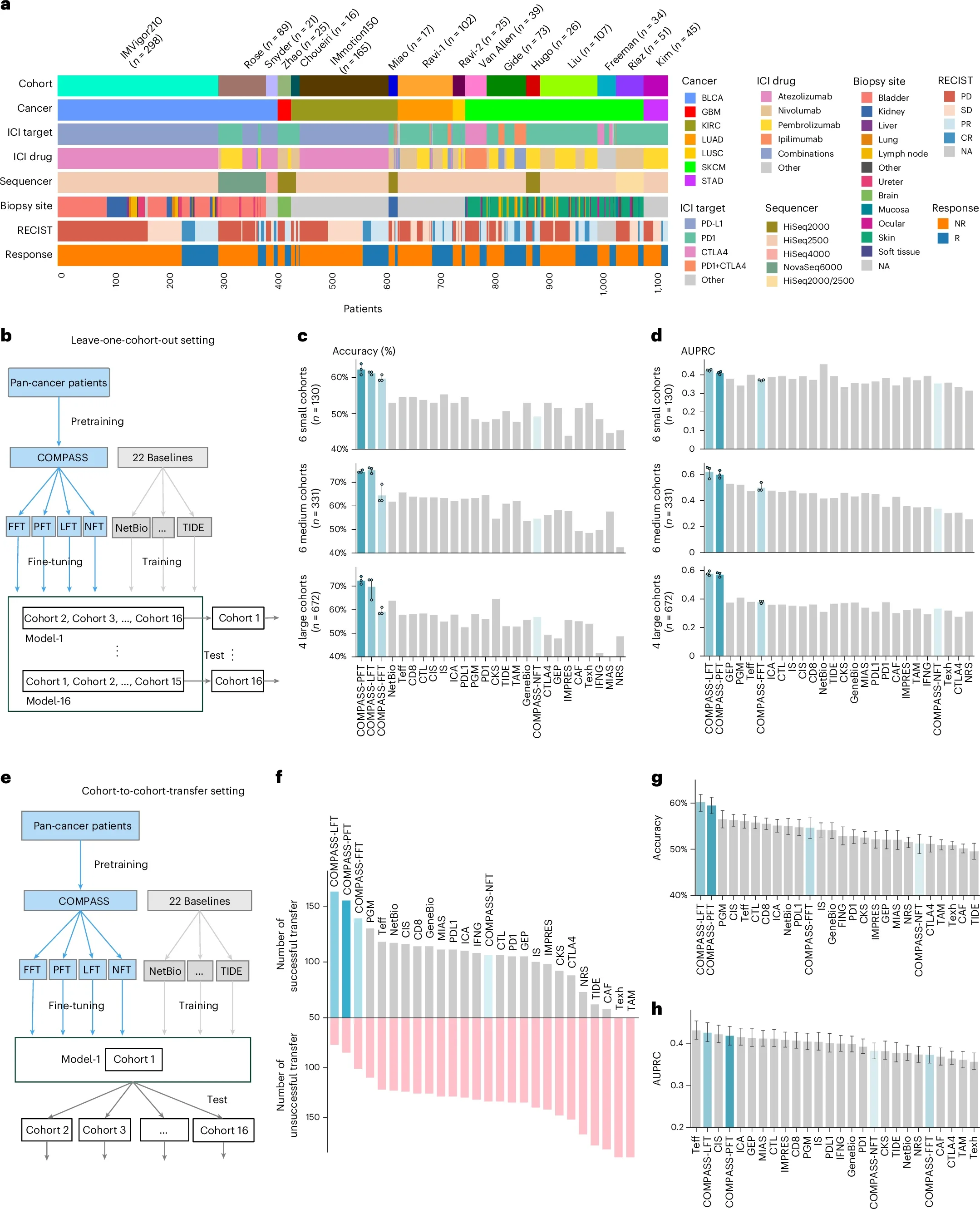
The investigators assembled one of the largest transcriptomic datasets yet used for immuno-oncology. The model was initially pretrained using tens of thousands of RNA sequencing profiles representing multiple solid tumors. After learning general transcriptional patterns, COMPASS underwent task-specific training using patients treated with immune checkpoint inhibitors.
The validation included numerous independent cohorts encompassing melanoma, non-small cell lung cancer, renal cell carcinoma, urothelial carcinoma, and several additional tumor types treated with PD-1 or PD-L1 blockade. This multi-cohort design allowed investigators to determine whether the model maintained predictive performance across different diseases, sequencing platforms, treatment regimens, and clinical settings.
Unlike traditional biomarker studies that focus exclusively on baseline molecular variables, COMPASS evaluated the entire transcriptional architecture of each tumor, capturing interactions between cancer cells, immune infiltrates, stromal elements, angiogenesis, metabolism, and inflammatory signaling simultaneously.
How COMPASS Works
Rather than evaluating single genes independently, COMPASS analyzes global transcriptional relationships throughout the tumor microenvironment.
Every tumor contains thousands of active genes participating in interconnected biological networks. Immune activation depends not only on cytotoxic T cells but also on antigen presentation, interferon signaling, dendritic-cell activation, chemokine production, stromal architecture, metabolic competition, vascular remodeling, and numerous suppressive pathways. Traditional biomarkers reduce this complexity to one variable—for example PD-L1 positivity or TMB.
COMPASS instead learns how these pathways interact.
The model identifies latent biological representations that summarize the functional immune state of each tumor. These representations allow prediction of clinical outcomes while simultaneously revealing which biological programs contribute most strongly to response or resistance.
Because the model captures higher-order biological relationships rather than isolated genes, it remains applicable across multiple cancer types despite substantial differences in tissue origin.
Clinical Performance
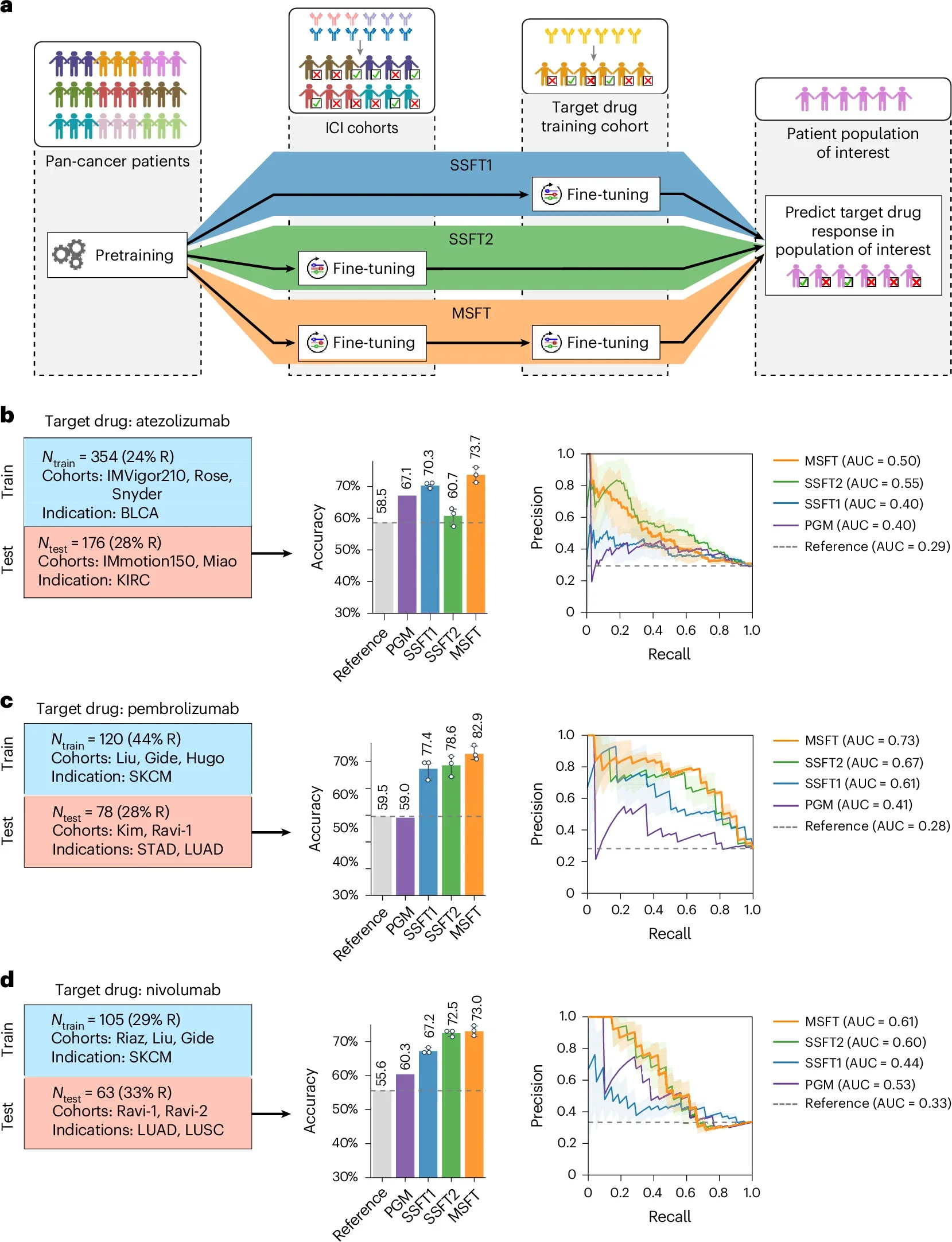
Across independent validation cohorts, COMPASS consistently outperformed many existing transcriptomic prediction approaches.
Its predictions remained accurate across different sequencing platforms and diverse tumor types, suggesting that the biological programs learned during pretraining generalized remarkably well.
Rather than depending heavily on individual biomarkers, the model integrated hundreds of immune-related pathways into a single prediction.
Key findings included:
- Higher predictive accuracy than conventional transcriptomic signatures across multiple validation cohorts.
- Consistent performance in melanoma, lung cancer, renal cell carcinoma, urothelial carcinoma, and other solid tumors.
- Robust discrimination between responders and non-responders despite heterogeneous clinical populations.
- Good generalizability across independent external datasets.
These findings suggest that large foundation models may overcome one of the major limitations of previous machine-learning approaches—the tendency to lose performance outside their original training cohorts.
Biological Programs Associated With Response
One of the study’s greatest strengths was its biological interpretability.
Instead of producing only response probabilities, COMPASS identified the molecular pathways responsible for favorable outcomes. Responding tumors consistently demonstrated features of an active antitumor immune microenvironment.
These included robust interferon signaling, increased antigen presentation machinery, enhanced cytotoxic T-cell activity, chemokine production promoting immune-cell recruitment, and evidence of ongoing adaptive immune responses. Rather than representing isolated biomarkers, these findings describe an integrated immune ecosystem in which multiple components cooperate to generate effective tumor control.
The model also recognized transcriptional signatures associated with tertiary lymphoid structures, dendritic-cell activation, and sustained T-cell function—features increasingly recognized as hallmarks of successful checkpoint inhibition.
Biological Programs Associated With Resistance
Equally important, COMPASS identified numerous mechanisms associated with immunotherapy resistance. Tumors predicted to have poor outcomes frequently demonstrated transcriptional evidence of immune exclusion rather than immune activation.
Several resistance-associated biological programs emerged repeatedly, including increased extracellular matrix remodeling, stromal activation, angiogenesis, metabolic reprogramming, hypoxia, and suppressive inflammatory signaling. These tumors often lacked coordinated interferon responses and exhibited reduced expression of genes involved in antigen presentation. Rather than representing complete immune ignorance, many resistant tumors appeared to develop highly organized immunosuppressive microenvironments that prevented effective T-cell infiltration and function.
This observation reinforces the growing concept that resistance is an active biological process rather than simply the absence of immune activation.
Beyond Single Biomarkers
One of the most clinically relevant observations was that COMPASS did not merely reproduce information already captured by PD-L1 expression or TMB. Instead, the model provided complementary biological information. Patients with similar PD-L1 expression frequently demonstrated markedly different COMPASS predictions, reflecting substantial differences in overall immune architecture.
Likewise, tumors with comparable mutational burdens sometimes exhibited entirely different immune programs. These findings highlight an important limitation of current biomarker strategies. Two tumors may appear identical according to PD-L1 testing while possessing profoundly different immune microenvironments that ultimately determine clinical response.
COMPASS appears capable of capturing this additional biological complexity.
Personalized Biological Interpretation
Perhaps the most innovative aspect of the study was the generation of individualized biological response maps. Rather than assigning patients to broad responder or non-responder categories, COMPASS identifies the dominant pathways influencing each prediction.
For one patient, resistance may primarily reflect angiogenesis and stromal remodeling. For another, impaired antigen presentation may be the dominant mechanism. In others, metabolic suppression or chronic inflammatory signaling may predominate. This level of biological personalization has important therapeutic implications because different resistance mechanisms may require entirely different combination strategies.
Rather than simply adding another checkpoint inhibitor, clinicians may eventually select targeted therapies that specifically address the dominant resistance pathway identified by AI.
Clinical Implications
The study represents an important step toward precision immuno-oncology.
Current treatment decisions frequently rely on relatively simple biomarkers that incompletely represent the biology of individual tumors. Foundation AI models like COMPASS could eventually provide far more comprehensive biological characterization before treatment begins.
Such models may help identify patients likely to benefit from single-agent immunotherapy, recognize individuals who require combination approaches, prioritize enrollment into biomarker-driven clinical trials, and potentially reduce unnecessary toxicity from ineffective treatment. Importantly, the study also demonstrates that artificial intelligence can generate clinically meaningful predictions while remaining biologically interpretable—a critical requirement for clinical implementation.
Rather than replacing physicians, models like COMPASS may function as sophisticated decision-support tools capable of integrating transcriptomic complexity into practical clinical recommendations.
Limitations
Despite its impressive performance, several challenges remain before COMPASS can enter routine clinical practice. Most validation cohorts were retrospective, making prospective clinical validation essential before implementation.
Transcriptomic profiling also requires high-quality RNA sequencing, which remains expensive and is not yet universally available. Furthermore, although the model generalized across several tumor types, additional evaluation will be necessary in rare malignancies and underrepresented patient populations.
Finally, immune responses remain dynamic. Future versions of COMPASS may benefit from incorporating longitudinal transcriptomic data, circulating biomarkers such as ctDNA, spatial transcriptomics, digital pathology, and radiologic imaging to provide even more comprehensive prediction.
Conclusion
COMPASS represents one of the most sophisticated applications of artificial intelligence in immuno-oncology to date. By leveraging large-scale transcriptomic pretraining, the model successfully identified conserved biological programs associated with immune checkpoint inhibitor response across multiple cancer types while maintaining strong predictive performance in independent validation cohorts.
Perhaps more importantly, the study demonstrates that AI models no longer need to function as opaque “black boxes.” COMPASS provides biologically interpretable predictions, revealing the molecular pathways that underlie both sensitivity and resistance to immunotherapy. This capability moves the field beyond conventional biomarkers such as PD-L1 or tumor mutational burden and toward a more integrated understanding of the tumor–immune ecosystem.
Although prospective validation and broader clinical implementation are still required, COMPASS illustrates how foundation AI models could reshape precision oncology. In the future, treatment selection may no longer depend on a single biomarker but instead on comprehensive AI-driven analyses capable of identifying each patient’s unique immunological landscape and guiding individualized immunotherapy strategies.
Read Full Article Here