






Aya El Helali, Principal Investigator at the Centre for Oncology and Immunology, Clinical Assistant Professor at The University of Hong Kong, and Vice President of the Hong Kong Neuro-Oncology Society, shared a post on LinkedIn:
“Thrilled to share our latest publication Nature Communications!
‘Mapping Glioblastoma’s Isoform Diversity Using Long-Read Single-Cell Analysis’ is now online.
Glioblastoma is the most aggressive primary brain tumour in adults, with a median survival of 10 – 15 months despite standard treatment. Much of this is driven by molecular heterogeneity, not only at the gene level, but at the level of RNA isoforms, which conventional short-read sequencing simply cannot resolve.
We applied single-cell long-read RNA sequencing to 27 IDH-wildtype GBM tumours, profiling 182,222 cells to build the first isoform-resolution atlas of glioblastoma. Key findings:
- 96,462 differentially expressed transcripts between tumour and non-tumour cells
- 6,524 isoforms absent from existing annotations, including 179 that are tumour-specific
- 40 patient-specific dual-target pairs across 7 patients, pairing tumour-restricted surface isoforms with intracellular targets for personalised aptamer-siRNA chimera therapies
- 89 tumour-specific isoforms encoding neoantigen peptides with strong predicted MHC class I binding, showing broader and stronger antigen presentation than established mutation-derived neoantigens like EGFR A289V and TP53 R273H
This opens two therapeutic avenues for an immunologically ‘cold’ tumour: precision dual-targeting therapies and splicing-derived neoantigen vaccines.
This work owes a great deal to the Hong Kong Genome Institute, Professor Hon-Yin Brian Chung, Annie Chu, Wenshu Tang, and Cario W.S. Lo for their exceptional work driving this study. A huge thanks to Professor Gilberto K.K. Leung, his Lab group, Clinical Neuroscience Consortium, and the Neurosurgery team at the HKU Department of Surgery, and Queen Mary Hospital Hospital Authority for their clinical expertise and support that made this work possible. And to my own lab team (Dexter Wing Lun Lee and Dingyuan), your time and dedication made this happen.
Supported by the Hong Kong Genome Institute, work like this doesn’t happen without that kind of institutional commitment to genomic medicine, and it’s a reminder of what a city like Hong Kong can produce when the infrastructure and the drive are there.”
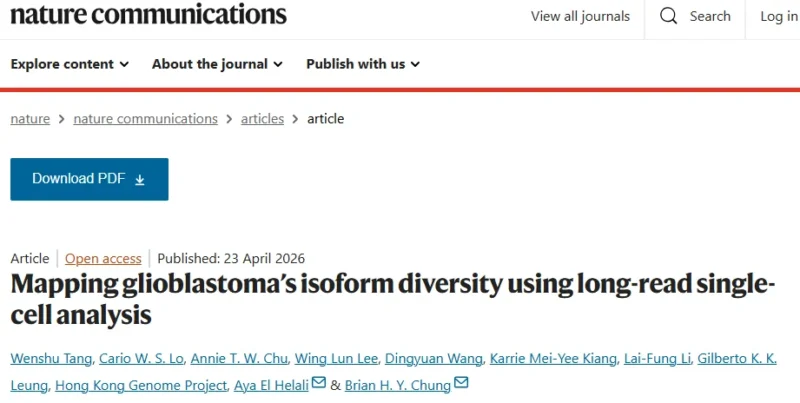
Title: Mapping glioblastoma’s isoform diversity using long-read single-cell analysis
Authors: Wenshu Tang, Cario W. S. Lo, Annie T. W. Chu, Wing Lun Lee, Dingyuan Wang, Karrie Mei-Yee Kiang, Lai-Fung Li, Gilberto K. K. Leung, Hong Kong Genome Project, Aya El Helali, Brian H. Y. Chung
Read the Full Article.
Other articles about glioblastoma on OncoDaily.