






Ajay Major, Founder and President of Pager Publications and Assistant Professor of Medicine at the University of Colorado School of Medicine, shared a post on X:
“The tumor microenvironment (TME) may help explain the benefit of pola-R-CHP in diffuse large B-cell lymphoma (DLBCL).
A post hoc RNA sequencing analysis of more than 1,200 patients across three randomized clinical trials found that:
- Low M1-like macrophage infiltration was associated with worse progression-free survival (PFS) and overall survival (OS) in patients treated with R-CHOP.
- Low M1-like macrophage infiltration was not prognostic for patients treated with pola-R-CHP.
- In patients with low M1-like macrophage infiltration, pola-R-CHP improved progression-free survival compared with R-CHOP (HR 0.59).
- The activity of polatuzumab vedotin (pola) appears to be primarily driven by monomethyl auristatin E (MMAE).
These findings provide important biological insights, suggesting that antibody-drug conjugates (ADCs) may help overcome an unfavorable or immune-poor tumor microenvironment in diffuse large B-cell lymphoma (DLBCL).”
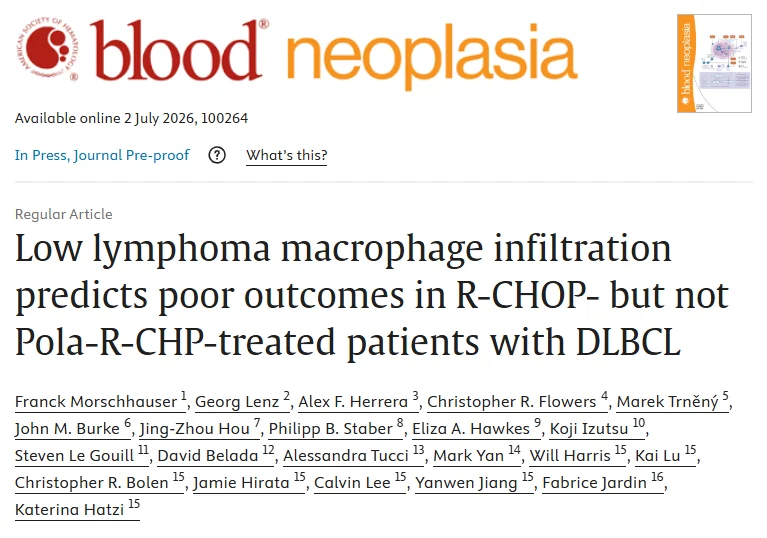
Title: Low lymphoma macrophage infiltration predicts poor outcomes in R-CHOP- but not Pola-R-CHP-treated patients with DLBCL
Authors: Franck Morschhauser, Georg Lenz, Alex F. Herrera, Christopher R. Flowers, Marek Trněný, John M. Burke, Jing-Zhou Hou, Philipp B. Staber, Eliza A. Hawkes, Koji Izutsu, Steven Le Gouill, David Belada, Alessandra Tucci, Mark Yan, Will Harris, Kai Lu, Christopher R. Bolen, Jamie Hirata, Calvin Lee, Yanwen Jiang, Fabrice Jardin, Katerina Hatzi
Read The Full Article
Other articles about lymphoma on OncoDaily.