






Abdu Adem Yesufe, Program Director of Adult Hematology and Medical Oncology Fellowship at St. Paul’s Hospital Millennium Medical College (SPHMMC), shared a post on LinkedIn:
“Hope is No Longer a Rare Commodity in Pancreatic Cancer Care
For decades, advanced pancreatic cancer has been synonymous with a grim reality: limited treatment options, rapid progression, and a median overall survival stubbornly stuck at under 7 months for second-line treatments.
But a major breakthrough just dropped in the NEJM, and the oncology community has every reason to look forward with renewed hope.
The Phase 3 RASolute302 trial evaluating Daraxonrasib—an oral RAS(ON) multiselective inhibitor—against standard chemotherapy in previously treated metastatic pancreatic cancer has delivered truly remarkable results:
- Survival Doubled: Median Overall Survival (OS) reached 13.2 months with Daraxonrasib compared to just 6.6 months with chemotherapy.
- Risk Reduction: The risk of death was slashed by 60% (Hazard Ratio: 0.40, p<0.001) in both the RAS G12 subgroup and the overall study population.
- Progression-Free Survival (PFS): More than doubled from 3.5 months to **7.3 months**.
- Better Tolerability: Only 1.2% of patients on Daraxonrasib discontinued treatment due to side effects, compared to 11.2% in the chemotherapy arm.
Since over 90% of pancreatic cancers are driven by RAS mutations, targetable therapies like this represent a paradigm shift. We are finally moving away from relying solely on toxic cytotoxic chemotherapies and entering an era of precise, effective targeted medicine for this disease.
The Uncomfortable Truth: Innovation Without Access is Half a Victory
While we celebrate this extraordinary milestone, we must confront a massive disparity. Breakthrough oral targeted therapies like Daraxonrasib carry a heavy price tag, meaning patients in low- and middle-income countries (LMICs) face a massive lag—or outright denial—in access.
When a drug doubles survival for one of the deadliest cancers on earth, ensuring its global equity shouldn’t be an afterthought. True success will be measured not just by the clinical trials we fund, but by our ability to build tiered pricing models, expanded access programs, and generic licensing agreements that deliver these lifelines to the patients who need them most—regardless of geography.
Kudos to the investigators, the oncology professionals, the patient families, and Revolution Medicines for pushing the boundaries of what’s possible. Now, let’s work on closing the access gap.”
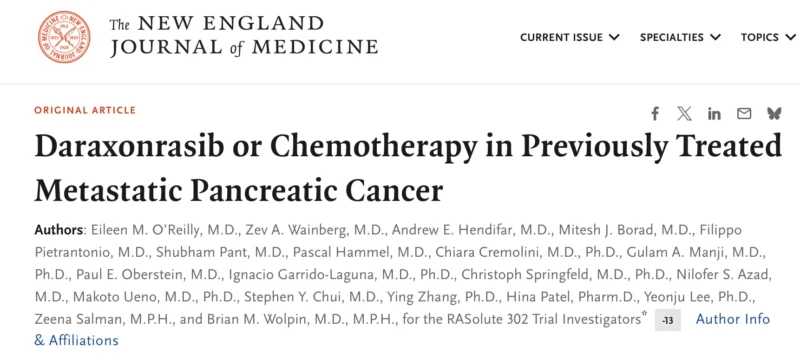
Title: Daraxonrasib or Chemotherapy in Previously Treated Metastatic Pancreatic Cancer
Authors: Eileen O’Reilly, Zev Wainberg, Andrew Hendifar, Mitesh Borad, Filippo Pietrantonio, Shubham Pant, Pascal Hammel, Chiara Cremolini, Gulam Manji, Paul Oberstein, Ignacio Garrido-Laguna, Christoph Springfeld, Nilofer Azad, Makoto Ueno, Stephen Chui, Ying Zhang, Hina Patel, Yeonju Lee, Zeena Salman, Brian Wolpin
Read the Full Article.
Other articles featuring Abdu Adem Yesufe.