This week’s ten oncology grants share a common theme: they’re built for projects that can translate strong ideas into clear outcomes. Across the list you’ll see support for early-stage studies, clinician–scientist and early-career development, and implementation awards designed to test approaches in real clinical environments—not just in theory.
The opportunities span precision diagnostics, data-driven and computational oncology, immunotherapy and platform development, and advances across radiation, surgical, and multimodal care. Several programs also prioritize pediatric oncology, survivorship and palliative services, and capacity-building efforts that strengthen care delivery where resources are limited.
Most of these grants favor applications that are specific and operational: a focused question, a realistic plan, the right collaborators, and a budget that matches the work. If you’re aiming to validate a tool, expand a clinical workflow, or build durable oncology services, one of this week’s programs may be a strong fit—especially if you align your proposal tightly to the funder’s priorities and timeline.
1. American Brain Tumor Association Medical Student Summer Fellowships
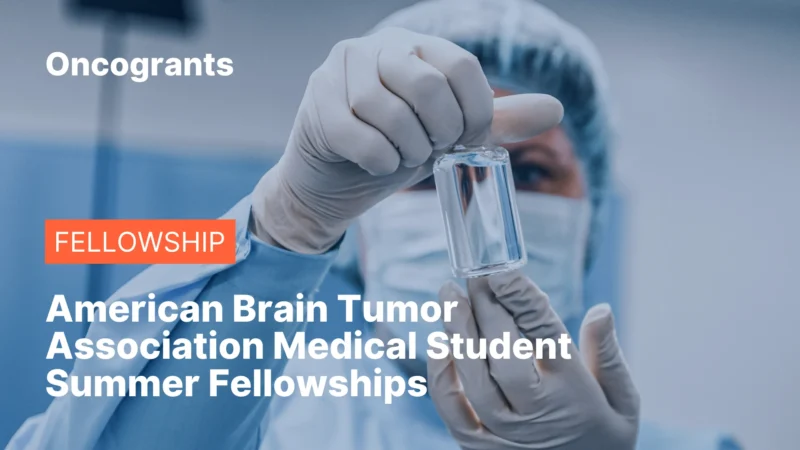
The American Brain Tumor Association Medical Student Summer Research Fellowships provide short‑term stipend support for medical students conducting brain tumor research under experienced mentors. The fellowships aim to attract trainees into neuro‑oncology early in their careers. Projects may be basic, translational, or clinical, but must focus on primary brain tumors.
Eligibility Criteria:
- Enrolled medical students (typically first–third year) at accredited medical schools.
- Must have a defined neuro‑oncology research project focused on primary brain tumors.
- Must identify an ABTA‑eligible mentor at a suitable host laboratory or clinical research group.
- Institutional approval and necessary regulatory clearances must be in place.
Funding Details:
- Fixed‑amount stipend for a single summer research experience (amount specified in the current call).
- Supports 8–12 weeks of full‑time research in brain tumor laboratories or clinical research settings.
- Funds are paid to the student’s institution or directly to the student per ABTA policy.
Deadline:
- Application deadline (current cycle): January 14, 2026.
- Fellowship term: Summer 2026 (exact dates arranged with mentor and institution).
Where to go for further information:
2. Sontag Foundation Distinguished Scientist Award Brain Cancer
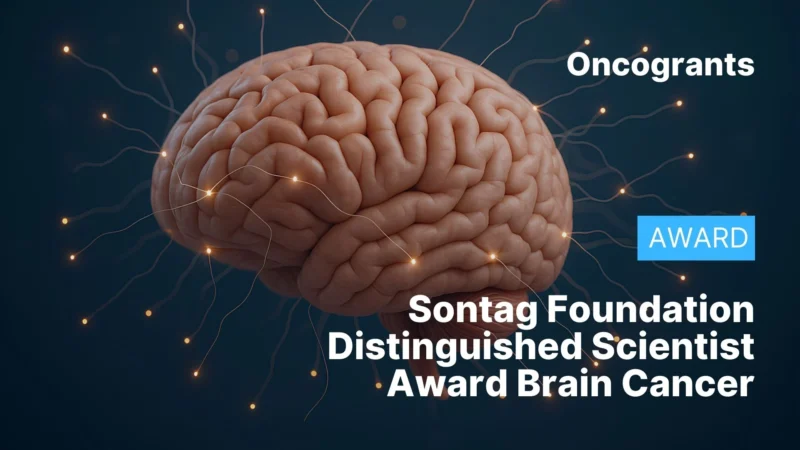
The Sontag Foundation Distinguished Scientist Award is a major career development award for early‑career investigators in brain cancer research in the United States and Canada. It supports high‑risk, high‑impact projects with clear potential to transform the understanding or treatment of brain tumors. The award provides substantial, long‑term funding to help recipients establish themselves as leaders in neuro‑oncology.
Eligibility Criteria:
- Early‑career faculty at tax‑exempt academic, medical, or research institutions in the United States or Canada.
- First independent faculty appointment typically between March 1, 2020 and January 1, 2025 for the 2026 cycle (see current guidelines).
- MD and/or PhD (or equivalent) with a strong track record in brain tumor or brain cancer research.
- Projects generally focus on mechanistic, translational, or platform‑level brain cancer research; traditional clinical trials are usually not supported.
Funding Details:
- USD 750,000 total over 5 years (USD 150,000 per year), inclusive of allowable indirect costs.
- Supports investigator salary, research staff, supplies, and other project‑related costs as per program rules.
- Funds are intended to provide long‑term stability and enable ambitious, innovative brain cancer research programs.
Deadline:
- Application deadline: March 18, 2026, 11:59 pm ET.
- Awards announced: Fall 2026.
Where to go for further information:
3. Leukemia Research Foundation New Investigator Grant Program
The New Investigator Research Grant is the flagship funding program of the Leukemia Research Foundation (LRF), aimed at jumpstarting the careers of new scientists focused on leukemia and related blood cancers. This grant provides up to $150,000 over 2 years to promising early-stage independent investigators pursuing novel ideas in leukemia or MDS (myelodysplastic syndromes) research By supplying critical seed funding, LRF enables these investigators – who are often just establishing their labs – to generate the preliminary data needed for larger awards, thereby accelerating discoveries in leukemia prevention, diagnosis, and treatment. LRF is a nonprofit dedicated exclusively to funding leukemia research, and this program has a strong track record of advancing breakthroughs while fostering the next generation of leukemia researchers
Eligibility Criteria:
- New Independent Investigators: Must be within 7 years of starting their first faculty-level appointment(assistant professor or equivalent) as of the award start date (July 1, 2026) Time spent in clinical training or postdoc fellowship is not counted toward the 7-year limit Adjustments can be made for significant career interruptions (family leave, military service, etc.) with documentation.
- Faculty Position: Applicants must hold an independent, tenure-track (or equivalent) faculty position at a non-profit institution at the time of application submission They should have their own dedicated lab space and the ability to lead a research team (fellows are not eligible)
- No Major Grant Funding: Candidates cannot have existing active grants ≥ $175K/year in direct costs, such as an NIH R01, VA Merit Award, or equivalent, at the time of application Having smaller grants (e.g., NIH K08/K99, R21, DoD, foundation grants under $175K/year) is permitted The intent is to fund investigators who have not yet obtained substantial federal funding.
- Research Focus: Proposals must be relevant to leukemia, leukemia-related blood cancers, or MDS. Both basic science and translational/clinical projects are welcome. The science should be innovative and feasible within the 2-year scope.
- Geography: Investigators worldwide are eligible – no U.S. citizenship or residency requirement The research can be conducted at any qualified non-profit research institution globally.
Funding Details:
- Grant Amount: Up to $150,000 total (USD) disbursed over a 2-year period Typically, this is budgeted as ~$75,000 per year for two years. No indirect costs are allowed; the entire award is for direct project expenses.
- Allowable costs: Funds may cover PI and staff salaries, supplies, equipment, core facility fees, and other research expenses directly related to the project. Travel to scientific meetings or LRF events can be included modestly.
- Project term: July 1, 2026 – June 30, 2028. An interim progress report and financial report are required after year 1, and continued funding for the second year is contingent on satisfactory progress. A final report is due at the end of year 2.
- Mentorship and collaboration: While not a formal requirement, LRF encourages grantees to leverage mentorship from senior leukemia researchers (many past awardees have gone on to secure NIH grants under mentorship). Grantees become part of LRF’s scientific community and may be invited to present findings at LRF sessions.
Deadline:
- Letters of Intent (LOI) due February 6, 2026 (noon CT).
Where to go for further information:
4. AACR-EMD Serono “I’M IN” Oncodisparity Fellowship for Bladder Cancer
A one-year postdoctoral fellowship jointly offered by AACR and EMD Serono to promote research in cancer health disparities. The 2026 fellowship supports a young investigator focusing on inequalities in bladder cancer care, providing $65,000 for salary and benefits to enable a mentored project addressing barriers and disparities in bladder cancer outcomes. This program aims to launch the fellow’s career in disparities research by fostering new approaches to improve equitable cancer care.
Eligibility Criteria:
- Applicants must hold a PhD, MD, or equivalent and be in a postdoctoral or clinical research fellowship (within 5 years of doctoral degree).
- At the July 2026 start date, must have a confirmed postdoc/fellow position and work under a mentor in an academic or research institution.
- Projects must specifically address cancer disparities in bladder cancer, with preference for proposals implementing strategies to reduce inequities in care.
- Open worldwide; no citizenship restrictions, but AACR membership is required (or application for membership by deadline).
Funding Details:
- Award Amount: $65,000 USD for 1 year, to cover the fellow’s stipend and fringe benefits. A portion of funds may be used for research supplies and travel directly related to the project.
- No indirect costs are allowed on this fellowship. The grant is intended as seed funding for high-risk, high-impact ideas that can generate data for future larger grants.
- Grant Term: July 1, 2026 – June 30, 2027. Progress reports are required, and awardees will have opportunities to showcase their work through AACR events.
Deadline:
- February 24, 2026 – Full application due by 1:00 PM ET. (No LOI stage; application portal typically opens in Fall 2025.)
- Decisions announced by May 2026, with the fellowship to begin in July 2026.
Where to go for further information:
5. American Cancer Society Catalyst Award
The ACS Catalyst Award is a new grant mechanism from the American Cancer Society designed to “catalyze” the research of early-stage independent investigators. It provides a one-year infusion of funds to sustain promising cancer projects that scored highly but missed out on major funding (such as near-miss applications to ACS Research Scholar Grants or NIH R01s) By bridging this gap, the Catalyst Award enables researchers to continue critical experiments and gather data for resubmissions, accelerating progress on innovative cancer science
Eligibility Criteria:
- Open to early-career independent investigators who meet ACS Research Scholar Grant (RSG) eligibility (typically within 10 years of their first faculty appointment).
- Applicants must have previously submitted either an ACS RSG or NCI R01 proposal in 2024–2025 that was scored.
- Outstanding/competitive but not funded (E.g. RSG applications given “contingent” status or NCI R01 applications in the top 15th percentile without funding).
- Must hold a doctoral degree and a full-time independent faculty position at a US academic institution (or equivalent non-profit) at the award start U.S. citizens or permanent residents are not required – international researchers at U.S. institutions are eligible.
- Cannot already be PI on more than one active R01 or large grant over $100K/year in direct costs Current or past Catalyst Award recipients are not eligible.
Funding Details:
- Award Amount: $150,000 (direct costs) for a 1-year project, with no indirect costs allowed This is a one-time, non-renewable grant.
- Supports personnel time (“protected time”) and research expenses to keep the project moving forward Funds must be used for the aims originally proposed in the unfunded application (within the scope of the initial project)
- Grant term expected to begin May 1, 2026, aligning with the ACS grant cycle Progress and financial reports will be required at the end of the award.
Deadline:
- January 5, 2026 – Full application due via ProposalCentral (No Letter of Intent stage; however, applicants should discuss their intent to apply with ACS program staff to obtain application access) Award notifications are expected by March 2026.
Where to go for further information:
6. Lustgarten Foundation Innovation & Collaboration Program
The Lustgarten Foundation Innovation & Collaboration (I&C) Program supports high‑impact, collaborative pancreatic cancer research with clear potential to advance early detection, biology, and treatment. Projects are expected to be innovative, hypothesis‑driven, and team‑based, spanning basic, translational, and clinical domains. Multi‑PI and multi‑institutional projects are strongly encouraged.
Eligibility Criteria:
- Independent investigators at non‑profit academic, medical, or research institutions.
- Project must focus primarily on pancreatic cancer (biology, prevention, early detection, or therapy).
- Multidisciplinary, multi‑PI, or multi‑institutional collaborations are strongly encouraged.
- Open internationally, subject to institutional and funder compliance requirements.
Funding Details:
- Multi‑year research grants, typically 2–3 years in duration.
- Total budget generally in the low six‑figure range per year (exact cap and allowed costs per current RFA).
- Funds may support personnel, supplies, research‑related services, and limited equipment as defined in the guidelines.
Deadline:
- Current cycle full proposal deadline: January 5, 2026 (time zone per RFA).
- Award start: Mid‑2026 (exact date specified in award notice).
Where to go for further information:
7. NCCN Foundation Young Investigator Award Program
The NCCN Foundation Young Investigator Award (YIA) Program supports early‑career clinicians and scientists at NCCN Member Institutions conducting independent cancer research. The goal is to improve the quality, effectiveness, equity, and accessibility of cancer care while helping awardees transition to research independence. Applications are internally selected and limited to nominated candidates from NCCN centers.
Eligibility Criteria:
- First full‑time appointment as Assistant Professor, Instructor, or equivalent at one of the NCCN’s 33 Member Institutions.
- MD, DO, PhD, or other advanced degree, working in an oncology laboratory, clinical research, or cancer control setting.
- Must have a committed mentor and institutional support for protected research time.
- Internal nomination required; only one candidate per institution is typically allowed.
Funding Details:
- USD 150,000 total over 2 years for research expenses.
- Indirect costs allowed up to 8% of the total award.
- May include a small allowance for IRB fees and travel to the NCCN Annual Conference.
- Funds support personnel, supplies, and other direct research costs related to the proposed project.
Deadline:
- Final application deadline to NCCN: January 21, 2026, 5:00 pm ET
- Award term: typically mid‑2026 to mid‑2028
Where to go for further information:
8. AHA Data Grant on CKM Syndrome in Cancer Patients and Survivors
The American Heart Association Data Grant on CKM Syndrome in Cancer Patients and Survivors funds analyses of real‑world data to quantify and address cardiovascular, kidney, and metabolic (CKM) disease in people with current or prior cancer. This cardio‑oncology initiative focuses on understanding prevalence, treatment patterns, and outcomes of CKM syndrome in cancer populations. Projects are expected to leverage large datasets such as electronic health records, registries, or claims databases.
Eligibility Criteria:
- Independent investigators at academic, clinical, or public‑health institutions worldwide.
- Proposals must focus on cancer patients or survivors and CKM disease (prevalence, management, shared risk factors, or outcomes).
- Multidisciplinary teams including oncology, cardiology, nephrology, epidemiology, and data science are encouraged.
- Ability to access and securely analyze suitable real‑world datasets.
Funding Details:
- AHA targeted research grant mechanism using large real‑world datasets.
- Budget and project duration follow AHA policies for this RFP; applicants propose a justified budget within program limits.
- Indirect costs are capped according to AHA rules stated in the current announcement.
Deadline:
- Letter of Intent deadline: January 19, 2026.
- Full application deadline (by invitation): March 23, 2026.
- Earliest project start date: August 1, 2026.
Where to go for further information:
9. UC Cancer Research Coordinating Committee Faculty Seed Grants
The UC Cancer Research Coordinating Committee (CRCC) Faculty Seed Grants provide one‑year internal funding for University of California faculty to pursue new cancer research projects. These seed grants support studies across the cancer continuum, including biology, prevention, early detection, treatment, survivorship, and population science. Awards are intended to generate preliminary data for larger external grant applications.
Eligibility Criteria:
- Academic Senate faculty at one of the 10 University of California campuses.
- Project must be cancer‑focused (any discipline, from laboratory science to community‑based research).
- Eligible categories include New Assistant Professor (NAP) and Regular (REG) faculty.
- One Letter of Intent and one full proposal per PI per cycle; multi‑PI and cross‑campus collaborations are encouraged.
Funding Details:
- One‑year Faculty Seed Grants in NAP and REG categories.
- Award size is a modest six‑figure seed‑grant level; specific caps and indirect cost policies are defined in the annual RFP.
- Funds may support personnel, supplies, and other direct project costs as detailed in program guidelines.
Deadline:
- Letter of Intent deadline: January 22, 2026, 12:00 noon Pacific.
- Full proposal deadline (by invitation): April 2, 2026, 12:00 noon Pacific.
- Award start: Early 2027 (per UC Office of the President schedule).
Where to go for further information:
10. AACR-Mark Foundation Chemistry in Cancer Research Grants
The AACR-Mark Foundation Chemistry in Cancer Research Grants provide significant funding (USD 435,000over 3 years) to support independent investigators using chemical science approaches to solve important problems in cancer research . Sponsored by The Mark Foundation for Cancer Research, these grants aim to stimulate cross-disciplinary work at the interface of chemistry and oncology – including areas like drug discovery, chemical biology, molecular imaging, and innovative diagnostics. The program empowers researchers to exploit chemical techniques or design new molecules to advance cancer prevention, detection, and treatment.
Eligibility Criteria:
- Applicants must hold an independent research position at an academic, medical, or nonprofit research institution anywhere in the world . This generally means an Assistant Professor (tenure-track or equivalent) or higher rank.
- Investigators who have recently established their labs are strongly encouraged, but more senior scientists can also apply if the project represents a new direction in chemical-cancer science.
- Candidates must have a doctoral degree (PhD, MD, or equivalent) and not be in training positions . They should be capable of leading a research team and supervising the project.
- Research proposals must clearly incorporate a chemistry-based approach to a cancer problem. This could involve medicinal chemistry, chemical biology, synthesis of novel compounds, probes for cancer biology, etc. Collaborative projects between chemists and cancer biologists are welcome (though the application should be submitted by one principal investigator).
- AACR membership: Required by the LOI deadline (Dec 16, 2025). Nonmembers must join AACR to be eligible . No citizenship restrictions apply.
Funding Details:
- Grant Amount: USD 435,000 over 36 months (approx. $145,000 per year).
- Supports direct research costs such as personnel salaries, laboratory reagents and supplies, small equipment, and possibly shared resource fees. Up to 10% indirect costs are permitted as per AACR policies.
- The grant term will begin September 1, 2026 and end August 31, 2029. Continuation of funding each year is contingent upon satisfactory progress.
- Recipients become part of AACR’s Chemistry in Cancer Research Working Group community, with opportunities to network and present at AACR conferences. The Mark Foundation may also engage with awardees for progress updates or partnership on future initiatives.
Deadline:
- Letter of Intent (LOI) Deadline: December 16, 2025 at 1:00 PM (ET) . A concise LOI outlining the research hypothesis, approach, and significance is required.
- LOI Decision: March 2026 – selected applicants will be invited to submit full proposals .
- Full Application Deadline: (Expected April–May 2026, date to be specified in invitation).
- Awardees announced by July 2026 (grant agreements executed for a Sept 1, 2026 start).
Where to go for further information: