
Astellas announced that the first patient has been dosed in a Phase 3 trial evaluating setidegrasib, an investigational KRAS G12D-targeted protein degrader, against docetaxel in previously treated advanced non-small cell lung cancer (NSCLC).
The study includes patients with KRAS G12D-mutated, locally advanced unresectable or metastatic NSCLC whose disease has progressed on or after platinum-based chemotherapy and checkpoint inhibitor therapy. It is the second Phase 3 study of setidegrasib, following the initiation of a pancreatic cancer trial in April 2026.
In written responses to OncoDaily, Moitreyee Chatterjee-Kishore, PhD, MBA, Head of Oncology Development at Astellas, discussed the science behind setidegrasib, its development across lung and pancreatic cancers, and emerging research on resistance.

Moitreyee Chatterjee-Kishore
What Will the Phase 3 NSCLC Trial Evaluate?
The randomized, open-label study, registered as NCT07566052, plans to enroll approximately 356 patients across multiple countries.
Its dual primary endpoints are:
- Progression-free survival, assessed by blinded independent central review:
- Overall survival.
The trial will compare setidegrasib with docetaxel to assess its potential benefit in this previously treated population. Setidegrasib remains investigational, and its safety and efficacy have not been established for the uses under study.
Targeting KRAS G12D Through Protein Degradation
KRAS has historically been difficult to target because of its structure and the absence of clear binding sites for conventional drugs, Chatterjee-Kishore explained.
She pointed to a scientific advance in 2013, when researchers identified molecules capable of binding covalently to the switch-II pocket of KRAS G12C. That discovery helped establish KRAS as a druggable target and supported subsequent efforts focused on inhibiting its activity.
Setidegrasib takes a different approach.
Chatterjee-Kishore told OncoDaily:
“We are exploring a distinct approach to KRAS-driven cancers called targeted protein degradation. This has provided a different way to approach difficult-to-target proteins, by harnessing the cancer cell’s own machinery to remove disease-driving proteins.”
According to Chatterjee-Kishore, Astellas researchers first identified a proprietary molecule that could bind to KRAS G12D and used it to develop an initial degrader. Structural modelling then helped researchers understand how to bring the mutant protein together with the VHL E3 ligase, part of the cell’s protein-disposal machinery.
These insights guided the optimization and identification of setidegrasib.
“By removing the disease-driving KRAS G12D protein, setidegrasib may help disrupt one of the key signalling mechanisms that cancer cells use to survive.”
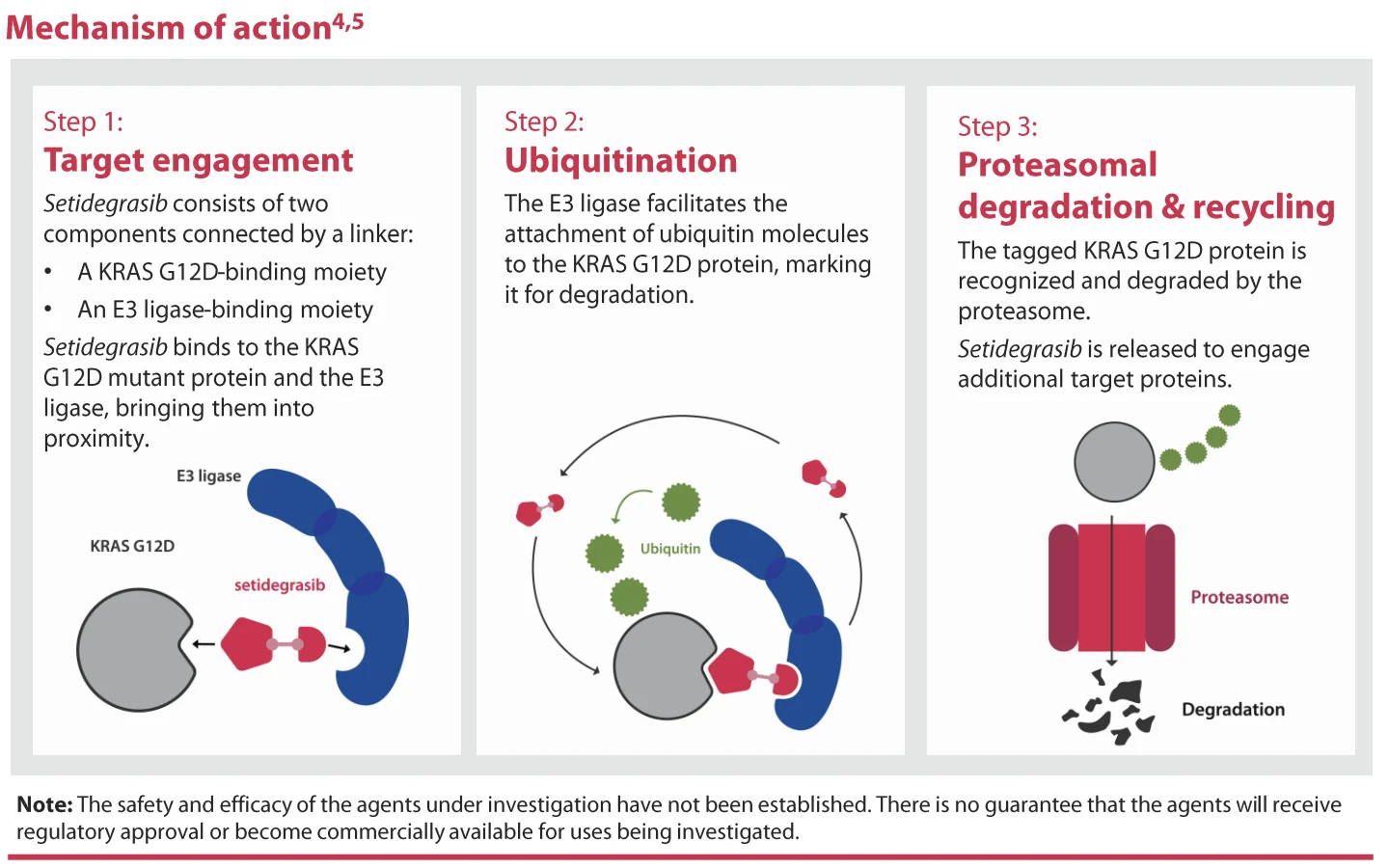
Setidegrasib’s proposed mechanism of action. The investigational protein degrader brings KRAS G12D and an E3 ligase together, enabling ubiquitination and subsequent degradation of the target protein by the proteasome. Setidegrasib is then released to engage additional target proteins. Source: Astellas, Setidegrasib Global Media Backgrounder, September 2026.
What Could Removing the Protein Change?
Targeted protein degradation raises a broader question for cancer drug development: whether eliminating a disease-driving protein could provide opportunities beyond suppressing its activity.
Chatterjee-Kishore said:
“Historically, targeted drug development has focused on finding a way to bind to a disease-driving protein and inhibit its activity. Targeted protein degradation introduces another possibility: rather than needing to continuously block a protein’s function, could we harness the body’s own machinery to remove the entire protein itself?”
She explained that this approach could expand research into mutant proteins that have been difficult to target with conventional strategies. It also creates new questions about how removing a protein affects cancer biology and the development of resistance.
These possibilities remain subjects of investigation; they do not establish that degradation will produce better clinical outcomes than inhibition.
Early Evidence of KRAS G12D Degradation in Lung and Pancreatic Cancer
Chatterjee-Kishore highlighted findings from the Phase 1 study published in The New England Journal of Medicine, which she said demonstrated evidence of target degradation in both NSCLC and pancreatic ductal adenocarcinoma (PDAC).
At the 600 mg dose, she reported median reductions from baseline in KRAS G12D protein levels of:
- 70.6% in patients with NSCLC.
- 95.5% in patients with PDAC.
“These findings provided evidence that setidegrasib was engaging and degrading its intended target across these different tumor types.”
These percentages describe reductions in KRAS G12D protein levels, rather than tumor response rates or improvements in survival.

A Shared Mutation, Different Clinical Development Strategies
Although KRAS G12D provides a common molecular target, lung and pancreatic cancers have different biological characteristics, treatment pathways, and patient needs.
Chatterjee-Kishore explained that the Phase 3 pancreatic cancer program is evaluating setidegrasib with standard chemotherapy in the frontline setting. The NSCLC trial is evaluating it against docetaxel after progression on platinum-based chemotherapy and checkpoint inhibitor therapy.
She told OncoDaily:
“So, while KRAS G12D provides a common molecular target, how we investigate setidegrasib is tailored to the biology, treatment landscape and needs of patients within each cancer.”
The development strategy therefore examines the drug within the treatment context of each disease, rather than assuming that a shared mutation will translate into identical clinical use.
Exploring Response, Resistance, and Combination Strategies
Resistance remains a central question for the setidegrasib program.
Chatterjee-Kishore discussed exploratory analyses presented at the AACR Conference on Pancreatic Cancer that examined biological differences between patients whose pancreatic tumors responded to treatment and those whose tumors did not.
The analyses identified differences in mTORC1, MYC, RAS, and cell-cycle signaling, alongside a higher number of baseline co-mutations in non-responders. Circulating tumor DNA analyses at the end of treatment also showed distinct molecular patterns associated with response and resistance.
Chatterjee-Kishore said:
“These findings identified potentially targetable resistance pathways that support further investigation of our combination strategies, including with chemotherapy such as FOLFIRINOX.”
She emphasized the preliminary nature of the findings:
“The analyses are exploratory and are also helping inform future research into setidegrasib and combination approaches in KRAS G12D-mutated pancreatic cancer.”
The findings support further research into combination strategies but do not establish which approach will overcome resistance or improve patient outcomes.
What Could Setidegrasib Mean for Targeted Protein Degradation?
Chatterjee-Kishore noted that KRAS G12D occurs in approximately 40% of PDAC and 5% of NSCLC, and that no therapies currently specifically target the mutation with regulatory approval.
The ongoing studies are intended to define setidegrasib’s potential clinical role. Beyond this individual drug, the program may also help researchers understand how targeted protein degradation could be applied to other cancer-driving proteins.
“Demonstrating that a degrader can successfully target a well-established cancer driver such as KRAS G12D in the clinic could help inform how we apply this approach to other disease-driving proteins and potentially broaden the range of cancer targets we are able to pursue in the future.”
For patients with previously treated KRAS G12D-mutated NSCLC, the Phase 3 trial will address the clinical question that remains: whether this approach can improve outcomes compared with docetaxel.
Read further on OncoDaily: Astellas Network Meta-Analysis Compares Zolbetuximab With ICI Regimens Across PD-L1 Subgroups in Advanced Gastric Cancer