The ROSELLA trial brought a new mechanism to the ASCO 2026 stage in one of oncology’s most stubborn settings: platinum-resistant ovarian cancer, where chemotherapy options are limited and survival has changed little in years. Presented by Lucy Gilbert, MD, MSc from McGill University Health Centre, Montreal, the analysis reported final overall survival (OS) results — and asked a question that matters to every patient facing this diagnosis: can adding a glucocorticoid receptor antagonist to chemotherapy help them live longer?
Relacorilant is a first-in-class, selective glucocorticoid receptor antagonist designed to restore tumor sensitivity to chemotherapy-induced cell death. ROSELLA tested whether combining it with weekly nab-paclitaxel could outperform nab-paclitaxel alone — the most active single-agent chemotherapy in this disease — and the trial was designed around the two endpoints that define a meaningful advance: progression-free survival and overall survival.
Background
Platinum-resistant ovarian cancer (PROC) carries a poor prognosis, and single-agent chemotherapy has long been the backbone of treatment despite modest benefit. Improving outcomes has been difficult, and few combinations have shown a survival advantage over a weekly taxane.
Relacorilant works through a distinct mechanism, blocking the glucocorticoid receptor to increase the tumor’s vulnerability to chemotherapy-induced apoptosis. ROSELLA had already reported that it met its dual primary endpoints of progression-free survival and overall survival, with a safety profile similar to nab-paclitaxel monotherapy. The analysis presented at ASCO 2026 reports the final OS results and subgroup analyses by prior taxane use.
Study Design
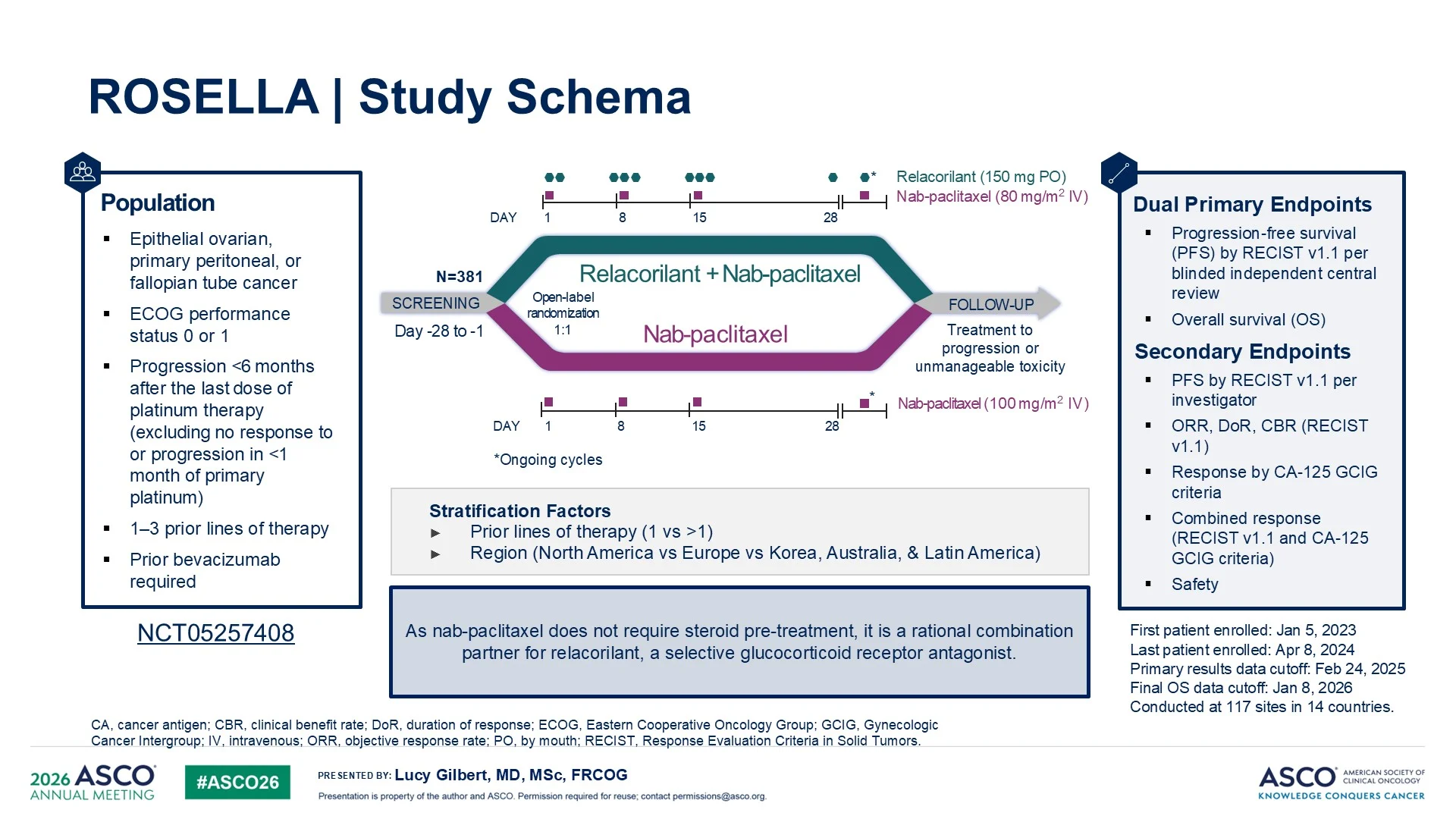
ROSELLA randomly assigned 381 patients with platinum-resistant ovarian cancer in a 1:1 ratio:
- Combination arm: relacorilant 150 mg orally the day before, the day of, and the day after nab-paclitaxel, plus nab-paclitaxel 80 mg/m² IV on days 1, 8, and 15 of each 28-day cycle.
- Monotherapy arm: nab-paclitaxel 100 mg/m² IV on the same schedule.
Key features of the analysis were as follows:
- Dual primary endpoints: progression-free survival and overall survival.
- The final OS analysis was performed after 288 deaths (76% data maturity).
- Median follow-up was 24.8 months.
- Hazard ratios were estimated with a Cox regression model adjusted for randomization stratification factors; medians and survival curves used Kaplan-Meier methods.
- Prior taxane exposure was near-universal (379/381 patients, 99.5%).
Overall Survival Results
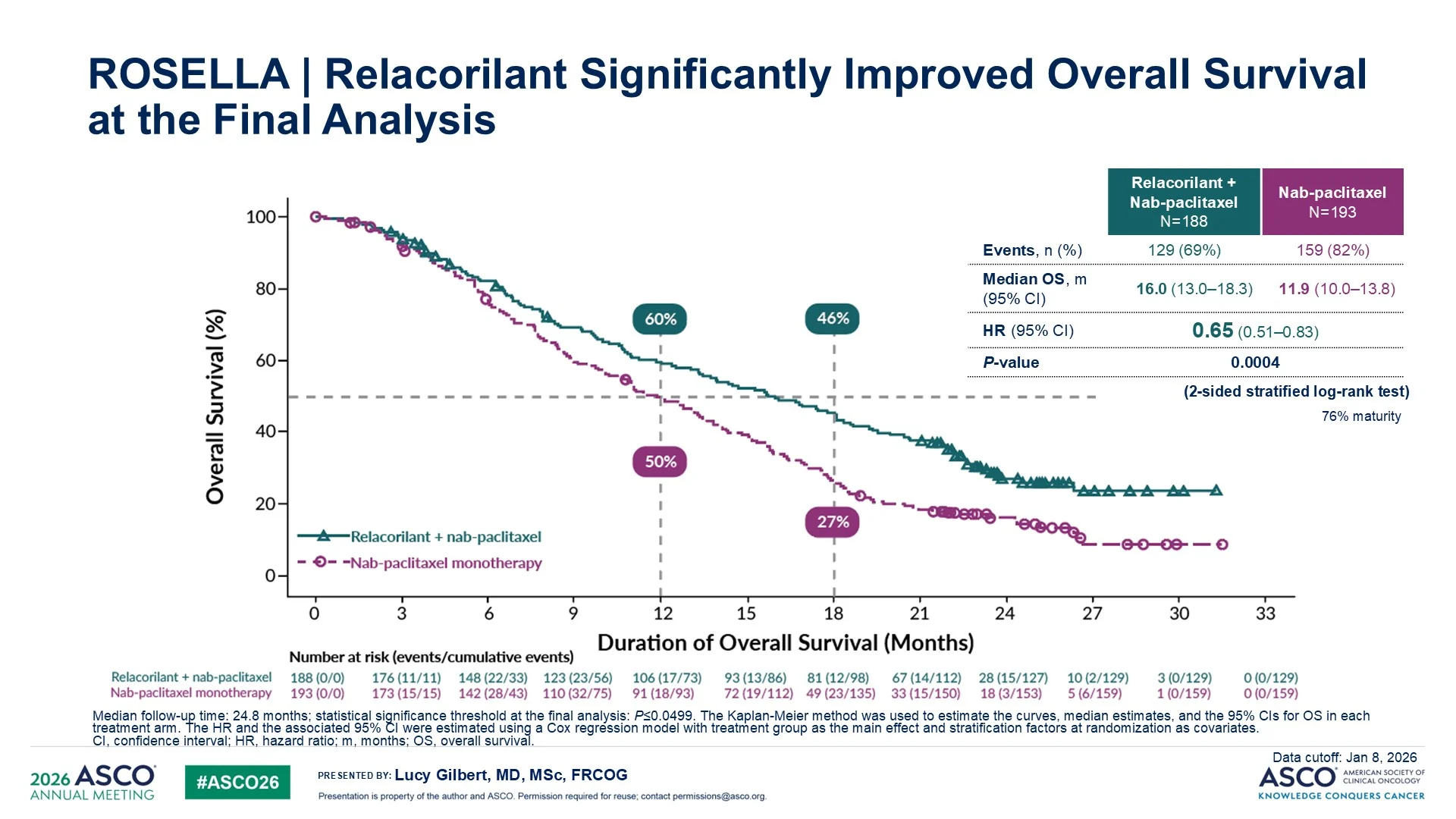
Adding relacorilant to nab-paclitaxel produced a statistically and clinically significant improvement in overall survival:
- Median OS: 16.0 months with relacorilant plus nab-paclitaxel versus 11.9 months with nab-paclitaxel alone — an absolute gain of 4.1 months.
- Hazard ratio: 0.65 (95% CI, 0.51–0.83); P=0.0004.
Subgroup Analyses: Prior Taxane Use
Because nearly every patient had received a prior taxane, a central question was whether relacorilant would still add benefit regardless of how recently or how often a taxane had been used. Across all four prespecified subgroups, the point estimates favored the relacorilant combination:
- Taxane-free interval ≤6 months (n=55): HR 0.60 (95% CI, 0.31–1.15); median OS difference 5.7 months.
- Taxane-free interval >6 months (n=324): HR 0.66 (95% CI, 0.51–0.86); median OS difference 3.6 months.
- Taxane in the most recent regimen (n=73): HR 0.67 (95% CI, 0.38–1.19); median OS difference 3.9 months.
- No taxane in the most recent regimen (n=308): HR 0.63 (95% CI, 0.48–0.82); median OS difference 4.2 months.
The direction of benefit was consistent throughout. It is worth noting that the two smaller subgroups — taxane-free interval ≤6 months and taxane in the most recent regimen — had wide confidence intervals that crossed 1, so they were not individually statistically significant; the consistency of the effect, rather than significance within each small subset, is the takeaway.
Safety
The relacorilant combination was well tolerated, with a safety profile similar to nab-paclitaxel monotherapy. Additional safety data were noted as forthcoming.
Key Takeaway from Rosella Trial
ROSELLA met both of its dual primary endpoints. In platinum-resistant ovarian cancer, relacorilant plus nab-paclitaxel delivered a statistically and clinically significant overall survival benefit compared with a weekly taxane — the most efficacious chemotherapy in this setting — with a consistent advantage across prior taxane exposure patterns.
As a first-in-class glucocorticoid receptor antagonist, relacorilant introduces a new mechanistic approach to a disease where progress has been slow, positioning the combination as a potential new option for patients with platinum-resistant ovarian cancer.
Trial Summary Written by Anush Budumyan, MD, London, UK