The wearable Tumor Treating Fields device won U.S. FDA approval alongside gemcitabine plus nab-paclitaxel after a randomized pivotal clinical trial showed a statistically significant overall survival gain—small in absolute terms and potentially constrained by real-world adherence.
Novocure announced that the U.S. Food and Drug Administration approved Optune Pax for adult patients with locally advanced pancreatic cancer when used concomitantly with chemotherapy (gemcitabine plus nab-paclitaxel).
The approval is supported by the randomized, open-label PANOVA-3 phase III clinical trial (n=571), which met its primary endpoint: median overall survival (OS) 16.2 vs 14.2 months (hazard ratio [HR] 0.82; p=0.039).
Safety was dominated by localized, device-related skin reactions and did not appear to add systemic chemotherapy toxicity; the most important practical constraint is wear time—recommended at ~18 hours/day—with trial median usage reported at 62.1%, making adherence a key real-world variable.
What the FDA approved
Optune Pax is a portable, wearable medical device that delivers Tumor Treating Fields (TTFields)—alternating electric fields intended to disrupt cancer cell proliferation.
The FDA said Optune Pax was approved via the premarket approval (PMA) pathway (its most rigorous device review process) based on a pivotal study run under an investigational device exemption; the agency described the OS improvement as approximately two months versus chemotherapy alone and highlighted localized skin reactions as the most common device-related risk.
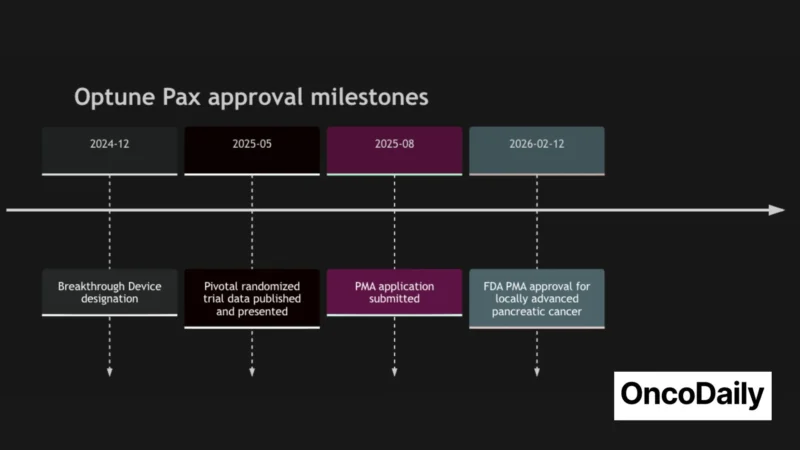
Milestone dates above are drawn from the FDA announcement and oncology trade reporting around the submission timeline.
Clinical trial evidence behind the FDA approval
PANOVA-3 was a global, randomized, open-label phase III trial enrolling 571 adults with newly diagnosed, unresectable locally advanced pancreatic adenocarcinoma, assigned 1:1 to gemcitabine/nab-paclitaxel with or without TTFields (Babiker et al. 2025).
The primary endpoint was overall survival; key secondary endpoints included PFS, local PFS, pain-free survival, and ORR (with distant PFS reported as a post hoc analysis in the publication).
Efficacy results were statistically significant for OS and pain outcomes, but selective: the publication reports no improvement in PFS, local PFS, or ORR, despite the OS and pain-free survival findings.
| Outcome (pivotal analysis) | Optune Pax + gemcitabine/nab-paclitaxel | Gemcitabine/nab-paclitaxel | Comparative effect |
| Median overall survival (intent-to-treat) | 16.2 months | 14.2 months | HR 0.82; p=0.039 |
| Median overall survival (modified per-protocol)* | 18.3 months | 15.1 months | HR 0.77; p=0.023 |
| Key adverse events (high-level) | Any-grade AEs 97.8%; grade ≥3 AEs 88.7%; device discontinuation for toxicity 8.4% | Any-grade AEs 89.9%; grade ≥3 AEs 84.2% | Device-related skin AEs 76.3% (grade ≥3: 7.7%) |
*Modified per-protocol definition required meaningful exposure (at least 28 days of device therapy or at least one full chemotherapy cycle), making it directionally relevant to adherence.
You can read more insights about Optune Pax on OncoDaily.
The market treated the FDA approval as a material catalyst: Novocure (NASDAQ: NVCR) shares finished up about 19% on February 12, 2026 after the Optune Pax FDA approval news, according to Barron’s.
Sell-side commentary split along a predictable line: upside optionality (new market entry) versus adoption friction (wear-time burden). Positive takes leaned on earlier-than-expected timing and long-run revenue optionality.
Limitations and implications for patients, clinicians, and investors
The FDA approval rests on a statistically significant OS improvement, but the absolute median OS gain (about two months in intent-to-treat) is small, and the trial was open-label, which can complicate interpretation of symptoms and downstream care patterns (though OS is less bias-prone than subjective endpoints).
The trial also shows a nuanced efficacy pattern: OS and pain-free survival improved, while PFS/ORR did not, raising plausible questions about mechanism, post-progression pathways, or the role of local control and symptom burden in this setting.
For patients and clinicians, the trade-off is concrete: potential OS and pain-control benefit versus device logistics, skin toxicity, and sustained adherence demands; patient-advocacy voices framed the approval as a meaningful milestone given slow historical progress in locally advanced disease.
For investors, the NVCR stock jump reflects a new commercial lane, but launch success will likely hinge on reimbursement execution, support services, and whether real-world adherence approaches the exposure levels where the modified per-protocol OS separation looked larger.
Written by Semiramida Markosyan, Editor, OncoDaily Canada