There was a time when biopharma megadeals read like blunt-force events, one giant swallowing another to buy scale, revenue, or a single blockbuster. The deals stacking up across oncology and life sciences in early 2026 tell a more surgical story. Across about ten days spanning late March and early April 2026, Merck, Eli Lilly, and Biogen committed more than $18 billion across three acquisitions, AI-biology partnerships reached new scale, a CAR-T therapy locked in full FDA approval, and the largest private life sciences fund ever raised closed its books. Taken together, they signal a sector that is not simply spending, it is aiming.
The throughline is the patent cliff. And the response to it increasingly looks less like a spending spree and more like a precision instrument: capital deployed deliberately to shore up pipelines, acquire scarce talent, or fold revenue-generating assets under a larger roof.
The cliff that’s reshaping every boardroom
To understand the urgency, start with the number that haunts Merck’s planning. Keytruda, the company’s PD-1 inhibitor, generated roughly $31.7 billion in global sales in 2025, nearly half of the company’s total revenue, and its key patents begin expiring with the U.S. compound patent in December 2028. Across the industry, analysts have pointed to an estimated $300 billion-plus in revenue exposed to loss of exclusivity by the end of the decade. That is the macro pressure compressing decision timelines in every large-cap oncology boardroom.
Merck’s answer was its acquisition of Terns Pharmaceuticals, a roughly $6.7 billion all-cash deal at $53 a share, a 31% premium to Terns’ 60-day volume-weighted average price, and 42% to the 90-day, that values the biotech near $5.7 billion once its cash holdings are netted out. The prize is TERN-701, an oral allosteric BCR::ABL1 tyrosine kinase inhibitor for chronic myeloid leukemia. The asset earned FDA fast track designation in Q4 2025 on the back of encouraging early data, and went on to secure breakthrough therapy designation in April 2026; analysts have framed it as a credible challenger to Novartis’ Scemblix franchise, with peak-sales projections ranging from the low billions to north of $6 billion in the long run.
What makes the deal instructive is its timing. Merck moved on Terns while dose-expansion work in the CARDINAL trial was still ongoing, a tell that the buyer was pricing conviction in the science, not waiting for de-risked certainty. It also extends a clear pattern: the Terns deal follows Merck’s roughly $10 billion purchase of Verona Pharma and a $9.2 billion deal for Cidara Therapeutics. This is a company methodically reconstructing its growth engine one differentiated, clinical-stage asset at a time, rather than betting everything on one transformative buy. Several analysts even argued the offer undervalued TERN-701, raising the prospect of competing bids, a reminder that high-quality oncology assets now command something close to a valuation floor.
Reshaping portfolios, not just patching holes
The same stretch made clear that the precision logic extends beyond pure oncology defense. Eli Lilly agreed to acquire Centessa Pharmaceuticals for $6.3 billion upfront, anchored by cleminorexton, an orexin receptor 2 agonist aimed at narcolepsy and idiopathic hypersomnia, a deliberate push deeper into neuroscience and sleep medicine. Biogen, meanwhile, agreed to acquire Apellis Pharmaceuticals for $5.6 billion upfront, picking up two already-approved products, Empaveli in rare kidney and blood diseases and Syfovre in geographic atrophy, an advanced form of macular degeneration, that together carried roughly $689 million in 2025 net sales.
The Biogen-Apellis deal illustrates a different flavor of the same strategy: rather than acquiring a years-from-market candidate, Biogen bought immediate, revenue-generating assets that diversify it beyond neurology into immunology and rare disease. One buyer is reaching for future growth; another is buying present-day revenue and optionality. Both are using M&A to redirect a portfolio’s center of gravity with intent.
The AI-native talent grab
If patent defense is one axis of the precision instrument, the scramble for AI-native biology talent is the other, and it is producing some of the most striking valuations in the sector.
The headline example: Anthropic’s roughly $400 million, all-stock acquisition of Coefficient Bio, a New York startup with fewer than 10 employees that had operated in stealth for only about eight months. The company applies AI to drafting drug R&D plans, managing regulatory strategy, and modeling biomolecules. The price tag for a sub-10-person, pre-revenue, eight-month-old company says less about its current footprint than about how scarce, and strategically prized, the intersection of foundation models and biology has become. Anthropic’s head of healthcare and life sciences framed the ambition bluntly: the company wants a meaningful share of the world’s life science work to run on its models, the way coding already does.
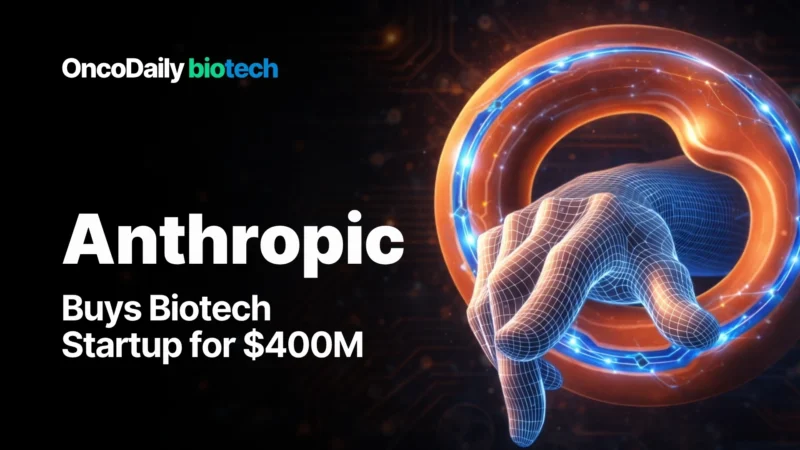
Read more on Anthropic’s acquisition of Coefficient Bio on OncoDaily.
That same conviction shows up in partnership structures, not just buyouts. Insilico Medicine struck a deal with Eli Lilly worth up to $2.75 billion, with $115 million upfront, validating its capacity to design novel molecules in a fiercely competitive market. And Infinimmune, a company just 44 months old, announced a discovery collaboration with Merck worth up to roughly $838 million, deploying its human-first Anthrobody discovery platform and its GLIMPSE antibody language model to mine therapeutic candidates directly from human immune repertoires. The common thread: large pharma is paying premium prices not only for molecules, but for the computational engines and the people who build them.
Capital is abundant, and increasingly disciplined
None of this happens without a deep capital base, and the stretch underscored that too. Blackstone closed its BXLS VI fund at $6.3 billion, the largest private life sciences fund ever raised, an expansion of nearly 40% over its predecessor. The platform, which now manages around $15 billion in assets, has touted an 86% Phase 3 approval success rate, well above industry norms, across a track record that includes commercialized therapies and devices. Abundant capital paired with selective deployment is precisely the environment in which M&A behaves like a precision tool rather than a firehose.
Behind every deal, the clinic still decides
For all the dealmaking, the period’s regulatory and clinical milestones were a useful corrective: capital can reposition a company, but execution still determines whether the bet pays off. Kite Pharma secured full, traditional FDA approval for its CAR-T therapy in adults with relapsed or refractory mantle cell lymphoma, converting the therapy from an accelerated-approval option into a durably approved one. And Revolution Medicines began dosing patients in RASolute 303, a global Phase 3 trial of its investigational therapy as a first-line treatment for metastatic pancreatic cancer, a disease that is roughly 90% RAS-driven and overwhelmingly diagnosed at advanced stages. These are the moments that ultimately justify, or undercut, the valuations being assigned upstream.
The takeaway
The early-2026 wave reframes how to read oncology M&A. The defining question is no longer simply “who is buying whom,” but what each deal is engineered to accomplish: defending against a looming loss of exclusivity, acquiring AI-native capabilities that are nearly impossible to build from scratch, or importing approved revenue to steady a portfolio in transition. Scale, science, and timing have become inseparable, and the most telling signal is conviction, buyers acting early, before the data is fully de-risked, because the cost of waiting now outweighs the cost of being wrong.
The patent cliff is not a future event the sector is bracing for. It is a present-tense force already shaping where capital, talent, and conviction converge, and, increasingly, the precision with which they are deployed.
Read more biotech insights on OncoDaily Biotech.
Written by: Semiramida Nina Markosyan, Editor, OncoDaily Canada