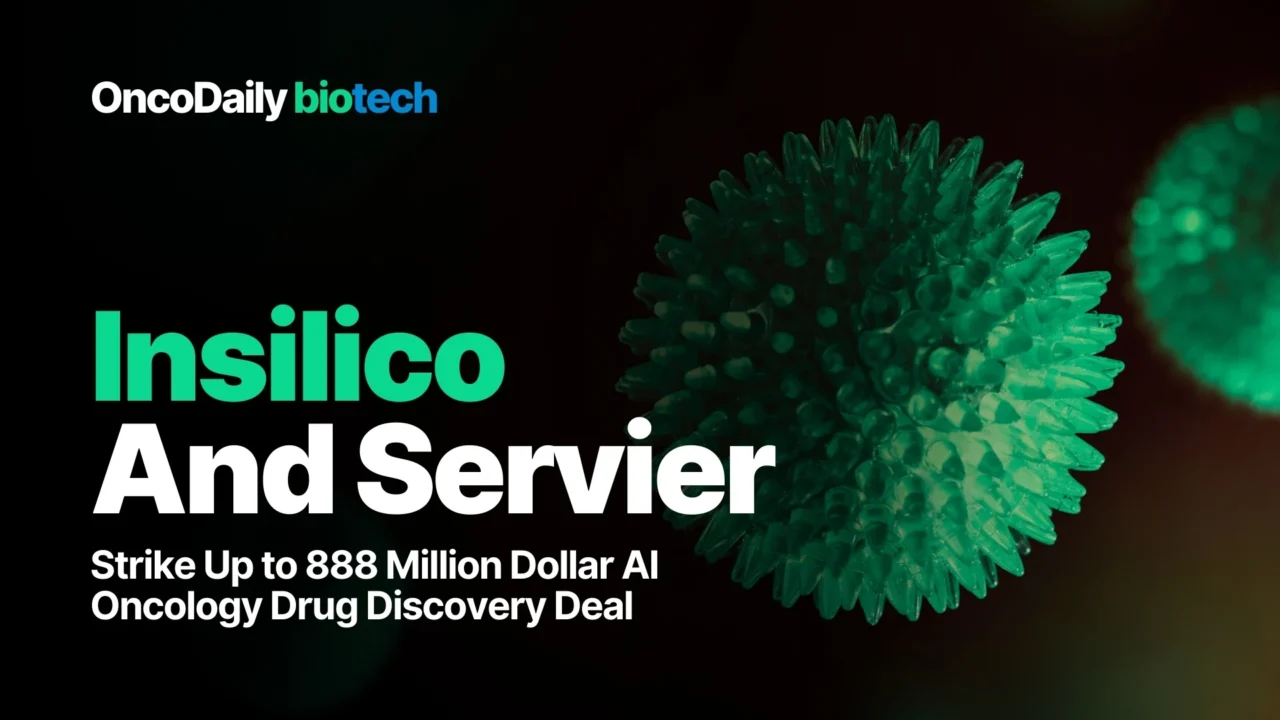
According to Insilico Medicine’ s official website, Insilico has signed a multi-year R&D collaboration with French pharma company Servier valued at up to US$888 million to discover and develop new oncology therapies by combining Insilico’s AI-driven drug discovery platforms with Servier’s global cancer drug development capabilities.
Under the agreement, Insilico is eligible to receive up to US$32 million in upfront and near-term R&D payments. The company will use its proprietary AI platform, Pharma.AI, to identify and advance potential drug candidates that meet predefined scientific and development criteria.
Servier will share research and development costs and, once promising candidates are identified, will take the lead on downstream execution, including clinical validation, regulatory engagement, and global commercialization of any resulting oncology assets. The collaboration, the companies said, is designed to accelerate work on challenging oncology targets and help translate discoveries into clinical programs more efficiently.
Servier said the partnership reflects its focus on applying advanced technologies to address unmet needs in cancer care.
“This collaboration underscores Servier’s commitment to applying cutting-edge technologies to address unmet medical needs for the benefit of patients and reflects our confidence in Insilico’s internally developed and validated AI platform,”
said Christophe Thurieau, Executive Director Research at Servier.
Insilico also framed the deal as another marker of growing momentum for AI-enabled R&D in biopharma.
“I am excited to see the collaboration—it is yet another strong acknowledgment of our AI capabilities and R&D expertise,”
said Alex Zhavoronkov, PhD, founder, CEO and CBO of Insilico Medicine.
Insilico highlighted its broader oncology track record, noting an internal pipeline spanning multiple cancer indications across both established and moderately novel mechanisms. Among its lead assets, the company pointed to the pan-TEAD inhibitor ISM6331 and the MAT2A inhibitor ISM3412, both of which are currently in global, multicenter Phase I clinical trials. Insilico added that four additional oncology programs have been fully or partially out-licensed to partners, with early-stage clinical trials underway.
The company also emphasized progress in speeding up preclinical development timelines using AI and automation. While traditional early-stage drug discovery often takes roughly four to five years, Insilico said it nominated 20 preclinical candidates from 2021 to 2024, with an average timeline of 12 to 18 months per program—from project initiation to preclinical candidate nomination—typically requiring only 60 to 200 molecules synthesized and tested per program.
Overall, the collaboration underscores the expanding role of AI and automation in pharmaceutical R&D, with the stated goal of improving early discovery efficiency, strengthening candidate selection, and accelerating the path from concept to clinic in oncology.