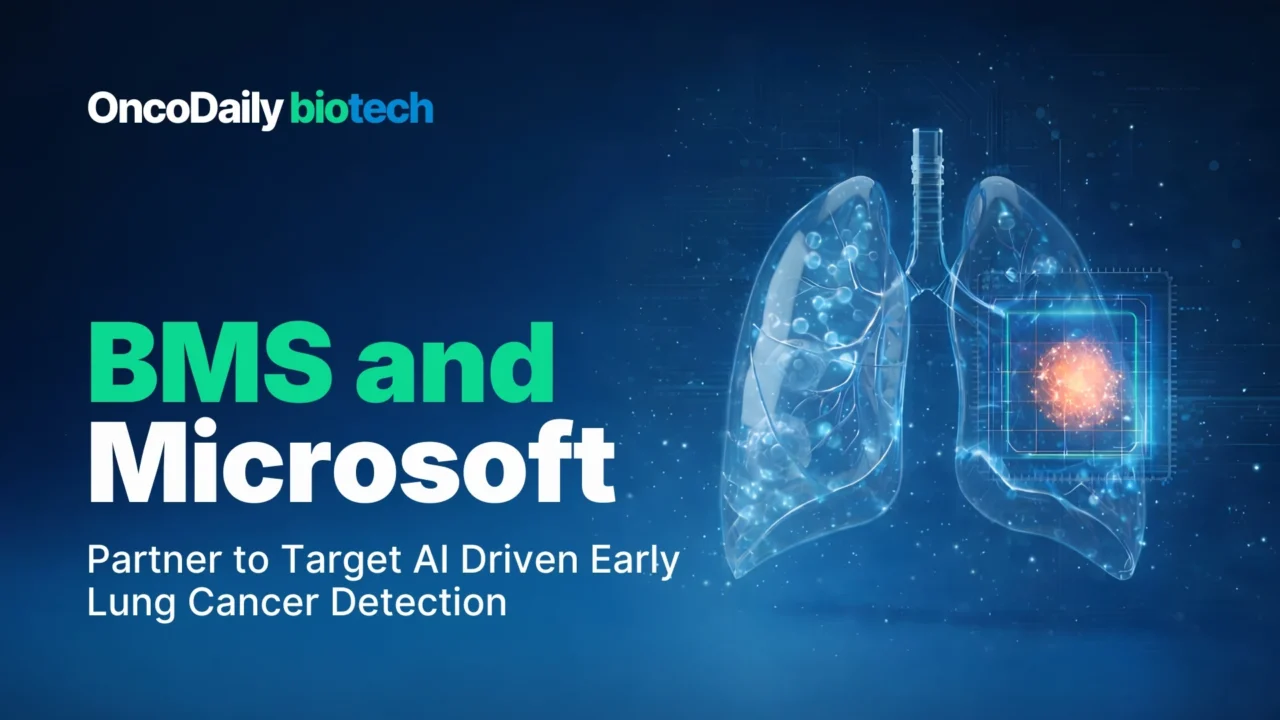
Bristol Myers Squibb (BMS) and Microsoft have announced a strategic collaboration to leverage artificial intelligence (AI) for the early detection of lung cancer. This objective, evidence-based initiative combines Microsoft’s cutting-edge radiology AI platform with BMS’s oncology expertise, aiming to identify lung cancer at earlier stages when it is more treatable. The joint effort centers on deploying FDA-cleared AI algorithms via Microsoft’s Precision Imaging Network to analyze medical images for subtle signs of lung malignancy. In doing so, the partners seek to improve patient outcomes, streamline clinical workflows, and expand equitable access to life-saving diagnostics.
Scientific Rationale for Early Lung Cancer Detection
Lung cancer remains the leading cause of cancer-related death in the United States, accounting for roughly 125,000 deaths and 227,000 new cases each year. A major reason for this high mortality is that lung cancer is often diagnosed at an advanced stage. Survival rates drop dramatically as lung cancer progresses for non-small cell lung cancer (NSCLC), the five-year survival is about 67% when the disease is still localized to the lung, but only ~12% once it has spread to distant organs. Identifying cancer earlier is therefore crucial, as early-stage patients can often undergo curative surgery or other interventions that substantially improve long-term survival.
You Can Read More About NSCLC on OncoDaily.
Medical experts have long known that early detection saves lives. For example, low-dose CT screening programs in high-risk smokers have shown significantly reduced lung cancer mortality in clinical trials. However, real-world adoption of screening has been suboptimal, especially in underserved populations. Moreover, many lung tumors are first detected incidentally, spotted on imaging scans ordered for other reasons, and tragically over half of patients with incidental lung nodules are lost to follow-up and never receive timely evaluation. This gap in care occurs due to limited resources, inconsistent tracking, and the challenge of distinguishing benign from suspicious findings on crowded chest images.
By harnessing AI’s pattern-recognition abilities, the initiative aims to “surface hard to detect lung nodules” on routine X-rays and CT scans. Even small or subtle lesions that a busy radiologist might overlook could be flagged by the algorithm for closer inspection. Catching such nodules when patients are asymptomatic enables work-up and diagnosis at an earlier stage of lung cancer, often before the disease spreads or causes symptoms.
Automating the identification and tracking of these findings addresses the follow-up problem: AI-driven workflow management tools will log and monitor incidental nodules, prompting clinicians to recall patients for appropriate diagnostic steps. In short, the collaboration is rooted in evidence that earlier diagnosis leads to better outcomes, and it deploys AI to overcome practical barriers that have hindered early lung cancer detection.
You Can Read More About AI’s Influence on Lung Cancer on OncoDaily.
Microsoft’s AI Platform and How It Works
At the core of the partnership is Microsoft’s Precision Imaging Network, an AI-powered radiology platform that is already widely used in clinical practice. In fact, over 80% of U.S. hospitals participate in this network to share medical images and access third-party imaging AI tools. Precision Imaging Network (built on technology from Microsoft’s Nuance division) integrates seamlessly into radiology workflows: when a patient gets an imaging study such as a chest X-ray or CT scan, the images can be automatically uploaded to the secure cloud-based platform.
AI algorithms then analyze the scans in the background, searching for abnormalities like lung nodules or signs of lung disease. The system highlights any suspicious regions on the images and returns the results to the radiologist within their usual viewing software, essentially acting as a second set of eyes.
What makes this platform particularly powerful is that it uses FDA-cleared AI algorithms, tools that have been vetted in clinical studies and approved for medical use . These algorithms have demonstrated high accuracy in detecting lung lesions. For example, modern AI models for chest imaging can achieve nodule detection sensitivities on the order of 70–90%, comparable to expert radiologists. The AI doesn’t diagnose cancer outright; rather, it flags potential problem spots, such as a 1 cm nodule lurking in the upper lobe, so that the radiologist can give it careful attention.
Another key feature is workflow integration and patient tracking. The platform not only detects nodules but also embeds tools to ensure those findings aren’t ignored. BMS and Microsoft have emphasized using AI-driven workflow management to address low adherence to follow-up recommendations. In practice, this means if an AI flags a nodule on a scan, the system can automatically create a alert or follow-up task in the hospital’s system.
“By combining Microsoft’s highly scalable radiology solutions with BMS’ deep expertise in oncology and drug delivery, we’ve envisioned a unique AI-enabled workflow that helps clinicians quickly and accurately identify patients with NSCLC and guide them to optimal care pathways and precision therapies.”

Alexandra Gonçalves/LinkedIn
Health Equity and Clinical Impact
A notable aspect of the BMS-Microsoft partnership is its emphasis on health equity. Lung cancer outcomes have historically been worse in rural and low-resource communities, partly due to limited access to specialized screening and diagnostics. The collaboration explicitly targets medically underserved areas, rural hospitals and community clinics, to deploy the AI early detection workflows. Because Microsoft’s Precision Imaging Network is cloud-based, a small community hospital can tap into the same AI expertise as a top academic center, without needing an on-site AI team.
This democratization of technology means patients in remote areas can benefit from early lung cancer identification just by getting a routine chest X-ray at their local clinic. If a concerning nodule appears, the system will flag it and guide the local providers on next steps, who can then coordinate care (e.g. refer for biopsy or surgery) in a timely manner.
Early pilot programs have suggested that AI can “close the loop” on incidental findings. For instance, automated alerts and tracking significantly increase follow-up rates for nodules, thus improving the likelihood of curative treatment. Over time, if successful, the BMS-Microsoft model could reduce the disparity in lung cancer survival between different socioeconomic groups.
Additionally, this partnership is part of a larger trend of life science companies adopting AI to augment research and care. Pharmaceutical companies are increasingly using AI not only for diagnosis but also in drug discovery and clinical trial efficiency. BMS’s move aligns with competitors like AstraZeneca, which recently acquired an AI firm to accelerate oncology R&D. What makes the BMS-Microsoft collaboration distinct is its clinical focus on patients today is that it seeks near-term improvement in cancer care delivery, rather than a longer-term drug research payoff.

You Can Read More About AstraZeneca’s Acquisition of Modella AI on OncoDaily.
Written by: Semiramida Nina Markosyan, Editor, OncoDaily Canada