“The first AI-designed cancer drug could be approved this year.” It’s the kind of line that captures the mood in oncology drug development right now, and it deserves a careful reading. The more precise version, drawn from industry analyses such as IntuitionLabs’ review of the AI drug pipeline, is that the first FDA approval of any AI-discovered drug is projected for 2026–2027. That is a forecast, not a fact. And the molecules closest to the finish line aren’t cancer drugs at all: the single most-advanced AI-designed compound, Insilico Medicine’s rentosertib, treats idiopathic pulmonary fibrosis, not a tumor.
So the honest framing is narrower, but still striking. AI-originated drugs are arriving in the clinic in real numbers, a meaningful share of them in oncology, and the field is about to learn whether the technology’s early promise survives contact with late-stage trials.
What’s actually happening?
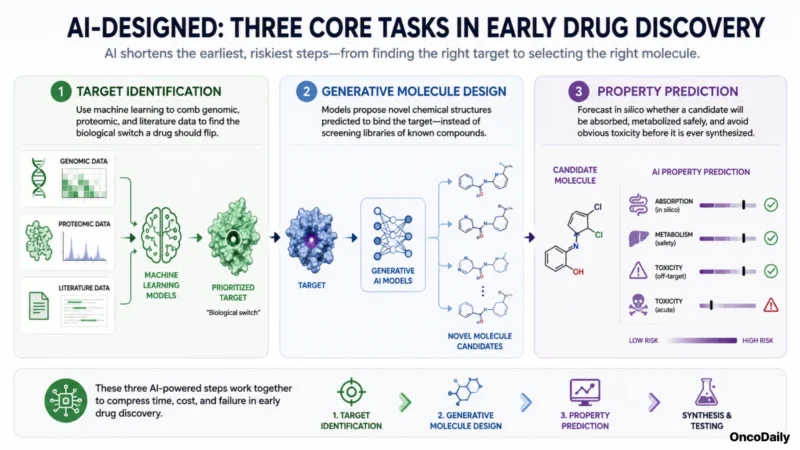
“AI-designed” is shorthand for three distinct tasks. The first is target identification, using machine learning to comb genomic, proteomic, and literature data for the biological switch a drug should flip. The second is generative molecule design, in which models propose novel chemical structures predicted to bind that target, rather than screening libraries of known compounds. The third is property prediction: forecasting in silico whether a candidate will be absorbed, metabolized safely, and avoid obvious toxicity before it is ever synthesized. Used together, these tools compress the slowest, most failure-prone early steps. Insilico reports moving rentosertib from discovery through preclinical work in roughly 30 months, against an industry norm closer to six years.
The pipeline reflects that acceleration. Per IntuitionLabs, more than 173 AI-originated drug programs are now in clinical development, up from roughly two dozen in late 2023, with an estimated 15–20 expected to reach pivotal trials in 2026. Oncology is well represented: Insilico has AI-designed candidates against targets such as USP1 and ENPP1 in early trials, and the merged Recursion–Exscientia is advancing cancer programs including an RBM39 degrader with data expected this year.
Read more on Insilico has AI-designed candidates on OncoDaily.
The numbers, and the asterisks
The statistic doing the heaviest lifting is the Phase I success rate. Analyses cited by IntuitionLabs and published in Drug Discovery Today put AI-discovered molecules at an 80–90% Phase I pass rate, against a historical average near 52%. Taken at face value, that suggests AI is unusually good at designing molecules with drug-like properties.
It is encouraging. It is not yet decisive, for three reasons. First, Phase I primarily measures safety and tolerability, whether patients can take the drug without unacceptable harm, and says little about whether it treats the disease. A high Phase I pass rate is consistent with AI being excellent at chemistry and silent on biology. Second, the sample is small and young: the headline figure rests on roughly 24 molecules that had cleared Phase I by late 2023. Third, selection and survivorship effects likely inflate it. AI-native companies advance their best candidates and partner the most promising ones, and failures are quieter than successes.
Tellingly, when the same analyses look one stage later, the Phase II success rate for AI-discovered drugs falls to around 40%, essentially in line with traditional methods. The early edge, so far, narrows.
The deals, conviction, not validation
If the clinical data are still maturing, the dealmaking is not subtle. In March 2026, Eli Lilly signed a collaboration with Insilico worth up to $2.75 billion in milestones, $115 million of it upfront, for AI-designed oral therapeutics. Days later, Anthropic, the AI lab behind Claude, acquired the stealth biotech startup Coefficient Bio for roughly $400 million in stock, absorbing a team of fewer than ten former Genentech computational scientists.
Read more on Anthropic’s acquisition of Coefficient Bio on OncoDaily.
These are different animals: one a back-loaded pharma licensing bet that pays out mostly on success, the other a Silicon Valley acqui-hire of scarce biology-and-AI talent. Together they signal that both incumbents and tech entrants now treat AI-driven discovery as strategically essential. But conviction is a claim about expected value, not evidence of clinical benefit, and notably, neither deal is oncology-specific. Capital is a leading indicator of belief, not a substitute for a positive Phase III.
Feasibility versus validation
This is the distinction the field most needs. What AI has clearly demonstrated is feasibility: it can identify targets, design plausible novel molecules, and move them into humans faster and, on early evidence, with fewer safety washouts. That is a genuine inflection, and the optimistic read is reasonable, if AI systematically yields cleaner molecules against better-chosen targets, improved approval odds should eventually follow.
Validation is a higher bar, and AI has not cleared it yet. Validation means Phase II and Phase III efficacy, regulatory approval, and, in oncology specifically, evidence that patients live longer or better, not merely that a tumor shrinks on a scan. The skeptical read has support: AI-native firms often chase novel, first-in-class targets, which historically fail more often than validated ones. And the field has already logged cautionary failures, such as BenevolentAI’s eczema candidate, which missed in Phase IIa in 2023. The most encouraging counterexample, Insilico’s rentosertib showed a real lung-function benefit over placebo in a 71-patient Phase IIa published in Nature Medicine, is meaningful, but it is one trial, in one disease, that is not cancer.
A measured forward look
The right expectation for 2026 is an inflection in activity, not yet a verdict on value. The first AI-discovered drug may well be approved in the next year or two; the first AI-designed cancer drug is a harder, later bet, because the leading oncology candidates remain in early trials. What to watch is unglamorous and decisive: Phase II and III readouts, and whether any AI-originated oncology program ultimately shows a survival benefit. Until then, the most accurate statement is also the least dramatic. AI has changed how fast cancer drugs reach the clinic. We are still waiting to learn whether it changes how well they work.
Read more biotech insights on OncoDaily Biotech.
Written by: Semiramida Nina Markosyan, Editor, OncoDaily Canada