In 2023, AstraZeneca paid Tao Hu’s previous company $24 million upfront for a KRAS G12D drug. On Monday, Merck agreed to pay his new company, SciBrunch, $400 million for another. In between, drugs built like SciBrunch’s started working in patients, and Chinese assets got much more expensive.
Merck has agreed to pay SciBrunch Therapeutics $400 million upfront for SPR2015, an oral KRAS G12D (ON) inhibitor that has yet to be tested in people. Milestones could take the total to $2.13 billion, and the deal has closed.
SciBrunch’s founder and CEO, Tao Hu, has done this before. In November 2023, Usynova, the Shanghai biotech he co-founded and ran, licensed its preclinical G12D inhibitor UA022 to AstraZeneca for $24 million upfront and up to $395 million in milestones.
Same mutation, same stage of development, and an upfront nearly 17 times larger. Total potential value grew only about fivefold, from $419 million to $2.13 billion, so the share paid upfront rose from about 6% to 19%. What changed in between helps explain the price.
The design now has a track record
UA022 was a reversible inhibitor built to bind KRAS G12D in both its active and inactive states. AstraZeneca took it into Phase 1 as AZD0022, then dropped it in late 2025, citing portfolio prioritization.
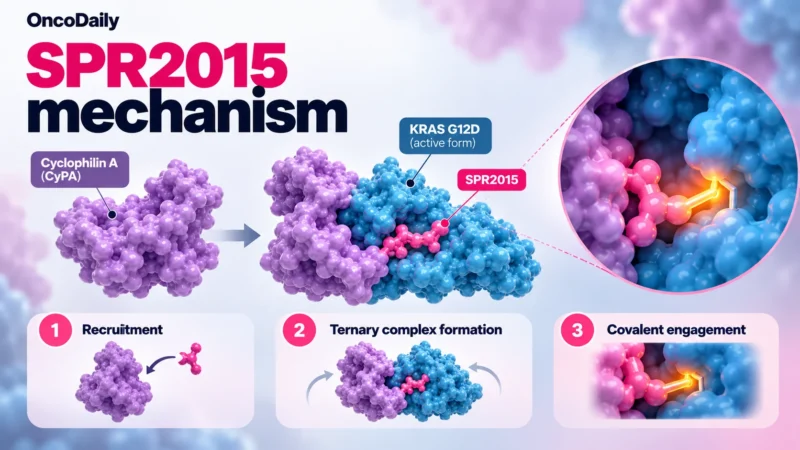
SPR2015 takes a different route. According to SciBrunch’s AACR 2026 abstract, it pulls cyclophilin A, a common cellular protein, into a three-part complex with the active form of KRAS G12D. It then locks on with a covalent bond to the mutant residue. That closely mirrors Revolution Medicines’ zoldonrasib, and 2026 is the year Revolution’s cyclophilin A-based drugs proved themselves in patients.
In the Phase 3 RASolute 302 trial, daraxonrasib, a non-covalent sibling that hits many RAS mutants, nearly doubled median overall survival against chemotherapy in previously treated metastatic pancreatic cancer, 13.2 months versus 6.7. The FDA approved it as Rasonque on August 26. Zoldonrasib won Breakthrough Therapy designation in lung cancer in January and posted a 52% confirmed response rate at AACR in 27 patients previously treated with immunotherapy and platinum chemotherapy, but not docetaxel.
In 2023, a preclinical G12D molecule was a bet on an idea. Today it is a bet on a mechanism that has already worked in people.
Merck’s KRAS math
Merck has its own KRAS drug in Phase 3. Calderasib (MK-1084), its G12C inhibitor developed with Taiho and Astex, is in five such trials and in May won Breakthrough Therapy designation with Keytruda for first-line G12C lung cancer that expresses PD-L1. But G12C sits mostly in lung cancer. G12D turns up in roughly 38% of pancreatic cancers and is the most common KRAS mutation in colorectal cancer. In both diseases, immunotherapy, Keytruda included, has helped only a small group of patients, mainly those with MSI-high tumors.
In January, the Financial Times reported that Merck was in talks to buy Revolution for $28 billion to $32 billion. The Wall Street Journal later reported that the talks had ended over price, and it was widely suggested that Revolution’s G12C drug, elironrasib, would have been redundant next to calderasib. SPR2015 has no such overlap. Merck says the deal “complements and diversifies” its pipeline of precision targeted candidates.
The patent clock and China’s rising prices
Keytruda and Keytruda Qlex, its new subcutaneous version, brought in $31.7 billion of Merck’s $65.0 billion in 2025 sales. Keytruda’s key US patent expires in 2028, and Merck expects to shift 30% to 40% of Keytruda use to Qlex.
China has become a regular stop. In 2024, Merck paid LaNova $588 million upfront for a PD-1/VEGF bispecific in Phase 1, and Hansoh $112 million for a preclinical oral GLP-1 drug. SciBrunch’s upfront is more than three times Hansoh’s, for a molecule at the same stage.
The old China discount is fading. Evaluate data show the average upfront in cross-border licensing deals for Chinese biotech drugs more than tripled between 2022 and early 2026, to $172 million. “It’s not a bargain basement anymore,” said Evaluate’s Mark Lansdell.
SciBrunch is roughly two years old and has raised $65 million across two funding rounds, so Merck’s upfront is more than six times what investors have put in. Hu also has Merck on his résumé: before senior roles at WuXi AppTec, he did small-molecule research at Merck and Amgen in the US.
The catch: a late start
SPR2015 is still preclinical; it’s been reported that human testing was expected to begin by year-end. Its rivals are in Phase 3. Revolution has three Phase 3 trials of zoldonrasib under way, and Astellas has started Phase 3 trials of its G12D degrader, setidegrasib, in pancreatic and lung cancer. Verastem’s VS-7375, an ON/OFF inhibitor from China’s GenFleet Therapeutics, has been given to more than 200 patients, with Phase 3 trials due to start by mid-2027. GenFleet is running its own Phase 3 in China.
With pancreatic cancer getting crowded, SciBrunch’s data point to colorectal cancer. Its abstract notes that no G12D inhibitor had shown clinically meaningful single-agent activity in colorectal patients. That still largely holds: in June, VS-7375 alone shrank tumors by at least 30% in 11% of 35 colorectal patients in China. SPR2015 alone shrank tumors in nearly two-thirds of more than 15 colorectal mouse models, though at a higher dose than it needed in pancreatic and lung models. Results in mice often fail to hold up in patients, but if these do, Merck would have something its rivals lack.
What to watch
The near-term markers are the first patient dosed and early safety and response data, especially in colorectal cancer. Competitors will set the bar first: Verastem presents new VS-7375 data on October 14, and Incyte reports colorectal results for its G12D inhibitor, alone and with cetuximab, at ESMO on October 25. Rivals are pairing G12D drugs with EGFR antibodies in colorectal cancer, a playbook Merck already runs with calderasib in KANDLELIT-012, a first-line colorectal Phase 3 with cetuximab and chemotherapy.
AstraZeneca’s $24 million bought a G12D molecule it later shelved for portfolio reasons. Merck’s $400 million buys a design with an approved relative and strong colorectal data in mice. The first colorectal results in patients will show whether it was worth paying nearly 17 times as much upfront.
Read more on OncoDaily: Merck Enters $2.13 Billion License Agreement for SciBrunch’s Investigational Oral KRAS G12D (ON) Inhibitor SPR2015