





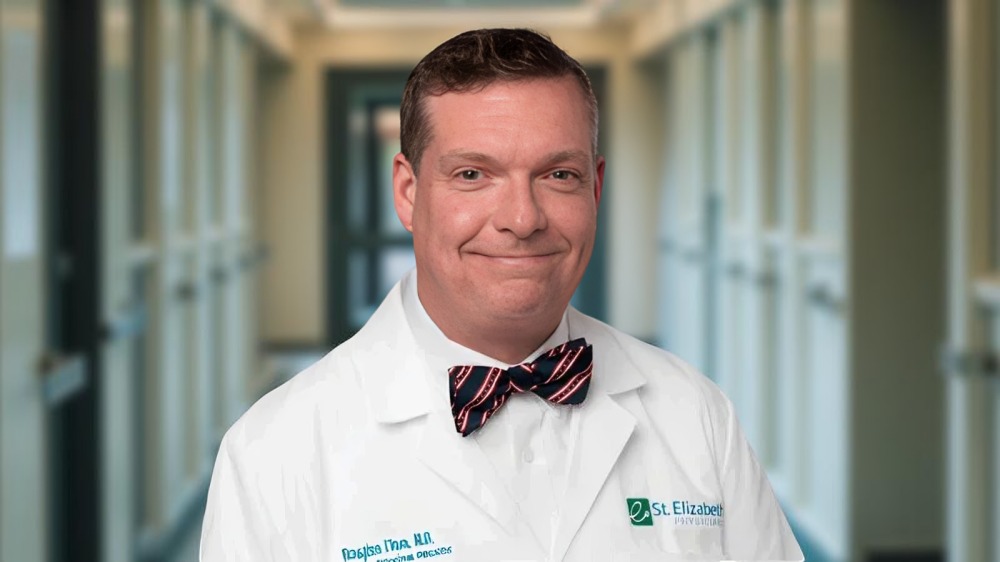
Douglas Flora, President-Elect at Association of Cancer Care Centers, shared on LinkedIn:
“For World Lung Cancer Day, August 1
‘Nothing in life is to be feared; it is only to be understood. Now is the time to understand more, so that we may fear less.’ -Marie Curie.
I say a version of this sentence to nearly every patient who sits across from me with a new diagnosis: There has never been a better day to have cancer than today, and tomorrow will be better than this one.
August 1 was World Lung Cancer Day. With her blessing, I want to share my friend Michelle’s story.
She was 34 when we met, and she had just been diagnosed with stage four lung cancer. She had a two-month-old infant at home. The disease had already reached her brain. A large amount of fluid had gathered around one lung, restricting her breathing. When I walked into her exam room for the first time, I felt sick to my stomach thinking about what I was going to have to share with her and her family.
We did not yet know that her tumor carried a specific vulnerability: a deletion in Exon 19 of a gene called EGFR.
This single detail changed everything. This mutation essentially works on her cell growth like a thermostat with a broken dial that stays permanently stuck on maximum heat, forcing the cells to grow endlessly until a targeted pill comes along to reset the temperature manually. Fortunately, we had a new pill designed to attack that exact mutation. She started on it 12 years ago. Because of this, she has now been able to raise that two-month-old infant and watch both of her children grow. She takes a single tablet each morning and continues her life.
For most of the history of oncology, a story like hers would be classified as a miracle. I think that term does a disservice to the science. A miracle, by definition, cannot be replicated. Michelle survived because we identified the specific genomic driver of her cancer and deployed a targeted intervention against it.
She survived because of the dedicated work of thousands of people, identifying the EGFR receptor as a target, the tests that locate it, and the drugs that treat it. This represents a method we have learned to apply, one that is now being repeated and refined. That distinction forms the basis of my optimism for the field.
The therapeutic toolkit has expanded in the years since her diagnosis. When Michelle became ill, identifying such mutations was a slow process. A patient presenting with her disease today enters a vastly different clinical landscape. We can analyze a tumor across multiple dimensions simultaneously, examining its genomics, proteomics, and metabolism. We monitor cancer evolution through peripheral blood draws rather than repeated surgical biopsies. Next-generation targeted therapies achieve central nervous system penetration that early drugs could not. Increasingly, we utilize artificial intelligence to analyze immense datasets, identifying patterns beyond human visual limits. And the best part is that these advancements compound over time.
World Lung Cancer Day also brings attention to early detection. Low-dose computed tomography can identify lung cancer at an early, asymptomatic stage, vastly expanding our therapeutic options. Access to this screening remains uneven due to stringent qualification criteria, geographic proximity to specialized centers, and general awareness. Expanding access to early detection requires concerted structural changes in healthcare delivery alongside scientific discovery.
World Lung Cancer Day is a good reminder to celebrate the victories, and it is equally a day to honor the memories of the people we could not save. I still have hard conversations regarding poor prognoses. Transformative treatments have not yet reached everyone in the clinic, and we carry the memory of those we have lost into every patient encounter. Yet, I am grateful that survival rates for lung cancer continue to improve steadily. This progress is driven by more patients undergoing early screening and the continuous development of more effective treatments.
We are doing measurably better, and there remains a vast amount of work to be done.
What has changed within the span of my life as an oncologist is the ratio of these outcomes. The American Cancer Society’s 2026 Facts and Figures report reflects this shift on a population scale, detailing unprecedented, compounding improvements in lung cancer survival rates over the last decade.
During my training, a case like Michelle’s was a rare anomaly. Today, my clinic schedule includes many individuals whose long-term survival would have once been considered impossible. Patients I met eight or ten years ago with advanced disease continue to return for routine follow-ups. They consistently outlive the initial statistical projections. The routine nature of these appointments serves as compelling evidence of clinical progress (and why I care so much about cancer research!)
Michelle has become a fixture in my practice. Over time, the traditional boundaries of the physician-patient relationship naturally dissolve. We are good friends now. We share book recommendations during her visits, and we have even shared a few beers at a local festival. We have grown closer, a bit older, and neither of us takes any of this for granted. The theme for this year’s World Lung Cancer Day observance is ‘Together through Lung Cancer.’ It accurately describes the shared journey of our relationship.
The medicines improved, and her specific tumor biology was responsive. I expect that outcomes like hers will increasingly become the standard rather than the exception. The diagnostic and therapeutic tools we are building systematically convert isolated successes into reproducible methods. Over time, these methods will become the rule, rather than a happy exception.
When I tell my patients that there has never been a better day to face this diagnosis than today, I really believe what I am saying. I now tell people with Stage IV disease we cannot cure their cancer with today’s drugs; I place an intentional emphasis on the latter part of the sentence.
We offer the best interventions available now, and we expect our capabilities to expand next year. Michelle trusted in the trajectory of that science. You know, if you follow this page, that some of these advancements are accelerating due to the impact of AI on screening and early detection, and faster/better drug discovery and development.
The future of cancer care is visible in the patients we treat today. When I first walked into Michelle’s life, with that pit in my stomach, the prevailing statistics suggested Michelle would not see her daughter’s second birthday. Twelve years later, her kids are thriving as they enter their teenage years, and Michelle has become a powerful advocate for the lung cancer community and a true friend. She lived to change the narrative of this disease.
Her life today stands as the most compelling proof I know that there has never been a better day to have cancer than today.”
Other articles featuring Douglas Flora on OncoDaily.