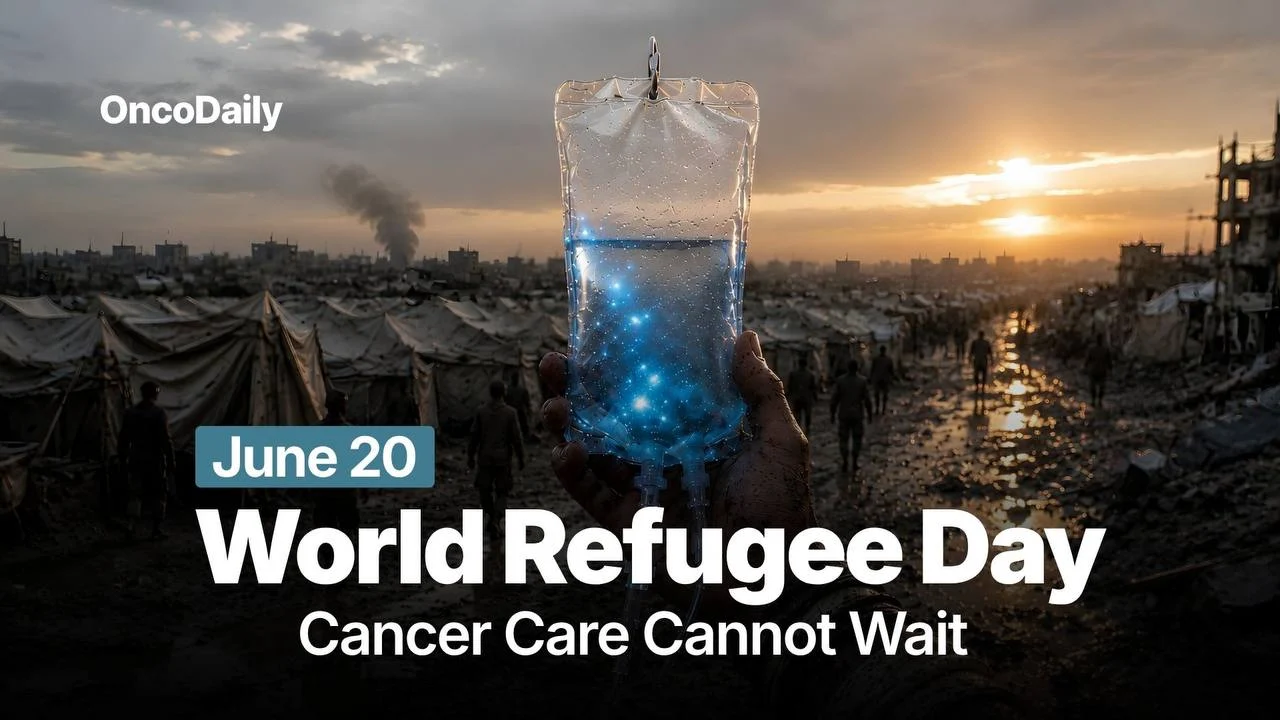
On World Refugee Day, the global community recognizes people forced to flee conflict, persecution, and disaster. Among them are patients whose cancer diagnosis, treatment, and follow-up are disrupted by displacement.
Cancer is an important but often under-recognized challenge in refugee health. Humanitarian responses have historically focused on acute infection, malnutrition, injury, and maternal-child health. Yet many displaced people now live for years in host communities and require sustained care for noncommunicable diseases, including cancer. A 2025 systematic review and meta-analysis brought together evidence from 29 studies involving 561,850 refugees across 12 host countries. The findings show substantial variation in cancer burden, major gaps in data, and persistent barriers to prevention, early diagnosis, treatment, and continuity of care.
World Refugee Day: What It Means and Who It Honors
Observed every year on June 20, World Refugee Day is a United Nations international day that honors the strength, courage, and resilience of people forced to flee their homes because of conflict, violence, or persecution. First marked globally in 2001, it also calls attention to refugees’ rights, safety, dignity, and ability to rebuild their lives.
A refugee is someone who has left their country because they cannot safely remain there and has sought protection in another country. Under the 1951 Refugee Convention, refugee status is linked to a well-founded fear of persecution based on factors such as race, religion, nationality, political opinion, or membership in a particular social group.
For people living with cancer, becoming a refugee can mean more than leaving home. It may involve losing access to diagnosis, treatment records, medicines, specialist care, and long-term follow-up—making equitable cancer care an essential part of humanitarian response.
A Burden That Is Difficult to Measure
Reliable cancer surveillance among refugee populations remains limited. Displacement can interrupt medical records, fragment follow-up, and reduce access to cancer registries and diagnostic services. As a result, the true burden of cancer is likely under-documented in many humanitarian settings.
Across the studies included in the 2025 systematic review, cancer prevalence ranged from 0.5% to 13.3%, reflecting major differences in population characteristics, host-country health systems, study methods, and access to diagnosis.
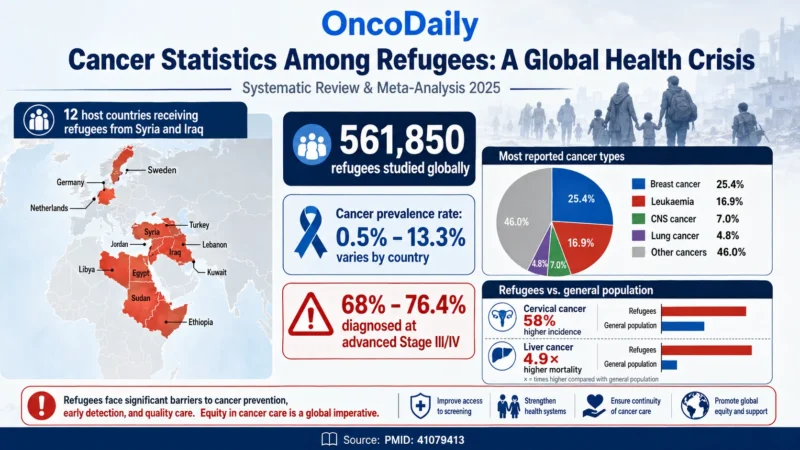
The review found that breast cancer was the most frequently reported cancer type, accounting for 25.4% of cases. Leukaemia represented 16.9%, central nervous system cancers 7.0%, and lung cancer 4.8%. These figures do not define a universal cancer profile for all refugee communities, but they underline the need for cancer services that address both common adult malignancies and paediatric cancers.
The Cost of Late Diagnosis
One of the most concerning findings in the literature is the frequency of advanced-stage presentation. In studies of Syrian refugees in Turkey, between 68% and 76.4% of patients were diagnosed with stage III or IV disease. This is not a pooled global estimate, but it illustrates how displacement can delay diagnosis and limit access to timely treatment. Late-stage presentation may result from multiple overlapping barriers: limited cancer awareness, language differences, transportation difficulties, financial hardship, lack of documentation, fragmented referral pathways, and competing priorities such as housing, food security, and safety.
For many refugee families, seeking medical care may require travel across long distances, repeated administrative steps, and costs that are difficult to meet. In these circumstances, symptoms may be ignored or evaluated only when they become severe. Earlier diagnosis is not achievable through screening alone. However, accessible primary care, symptom awareness, appropriate referral systems, vaccination programmes, and context-specific early detection strategies can help reduce avoidable delays.
Cancer Treatment and the Funding Gap
Cancer care is costly, complex, and time-sensitive. It requires access to pathology, imaging, surgery, systemic treatment, radiotherapy, supportive care, and follow-up. In humanitarian settings, these services are often fragmented or unavailable.
Data from UNHCR Exceptional Care Committees in Jordan demonstrate the difficult decisions that can arise when funding is limited. Between 2010 and 2012, 511 applications for cancer treatment were reviewed, but only 246 were approved. The main reason for denial was poor prognosis, reflecting a setting in which limited resources had to be allocated among patients with high-cost needs. A later analysis of Jordan showed that, between 2016 and 2017, only 40% of 289 cancer-treatment applications reviewed by the UNHCR Exceptional Care Committee were approved and funded. These figures should be understood as historical, setting-specific data from Jordan, not as a current global treatment-approval rate for refugees.
They nevertheless reveal a fundamental ethical challenge: cancer care cannot depend on short-term emergency funding alone.
Interrupted Treatment Is Another Form of Inequity
For patients already diagnosed with cancer, displacement can interrupt treatment at every stage.
Radiotherapy may be delayed because of travel barriers or lack of local facilities. Systemic treatment may be interrupted when patients move across borders or lose access to medicines. Medical records may not travel with the patient, making it difficult for new oncology teams to safely continue treatment. Studies among Syrian refugees have reported substantial challenges with treatment completion, while research involving Ukrainian refugee patients showed that not all individuals were able to continue treatment initiated in their country of origin.
For cancer patients, an interruption is not simply an administrative problem. It can mean delayed surgery, missed cycles of systemic therapy, incomplete radiotherapy, untreated toxicity, or loss of follow-up after remission. Continuity of care must therefore be treated as a core component of refugee cancer policy.
Children With Cancer Face Added Vulnerability
Paediatric cancer care requires specialized multidisciplinary teams, timely diagnostics, access to pathology, chemotherapy, transfusion support, infection management, surgery, radiotherapy, and long-term follow-up. Refugee children may face all of the structural barriers experienced by adults, while also depending on caregivers who may be navigating poverty, trauma, legal uncertainty, and unstable housing.
Evidence from Turkey has suggested poorer outcomes among Syrian refugee children with cancer than among non-refugee children treated in the same setting. These disparities highlight that providing nominal access to treatment is not enough. Families also need transport support, interpreters, accommodation, nutrition, psychosocial care, and reliable access to medicines.
What an Equitable Response Looks Like
Cancer care for refugees should not be treated as an optional service or a luxury reserved for stable health systems. It should be integrated into national cancer-control and universal-health-coverage plans.
Several priorities can help move the response forward: First, host countries and humanitarian partners need stronger cancer registries and interoperable medical records. A patient should not lose their diagnosis, pathology report, or treatment history because they cross a border.
Second, prevention and early-detection services should be adapted to refugee communities. This includes culturally appropriate cancer-awareness programmes, HPV vaccination, hepatitis B prevention and treatment, tobacco control, and access to evidence-based screening where feasible. Third, cancer services should be integrated into national health systems rather than delivered only through parallel emergency programmes. This can reduce inequities between refugees and host communities while strengthening local oncology capacity.
Fourth, sustainable financing mechanisms are essential. Humanitarian funding cycles are often too short to support cancers that require months or years of treatment and follow-up. Partnerships between governments, international organizations, cancer centres, insurers, philanthropic groups, and industry may help create more durable models. Finally, the research gap must close. More data are needed from low-income and middle-income host countries, from African and Asian refugee settings, and across the full cancer-care continuum.
Cancer Care Cannot Wait
The evidence available today does not show one single refugee cancer experience. Refugee populations are diverse, and access to care differs widely across countries and health systems. But the pattern is consistent: displacement can turn a treatable cancer into a late diagnosis, an interrupted treatment course, or an unaffordable need.
On World Refugee Day, the message is clear. Refugees with cancer need more than emergency support. They need timely diagnosis, uninterrupted treatment, supportive care, and a realistic chance of survival.
Cancer should not become a consequence of displacement.
You Can Also Read Immigration and Cancer Outcomes: Bridging the Gap in Healthcare Access by OncoDaily
Written by Aharon Tsaturyan, MD, Editor at OncoDaily Intelligence Unit
FAQ
What is World Refugee Day?
World Refugee Day is observed every year on June 20 to honor the courage and resilience of people forced to flee their homes because of conflict, persecution, violence, or disaster. It also draws attention to refugees’ rights, safety, dignity, and access to essential services, including healthcare.
Who is considered a refugee?
A refugee is a person who has left their country because they cannot safely remain there and has sought protection in another country. Refugees may flee war, persecution, violence, or serious threats to their safety and human rights.
Do refugees have access to cancer treatment?
Access varies widely by country. Some refugees can receive cancer treatment through national health systems, UN agencies, charities, or humanitarian programmes. However, many still face barriers such as high costs, limited insurance coverage, long travel distances, language differences, missing medical records, and shortages of specialist cancer services.
Why are refugees often diagnosed with cancer at a later stage?
Cancer diagnosis may be delayed because refugees can face disrupted healthcare access before, during, and after displacement. Barriers may include transportation costs, lack of information, language challenges, legal or documentation issues, limited screening programmes, and difficulty obtaining specialist referrals.
What cancers are most commonly reported among refugees?
Published studies have reported breast cancer, leukaemia, central nervous system cancers, and lung cancer among the most frequently documented malignancies in refugee populations. However, cancer patterns vary by age, country of origin, host country, and access to diagnosis.
Can refugees receive cancer screening?
Yes, but screening access is often inconsistent. Programmes for cervical, breast, colorectal, and other cancers may not be easily available to displaced populations. Culturally appropriate outreach, interpreters, transport support, and integration into national screening programmes can help improve access.
How can cancer care for refugees be improved?
Key priorities include integrating refugees into national health systems, ensuring affordable diagnosis and treatment, strengthening referral networks, maintaining portable medical records, expanding prevention and vaccination programmes, and developing sustainable financing for long-term cancer care.