
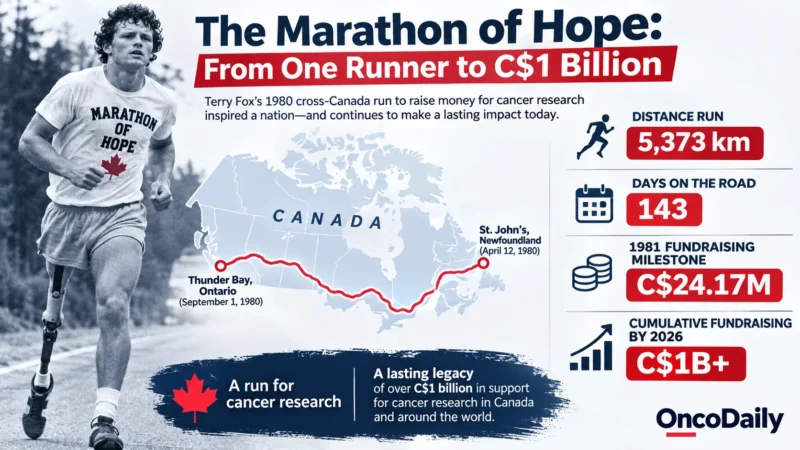
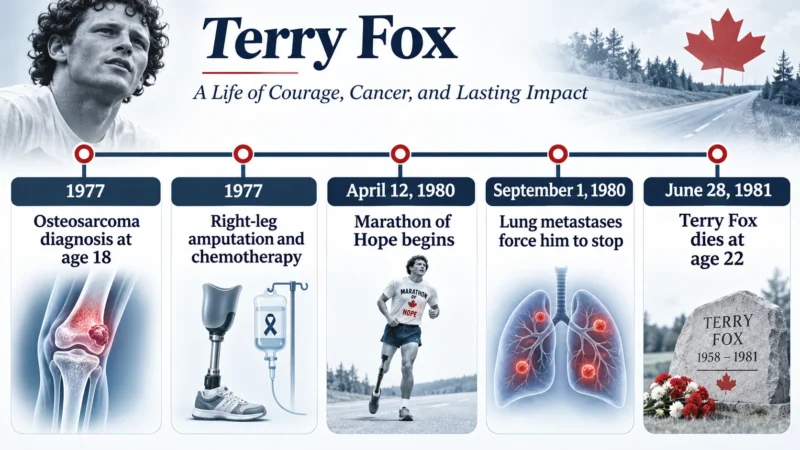
Terry Fox, the Canadian athlete who lost his right leg to bone cancer and attempted to run across Canada to raise money for cancer research, became one of the most influential figures in the history of cancer awareness. Diagnosed with osteosarcoma at just 18 years old, Fox turned his experience with the disease into an extraordinary humanitarian mission known as the Marathon of Hope. On April 12, 1980, wearing a prosthetic leg, Fox began running from Canada’s Atlantic coast toward the Pacific Ocean.
Over the following 143 days, he covered 5,373 kilometres, averaging almost the distance of a marathon each day. His journey ended on September 1, 1980, when doctors discovered that his cancer had spread to his lungs. Terry Fox died on June 28, 1981, at the age of 22. Yet the mission he began continued long after his death.
More than four decades later, the Terry Fox Foundation and its supporters have raised over C$1 billion for cancer research, supporting scientific discoveries and new approaches to treatment. In 2026, that legacy reached another milestone with a historic C$25 million donation and the expansion of national precision oncology research initiatives. Terry Fox’s story is powerful because it combines personal suffering with public purpose. He did not run to become famous.

Photo: Depositphotos St. John’s, Newfoundland, Canada – September 13, 2022: The Terry Fox Mile Zero statue marks the spot where the Canadian hero dipped his prosthetic leg into the Atlantic Ocean to begin his Marathon of Hope.
He ran because he believed that cancer research needed more support, and because he wanted to help people facing the same disease that had changed his life. His story is not only one of athletic determination. It is also the story of a young cancer patient whose personal experience helped transform public engagement with cancer research.
Who Was Terry Fox?
Terrance Stanley Fox was born on July 28, 1958, in Winnipeg, Manitoba, Canada. He grew up in Port Coquitlam, British Columbia, where he developed an enthusiasm for sports, particularly basketball. Although he was not considered an exceptional athlete during his early school years, Fox was known for his determination and willingness to work harder than others to improve. His interest in basketball continued into university. In 1977, he was a first-year kinesiology student at Simon Fraser University and a member of its junior varsity basketball team. Fox was also interested in physical education and hoped to build a future connected to sports.
At the time, there was little indication that his life would become associated with one of the most recognized cancer fundraising initiatives in history. That changed in March 1977, when he was diagnosed with an aggressive bone cancer in his right leg. He was only 18 years old. The diagnosis interrupted his education, athletic ambitions, and everyday life. Within days, he faced the prospect of losing his leg and undergoing months of intensive cancer treatment. What followed would eventually transform not only his own life but also the way Canadians understood the importance of cancer research.
When Was Terry Fox Diagnosed With Bone Cancer?
Terry Fox was diagnosed with osteogenic sarcoma, also known as osteosarcoma, in March 1977. Osteosarcoma is a malignant tumor that develops from cells responsible for producing bone tissue. It is among the most common primary malignant bone tumors in children, adolescents, and young adults. The disease frequently develops near the ends of long bones, particularly around the knee. In Fox’s case, the cancer affected his right leg near the knee. Doctors recommended amputation to remove the tumor and reduce the risk of further local progression.
On March 9, 1977, Fox underwent an above-knee amputation, approximately 15 centimetres, or six inches, above his knee. The operation was followed by an extended course of chemotherapy. According to the Terry Fox Research Institute, Fox underwent approximately 16 months of treatment to control the disease and reduce the risk of its spread. For a young athlete whose life revolved around physical activity, the loss of a leg represented an enormous adjustment.
Yet his time in hospital also changed his understanding of cancer. He encountered other patients receiving treatment, including children and teenagers whose lives had been profoundly affected by the disease. Their experiences left a lasting impression on him. Rather than focusing exclusively on his own recovery, Fox began thinking about how he could help others facing similar diagnoses.
What Is Osteosarcoma, the Cancer Terry Fox Had?
Osteosarcoma is a rare, aggressive form of primary bone cancer characterized by malignant cells that produce osteoid, an immature form of bone matrix. It occurs most frequently in adolescents and young adults, particularly during periods of rapid bone growth. The most common locations include the distal femur, proximal tibia, and proximal humerus. Symptoms often begin with persistent localized pain, which may initially be mistaken for a sports injury or another musculoskeletal condition. As the tumor grows, patients may develop swelling, tenderness, or reduced movement in the affected area. Occasionally, weakened bone may fracture with relatively minor trauma. Diagnosis generally requires imaging and a carefully planned biopsy.
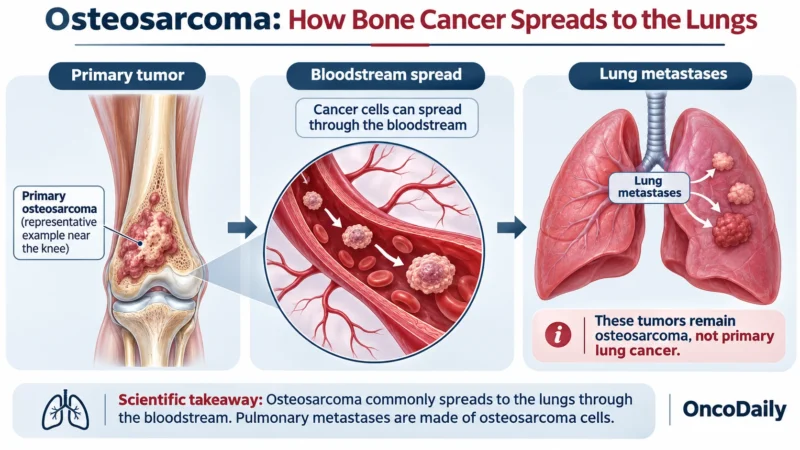
Modern evaluation commonly includes radiographs and MRI of the primary tumor, along with chest imaging to assess for pulmonary metastases. A tissue biopsy confirms the diagnosis and helps distinguish osteosarcoma from other bone tumors. Treatment usually involves systemic chemotherapy and surgery, with limb-sparing procedures possible for many patients. However, treatment depends on the tumor’s location, extent, response to chemotherapy, and the possibility of achieving complete surgical removal. One of the greatest challenges in osteosarcoma is its tendency to spread to the lungs. This is particularly relevant to Terry Fox’s story because pulmonary metastases eventually interrupted his Marathon of Hope.
Why Did Terry Fox Have His Leg Amputated?
When Terry Fox was diagnosed in 1977, treatment options for osteosarcoma were more limited than those available today. For many patients with tumors near the knee, amputation was a common treatment approach at the time. The objective was to remove the primary tumor completely while minimizing the possibility of leaving malignant tissue behind. At that time, limb-sparing surgery was not as widely available or technically advanced as it is today. Modern orthopedic oncology has developed sophisticated surgical and reconstructive techniques that allow many patients to retain their affected limb.
These procedures may involve removing the tumor and replacing the affected bone with specialized prosthetic implants, donor bone, or other reconstructive approaches. However, limb-sparing surgery is not appropriate in every situation, and amputation remains necessary for some patients. Importantly, amputation and limb-sparing surgery are both intended to achieve adequate cancer control. The decision depends on tumor location, neurovascular involvement, the ability to obtain clear surgical margins, and the patient’s functional needs. Fox’s amputation should therefore be understood within the medical context of the late 1970s rather than judged by today’s surgical possibilities. Following the operation, he began rehabilitation and learned to use an artificial leg. His physical recovery became the foundation for a challenge that few people thought possible.
How Did Chemotherapy Influence Terry Fox’s Mission?
Fox’s cancer treatment extended well beyond surgery. He underwent approximately 16 months of chemotherapy, a form of systemic treatment intended to destroy cancer cells that may remain after removal of the primary tumor. For osteosarcoma, chemotherapy is important because microscopic cancer cells may spread beyond the original bone tumor before they become visible on imaging. During the 1970s, chemotherapy was becoming a central part of osteosarcoma treatment and was helping improve survival rates. According to the Terry Fox Research Institute, Fox became aware that medical research was already changing survival prospects for patients with his disease.
This realization shaped his belief that further investment could lead to better treatments and, ultimately, more lives saved. During his hospital stays, he encountered patients whose experiences were often more difficult than his own. Some were children facing prolonged treatment, major surgery, and uncertain outcomes. These encounters became central to his motivation. Fox concluded that progress against cancer required more scientific research and substantially greater financial support. He began considering an ambitious fundraising effort that could bring national attention to the disease.
How Did Terry Fox Prepare for the Marathon of Hope?
The idea of running across Canada developed after Fox’s amputation and during his recovery. He had read about Dick Traum, an amputee who completed the New York City Marathon, and became interested in the possibility of long-distance running with a prosthetic leg. However, completing a single marathon and attempting to cross Canada were vastly different challenges. Fox needed to develop the physical conditioning required to run long distances while using a prosthesis that had not been designed for sustained marathon-level activity. He spent approximately 18 months preparing.
According to the Terry Fox Research Institute, he ran more than 5,000 kilometres during training before beginning his national journey. His running style was distinctive. Because of the limitations of his artificial leg, Fox developed an asymmetrical gait that involved hopping forward on his natural leg and swinging the prosthesis through each stride.
The movement required considerable physical effort and placed substantial demands on his remaining leg and upper body. He trained through pain, fatigue, and difficult weather conditions. His plan was to begin at the Atlantic Ocean in eastern Canada, travel west across the country, and eventually reach the Pacific Ocean. Fox initially hoped to raise C$1 million, but later expanded his goal to C$1 from every Canadian—about C$24 million. He called the journey the Marathon of Hope. The name reflected his belief that scientific progress was possible when individuals and communities worked toward a common purpose.
When Did Terry Fox Begin the Marathon of Hope?
Terry Fox began his Marathon of Hope on April 12, 1980, in St. John’s, Newfoundland. Before setting off, he dipped his artificial leg into the Atlantic Ocean, symbolically marking the beginning of his planned coast-to-coast journey. He hoped to repeat the gesture in the Pacific Ocean after completing the run. Initially, the campaign attracted relatively little public attention. Fox traveled with a small support team, including his close friend Doug Alward, who drove the support vehicle and helped organize the daily logistics. The group faced practical challenges involving accommodation, food, equipment, transportation, and fundraising.
Some nights they stayed in inexpensive accommodation or slept in their vehicle. The daily running schedule was demanding. Fox often began early in the morning, sometimes around 4:30 a.m., and continued running for many hours. His route passed through Newfoundland and Labrador, Prince Edward Island, Nova Scotia, New Brunswick, Quebec, and Ontario. Throughout the journey, he encountered heavy rain, wind, intense heat, and difficult road conditions. Nevertheless, he maintained an average distance of approximately 42 kilometres per running day, close to the standard marathon distance of 42.195 kilometres. What began as a relatively small fundraising effort gradually became a national movement.
How Far Did Terry Fox Run in 143 Days?
By the time the Marathon of Hope ended, Terry Fox had run 5,373 kilometres, equivalent to approximately 3,339 miles, in 143 days. His average daily distance was around 37.6 kilometres when calculated across all 143 calendar days, while the foundation commonly describes his running schedule as averaging close to 42 kilometres on running days. The achievement was extraordinary, particularly given the physical limitations of the prosthetic technology available at the time. As Fox traveled west, support increased. Local communities organized fundraising events, schools welcomed him, and supporters gathered along highways to watch him run. Television and newspaper coverage introduced his story to people who had never previously followed cancer fundraising campaigns.
Fox also met patients and families affected by cancer. His message was straightforward: research needed funding, and everyone could contribute. One of the defining moments came when he reached Ontario in June 1980. His arrival attracted substantial public attention, and donations increased rapidly. In Toronto, he received a particularly enthusiastic welcome, including support from professional athletes and public figures. Hockey star Darryl Sittler was among those who joined the campaign. Yet Fox continued to emphasize that the purpose of the run was cancer research, not personal recognition. He had become a national figure, but his goal remained unchanged.
Why Did Terry Fox Have to Stop Running?
On September 1, 1980, Terry Fox was forced to stop his Marathon of Hope near Thunder Bay, Ontario. During the preceding days, he had developed a persistent cough, chest discomfort, and increasing difficulty breathing. The symptoms became severe enough that he could no longer continue running. He was taken for medical evaluation, where doctors discovered that his osteosarcoma had returned and spread to his lungs. The finding meant that his disease was metastatic.
For Fox, the news was devastating not only because of its medical implications but also because it ended the journey he had spent so long preparing for. He had covered more than half of his planned route across Canada. During a press conference, Fox announced that he would have to suspend the run. His decision was based on medical necessity rather than a loss of determination. He hoped that treatment might eventually allow him to continue, but his health deteriorated over the following months.
The end of the Marathon of Hope became one of the most widely remembered moments in Canadian sporting and humanitarian history. However, the conclusion of the physical run did not end the fundraising campaign. Instead, public support continued to grow.
Why Does Osteosarcoma Commonly Spread to the Lungs?
Osteosarcoma can spread beyond the original bone tumor through the bloodstream. The lungs are the most common site of distant metastasis. Cancer cells may enter blood vessels, circulate through the body, and establish new tumors in pulmonary tissue. This process is known as hematogenous metastasis. When osteosarcoma spreads to the lungs, it remains osteosarcoma. It does not become a new primary lung cancer. This distinction is important because treatment is based on the original tumor’s biological characteristics.
Patients with pulmonary metastases may receive systemic chemotherapy, surgery to remove metastatic lesions in selected cases, or other individualized treatments. The feasibility of surgery depends on factors such as the number and location of lesions, whether they can be completely removed, and the patient’s overall condition. Metastatic osteosarcoma is generally more difficult to treat than localized disease. However, outcomes vary, and selected patients with resectable lung metastases can experience prolonged survival. In Terry Fox’s case, pulmonary metastases were discovered in September 1980, approximately three years after his original diagnosis. His recurrence illustrates one of the major challenges in osteosarcoma treatment: cancer may return even after removal of the primary tumor and chemotherapy.
What Was Terry Fox’s Cancer Treatment After His Relapse?
Following the discovery of lung metastases, Fox returned to British Columbia for additional medical care. His cancer had recurred and spread to his lungs, and treatment options were limited. Historical accounts describe further attempts to manage his disease, including additional cancer treatment. However, publicly accessible summaries do not provide enough detail to reconstruct every medication, dose, or treatment decision. It would therefore be inappropriate to assign him a modern chemotherapy regimen or claim that a specific treatment failure caused his death. By this stage, Fox had become a nationally recognized figure.
His illness attracted considerable attention from the public and media, while he continued to emphasize the importance of funding cancer research. The fundraising campaign continued during his treatment. On February 1, 1981, the Marathon of Hope fund reached C$24.17 million, achieving Fox’s ambition of raising approximately one dollar for every Canadian. It was an extraordinary accomplishment for a campaign started by a young athlete with a prosthetic leg and a small support team. Although Fox could not continue running, he had already helped create a new national commitment to cancer research.
When and How Did Terry Fox Die?
Terry Fox died on June 28, 1981, in New Westminster, British Columbia, at the age of 22. His death occurred approximately ten months after his Marathon of Hope ended. The underlying disease was metastatic osteosarcoma, which had spread to his lungs. His death came exactly one month before what would have been his 23rd birthday. Canadians responded with widespread grief. Fox had become a symbol of determination, but his story was also deeply personal for the millions of families affected by cancer.
The loss of such a young person highlighted the devastating consequences of aggressive malignancies and the limitations of cancer treatment at the time. His death also raised an important question: how could the mission he began continue? The response became one of the most enduring cancer fundraising traditions in the world.
What Awards and Honors Did Terry Fox Receive?
Terry Fox received several major distinctions during the final year of his life. On September 18, 1980, he became the youngest person appointed a Companion of the Order of Canada, one of the country’s highest civilian honors. In October 1980, he received the Order of the Dogwood, then British Columbia’s highest provincial honor. The American Cancer Society recognized his contribution to cancer awareness with its Sword of Hope Award. In December 1980, he received the Lou Marsh Award, recognizing him as Canada’s outstanding athlete of the year. He was also named Canadian Newsmaker of the Year.
These honors reflected not only his athletic achievement but also his humanitarian contribution. After his death, additional commemorations followed. He was inducted into Canada’s Sports Hall of Fame in 1981. Schools, roads, monuments, and public facilities were named in his honor. Mount Terry Fox in British Columbia and the Terry Fox Courage Highway near Thunder Bay became lasting geographical reminders of his extraordinary journey. In 2008, the Government of Canada designated him a person of national historic significance. These recognitions illustrate how a young athlete’s fundraising mission became part of Canada’s national identity.
How Did the Terry Fox Run Become a Global Cancer Fundraiser?
The first Terry Fox Run was organized in his memory on September 13, 1981, only a few months after his death. Approximately 300,000 people participated in the inaugural event, raising about C$3.5 million for cancer research. The annual event developed into an international fundraising tradition. Unlike many competitive sporting events, Terry Fox Runs emphasize participation and community involvement rather than speed or athletic achievement. Participants can run, walk, or take part in other accessible ways.
This inclusive approach reflects the campaign’s original purpose: allowing everyone to contribute to cancer research. The Terry Fox Foundation continues to coordinate fundraising activities and support cancer research initiatives. Over the decades, millions of participants have taken part in events held across Canada and internationally. In February 2026, the foundation announced that cumulative fundraising inspired by Terry Fox had surpassed C$1 billion. The milestone demonstrated how a campaign that began with one individual’s determination developed into a sustained source of support for scientific research.
What Happened During the 2026 Terry Fox Run?
The 46th annual Terry Fox Run took place on September 20, 2026, continuing the tradition established after Fox’s death. In advance of the event, the Terry Fox Foundation announced that participants from nearly 600 Canadian communities were expected to take part. The event encouraged people of different ages and physical abilities to contribute to cancer research. Schools, families, volunteers, and local organizations participated in fundraising activities inspired by Fox’s original mission.
The annual run has also become an important way to introduce younger generations to his story. Many participants were born decades after his death, yet the campaign continues to connect them with the broader goal of improving cancer treatment. The event’s significance extends beyond the money raised on any particular day. It represents a continuing commitment to scientific research and public participation in cancer awareness.
What Is the Terry Fox Foundation’s New ‘Powered by Terry’ Initiative?
On October 22, 2026, the Terry Fox Foundation and the Terry Fox Research Institute announced a new campaign called Powered by Terry. The initiative was presented as the next chapter of the foundation’s broader Finish It campaign. It includes an animated film inspired by Fox’s legacy and the people who continue his mission through research, fundraising, and community participation. The announcement also introduced a historic financial contribution. The Larry and Judy Tanenbaum Family Foundation committed C$25 million, the largest single donation in the Terry Fox Foundation’s history.
According to the foundation, the gift unlocks matching funding from the Government of Canada, creating approximately C$50 million in combined research impact. The announcement emphasized the importance of translating decades of public fundraising into scientific advances that can improve outcomes for people with cancer. It also highlighted the work of the Marathon of Hope Cancer Centres Network, a national collaborative initiative focused on precision oncology.
How Is Terry Fox’s Legacy Advancing Precision Oncology?
One of the most significant developments connected to Terry Fox’s legacy is the Marathon of Hope Cancer Centres Network. Led by the Terry Fox Research Institute, the network brings together research institutions and clinical centers across Canada to improve cancer research and treatment. Its work focuses on precision oncology, an approach that uses the biological and molecular characteristics of individual tumors to guide clinical decisions. Modern cancer care increasingly relies on biomarkers, genomic sequencing, and molecular profiling to identify potential treatment strategies. For example, certain genetic alterations may help determine whether a patient is eligible for targeted therapy or immunotherapy.
Large research networks can also help scientists understand why some patients respond to treatment while others develop resistance. According to the October 2026 foundation announcement, the Marathon of Hope Cancer Centres Network included 57 member institutions across Canada. It had developed a national resource containing genomic and clinical information from more than 16,000 cancer patients. The foundation also reported that more than 1,500 patients had received treatment guided by network-funded genomic sequencing.
These achievements demonstrate how cancer research has evolved since Fox’s own treatment in the late 1970s. At that time, physicians had relatively limited tools for understanding the molecular characteristics of a patient’s cancer. Today, researchers can investigate tumors at the genetic and cellular levels and use that information to develop increasingly individualized treatment strategies. The network’s work does not mean that cancer has been cured or that every patient will benefit from genomic testing. However, it represents a concrete example of how sustained research investment can contribute to progress in oncology.
How Has Osteosarcoma Treatment Changed Since Terry Fox’s Diagnosis?
When Terry Fox was diagnosed in 1977, osteosarcoma treatment was entering a period of important development. Chemotherapy was beginning to improve survival, but surgical options remained more limited than those available today. Since that time, advances in imaging, surgical reconstruction, supportive care, and multidisciplinary treatment have improved outcomes for many patients. According to the National Cancer Institute, the five-year relative survival rate for osteosarcoma increased from approximately 40% to 72% among children younger than 15 years between 1975 and 2020.
Among adolescents aged 15–19, it increased from approximately 56% to 71% over the same broad period. However, much of the improvement occurred during earlier decades, and survival gains have been more limited since the 1980s. These statistics describe age-specific patient populations and should not be interpreted as an individual prognosis.
Modern Treatment of Localized Osteosarcoma
For many patients with localized osteosarcoma, treatment involves chemotherapy combined with surgery. Chemotherapy is often given before surgery to treat possible microscopic disease and allow physicians to evaluate the tumor’s response. Surgery aims to remove the cancer completely while preserving as much normal function as possible. Limb-sparing procedures are now feasible for many patients, although amputation remains necessary in selected circumstances. Additional chemotherapy is commonly given after surgery. Treatment typically requires coordination between orthopedic oncologists, pediatric or medical oncologists, radiologists, pathologists, rehabilitation specialists, and supportive care teams.
Treatment of Metastatic or Recurrent Osteosarcoma
Metastatic osteosarcoma remains an important clinical challenge. The lungs are the most frequent site of distant spread. Treatment may involve chemotherapy and surgical removal of metastatic lesions when technically feasible and clinically appropriate. The likelihood of achieving prolonged disease control depends on factors such as the number of metastases, whether all visible disease can be removed, and the patient’s response to previous treatment.
Researchers continue to investigate new systemic therapies, molecular targets, immunotherapeutic approaches, and other strategies for patients with recurrent or metastatic disease. The need for better treatments in this setting remains substantial. Fox’s experience therefore continues to reflect an unresolved challenge in modern oncology: preventing and treating metastatic osteosarcoma.
Why Is Terry Fox Still Important to Cancer Research?
Terry Fox’s impact was not based on discovering a treatment or conducting scientific experiments. His contribution was different. He helped transform cancer research into a cause that ordinary people could support through collective action. At a time when cancer treatment remained limited for many patients, Fox showed how public awareness and fundraising could build long-term support for scientific progress. His journey made the consequences of cancer visible to a national audience. His campaign also reflected a broader principle: investments in research have the potential to benefit people far beyond those who initially inspire or support them.
Advances in cancer treatment can improve outcomes for patients and future generations who may never know the individuals whose efforts helped make that research possible. The continuing work of the Terry Fox Foundation illustrates this principle. Funds raised in his name support researchers investigating cancer biology, diagnosis, prevention, and treatment. The foundation’s collaboration with research institutions also connects public fundraising with modern scientific infrastructure. In this sense, Terry Fox’s legacy is not limited to remembering an extraordinary athlete. It remains connected to ongoing efforts to develop better cancer treatments.
What Can Patients and Families Learn From Terry Fox’s Story?
Terry Fox’s story is often described through courage, determination, and hope. These themes are meaningful, but his experience also offers a broader lesson about cancer care. His decision to run across Canada was deeply personal. It reflected his values, his abilities, and his desire to support others. Not every person with cancer will be able to undertake an extraordinary physical challenge, and no patient should feel that recovery depends on optimism or determination alone. Cancer progression is driven by complex biological factors, not by a lack of courage.
Fox’s achievement should therefore be understood as an example of individual purpose and humanitarian action rather than a standard against which patients measure themselves. His experience also highlights the importance of rehabilitation after major cancer surgery, psychological support, community involvement, and access to effective treatment. Perhaps most importantly, it shows how the experiences of patients can influence the direction of research and public awareness. Fox could not complete his planned journey, but the scientific mission he began continued to grow.
You Can Also Read Swim Against Cancer: Bartłomiej Kubkowski’s Historic 160-Km Baltic Crossing by OncoDaily

Written by Aharon Tsaturyan, MD, Editor at OncoDaily Intelligence Unit.
FAQ
What type of cancer did Terry Fox have?
Terry Fox was diagnosed with osteosarcoma, a rare and aggressive form of bone cancer, in March 1977 when he was 18 years old.
How did Terry Fox die?
Terry Fox died on June 28, 1981, at age 22, after his osteosarcoma returned and spread to his lungs.
Why did Terry Fox lose his leg?
Doctors amputated his right leg above the knee in March 1977 to remove an osteosarcoma tumor and control the disease.
How far did Terry Fox run?
Terry Fox ran 5,373 kilometres (3,339 miles) over 143 days during his Marathon of Hope in 1980.
Why did Terry Fox stop running?
He stopped on September 1, 1980, near Thunder Bay, Ontario, after learning that his cancer had spread to his lungs.
How much money did Terry Fox raise for cancer research?
Fox initially aimed to raise C$1 million before increasing his goal to approximately C$24 million. By February 1981, his campaign had raised C$24.17 million.
What was the purpose of Terry Fox's Marathon of Hope?
Terry Fox wanted to raise money for cancer research, increase public awareness, and help improve treatment for people affected by cancer.