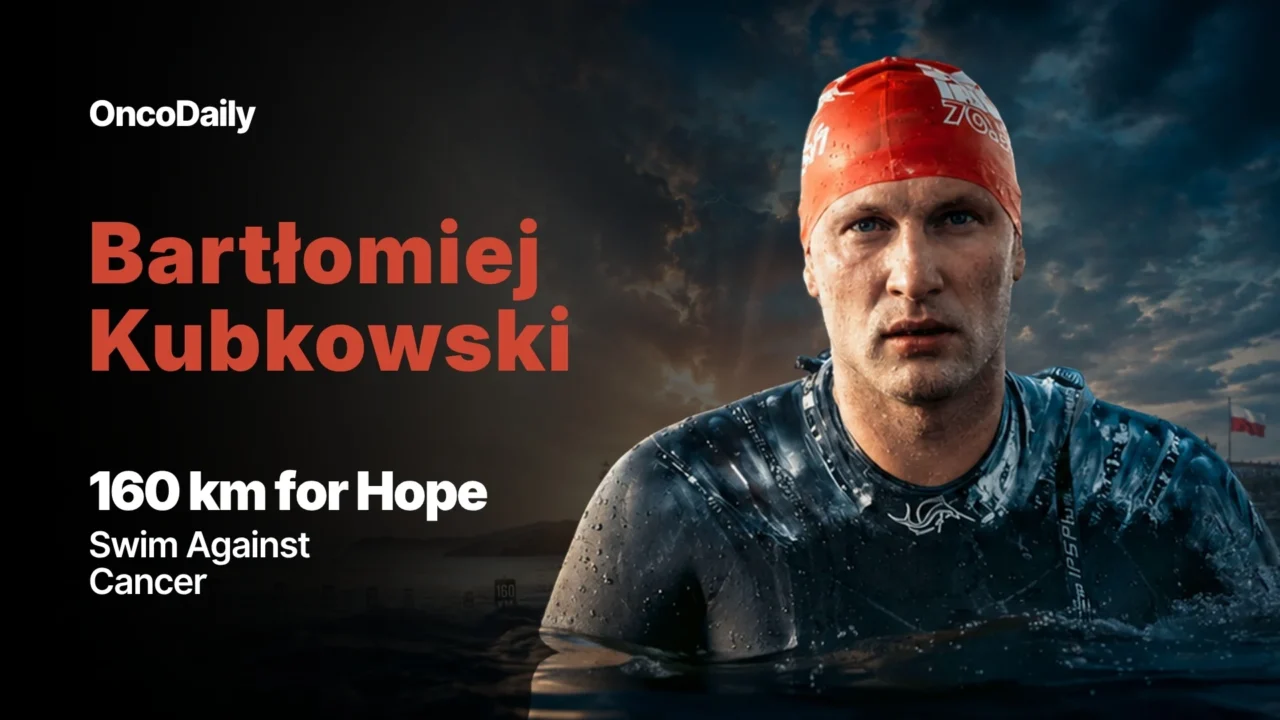
More than 160 kilometers. Nearly 55 hours in open water. Two nights without sleep. And one goal beyond the finish line: helping people affected by cancer. In early August 2026, Polish ultra-distance swimmer Bartłomiej Kubkowski completed an extraordinary swim across the Baltic Sea, traveling from Kåseberga, Sweden, to Dziwnów, Poland. After more than 160 km in the water, he reached the Polish coast following approximately 55 hours of continuous swimming. It was his fifth attempt at the crossing and his first successful completion.
The achievement was about more than endurance. Kubkowski dedicated his Ultra Baltic Swim 2026 to Poland’s Cancer Fighters Foundation, continuing a five-year relationship with the organization and using the challenge to raise money and awareness for people affected by cancer. His journey transformed one of the most demanding challenges in endurance swimming into a highly visible cancer-awareness and fundraising campaign.
Who Is Bartłomiej Kubkowski?
Bartłomiej Kubkowski is a Polish long-distance swimmer, world-record holder, and creator of the Ultra Baltic Swim project. His career has included multiple medals at Polish and international championships as well as repeated attempts to conquer the Baltic Sea. In January 2025, Kubkowski established a 24-hour swimming world record, completing 4,143 lengths of a 25-meter pool for a total distance of approximately 103.58 km.
But the Baltic crossing became a challenge of a different scale. For several years, Kubkowski repeatedly returned to the sea despite unsuccessful attempts. The 2026 edition was promoted as his fifth and final attempt. This time, he reached the other side.
What Was the Ultra Baltic Swim 2026?
The challenge was simple to describe but extraordinarily difficult to complete: swim from Sweden to Poland across the Baltic Sea without stopping. Kubkowski began his successful attempt on July 31, 2026, departing from Sweden and heading toward the Polish coast. He eventually emerged from the water at Dziwnów after covering more than 160 km in approximately 55 hours.
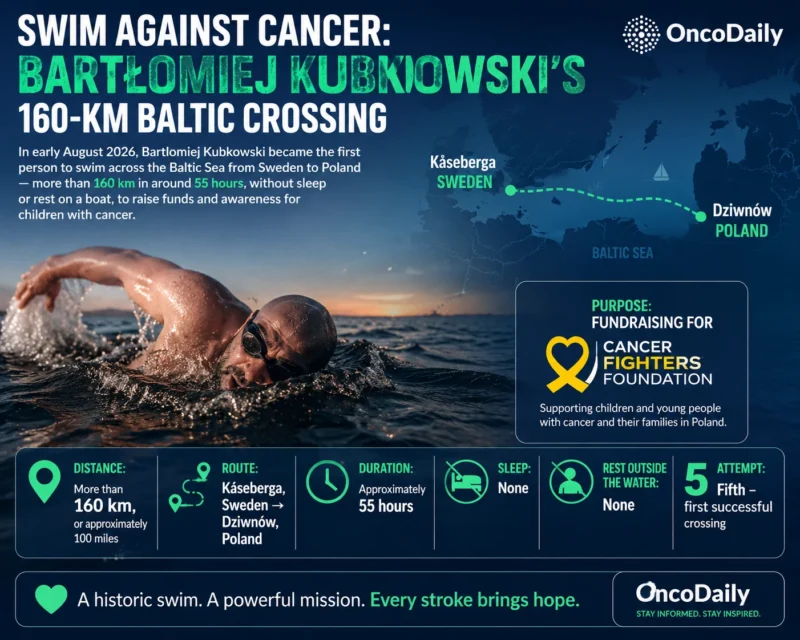
The basic figures illustrate the extraordinary scale of the achievement. Kubkowski covered more than 160 km (approximately 100 miles) across the Baltic Sea, swimming from Kåseberga, Sweden, to Dziwnów, Poland. The crossing took approximately 55 hours, during which he remained in the water continuously, without sleep or rest outside the water. The historic completion came on his fifth attempt to cross the Baltic Sea.
A support team accompanied Kubkowski for navigation, nutrition, safety, and monitoring. However, according to reports from the crossing, he did not touch the support boat, leave the water to rest, or sleep during the swim. For almost two and a half days, the basic pattern remained the same: swim, receive nutrition and fluids, and keep moving toward Poland.
Why Did Kubkowski Swim for Cancer?
Cancer advocacy has been embedded in the Ultra Baltic Swim project for years. Kubkowski’s official project states that he has supported the Cancer Fighters Foundation for five years, dedicating his undertaking to the foundation’s “fighters” and people living with cancer. The foundation describes itself as a nationwide Polish organization supporting people affected by cancer. Its work includes helping patients and families navigate the financial, organizational, psychological, and everyday consequences that can accompany a cancer diagnosis. For Kubkowski, the Baltic challenge therefore became a platform through which sporting attention could be redirected toward people facing cancer. The fundraising was not something added after the achievement. It was part of the purpose of the swim from the beginning.
How Much Money Did the Baltic Swim Raise for Cancer?
The fundraising campaign gained considerable momentum as Kubkowski approached Poland. Contemporary Polish reports indicated that more than PLN 560,000 had already been donated shortly before he reached the finish, with fundraising continuing around the challenge. Later reports placed the amount substantially higher, illustrating how quickly contributions continued to accumulate around the historic swim. The financial support matters because cancer creates costs that extend far beyond cancer-directed therapy. Patients and families can face rehabilitation expenses, transportation, psychological support needs, reduced employment, everyday living costs, and other financial pressures during and after treatment.
The Cancer Fighters Foundation’s work is designed around this broader reality: a person with cancer may need support not only medically, but also psychologically, organizationally, and financially.
What Happened During Kubkowski’s Previous Attempts?
The successful crossing was the culmination of years of failed attempts rather than a single extraordinary weekend. According to reporting after his finish, Kubkowski first attempted the crossing in 2022, when he completed approximately 115 km over 32 hours before the effort ended. He returned in subsequent years, gradually getting closer to Poland. His 2025 attempt came agonizingly close. Kubkowski remained in the Baltic for 53 hours and covered approximately 159 km, but the challenge was stopped just 11 km from the finish after he lost consciousness. Less than a year later, he returned to attempt the crossing for a fifth time. The difference in 2026 was the finish.
What Did 55 Hours in the Baltic Do to His Body?
Swimming continuously for more than two days exposes the body and mind to an extreme combination of physical stressors. Kubkowski faced prolonged cold-water exposure, waves and changing sea conditions, continuous muscular effort, nutritional demands, and severe sleep deprivation. The second night was particularly challenging. Marcin Cieślak of Purely Athletic, quoted by Eurosport after the crossing, explained that hallucinations can occur during the second sleepless night and said Kubkowski at times experienced impaired awareness and contact with reality. His team had prepared extensively around nutrition, training, and other aspects of the attempt to minimize these problems. The final stretch demonstrated how much the crossing had taken from him.
With approximately 1.5 km remaining, Kubkowski experienced another crisis and asked his support crew how far he still had to swim. He eventually continued toward shore. When he finally reached Dziwnów, footage showed him struggling to walk after leaving the water. He dropped to his knees before eventually standing and celebrating with his team and the crowd waiting on the beach.
Why Does the Ultra Baltic Swim Matter for Cancer Awareness?
Kubkowski’s achievement demonstrates how sport can create an audience for cancer advocacy far beyond hospitals, research conferences, and traditional fundraising campaigns. An extreme endurance challenge attracts attention because people want to know whether the athlete will succeed. When that attention is deliberately connected to a cancer organization, some of it can be transformed into donations, public engagement, and awareness. The Ultra Baltic Swim also gives a human dimension to charitable fundraising.
Instead of cancer support being represented only by a donation target, thousands of people could follow a swimmer moving kilometer by kilometer toward the Polish coast while simultaneously watching the fundraising campaign grow. But events such as this should be understood as one part of a much larger cancer-support ecosystem. Charitable challenges cannot replace sustained investment in cancer research, equitable access to diagnosis and treatment, rehabilitation, psychosocial services, survivorship care, or policies designed to reduce the financial burden of cancer. What they can do is mobilize people who might otherwise never engage with those issues.
What Is the Cancer Fighters Foundation?
The Cancer Fighters Foundation is a Polish organization supporting people affected by cancer. Its philosophy centers on the idea that nobody should have to face cancer alone. The foundation organizes fundraising initiatives and provides forms of support addressing the practical and psychological consequences of cancer for patients and their families.
Kubkowski’s relationship with Cancer Fighters did not begin with his successful 2026 crossing. His official Ultra Baltic Swim project states that the initiative has been supporting the foundation for five years. That continuity is an important part of the story. The successful crossing became the culmination of a long-running sporting challenge and a long-running commitment to cancer advocacy.
What Happened When Bartłomiej Kubkowski Finally Reached Poland?
After approximately 55 hours, more than 160 km, and two nights without sleep, Kubkowski reached the beach in Dziwnów. Crowds were waiting for him. Exhausted, he made his way out of the water the final act required to complete the challenge before falling to his knees. Moments later, he stood again, raised his arm, and embraced members of his team. After years of trying, the fifth attempt had ended differently from the four before it. But the finish line was never intended to mark the end of the wider mission. The Cancer Fighters Foundation continues supporting people affected by cancer, and the fundraising generated around Kubkowski’s crossing continues the relationship between the Ultra Baltic Swim project and the cancer community.
More Than a Swimming Record
Bartłomiej Kubkowski’s Baltic crossing can be measured in numbers: more than 160 km, approximately 55 hours, five attempts, and two nights without sleep. But those numbers explain only part of why the story resonated. For five years, Kubkowski had repeatedly entered the Baltic knowing that previous attempts had ended before he reached Poland. In 2025, just 11 km separated him from the finish. In 2026, he returned and completed the crossing. At the same time, thousands of people followed a fundraising campaign supporting people whose challenge cannot be measured in kilometers. The Ultra Baltic Swim ultimately became both an endurance achievement and a cancer-awareness campaign.
One swimmer crossed the Baltic. Thousands helped turn every kilometer into support for people affected by cancer.
You Can Also Read $70 Million Guinness World Record Livestream: How Łatwogang Changed Cancer Philanthropy by OncoDaily

Written by Aharon Tsaturyan, MD, Editor at OncoDaily Intelligence Unit
FAQ
Who is Bartłomiej Kubkowski?
Bartłomiej Kubkowski is a Polish long-distance swimmer and world-record holder who created the Ultra Baltic Swim project. In 2026, he successfully completed a more than 160-km Baltic Sea crossing from Sweden to Poland after several previous attempts.
Did Bartłomiej Kubkowski swim from Sweden to Poland?
Yes. Kubkowski swam across the Baltic Sea from Kåseberga, Sweden, to Dziwnów, Poland, covering more than 160 km in approximately 55 hours.
How far did Bartłomiej Kubkowski swim across the Baltic Sea?
Kubkowski covered more than 160 km, or approximately 100 miles, during his successful Baltic Sea crossing from Sweden to Poland in 2026.
How long did it take Bartłomiej Kubkowski to swim from Sweden to Poland?
The crossing took approximately 55 hours of continuous swimming. During the challenge, Kubkowski remained in the water without sleeping or resting outside the water.
Why did Bartłomiej Kubkowski swim across the Baltic Sea?
The challenge was closely connected with cancer advocacy. Kubkowski used the Ultra Baltic Swim to raise money and awareness for the Cancer Fighters Foundation, a Polish organization supporting people affected by cancer.
How much money did Bartłomiej Kubkowski raise for cancer?
More than PLN 560,000 had already been donated shortly before Kubkowski reached the finish, according to contemporary reports cited in the article, and fundraising continued around the challenge.
What is the Cancer Fighters Foundation?
Cancer Fighters Foundation is a Polish organization supporting people affected by cancer and their families. Its work addresses practical and psychological challenges associated with a cancer diagnosis, while Kubkowski's Ultra Baltic Swim project has supported the foundation for several years.
How many times did Bartłomiej Kubkowski try to cross the Baltic Sea?
Kubkowski completed the crossing on his fifth attempt. In 2025, he had come within approximately 11 km of the finish after swimming around 159 km over 53 hours before that attempt was stopped.
Did Bartłomiej Kubkowski sleep during the Baltic Sea swim?
No. During the successful crossing, Kubkowski spent approximately 55 hours in the water without sleep or rest outside the water. Severe sleep deprivation contributed to significant physical and mental challenges during the swim.
What is the Ultra Baltic Swim 2026?
Ultra Baltic Swim 2026 was Kubkowski's successful long-distance swimming challenge across the Baltic Sea from Sweden to Poland. Beyond the sporting achievement, the project served as a fundraising and awareness campaign supporting the Cancer Fighters Foundation.