
When Steve Jobs died on October 5, 2011, at age 56, the world lost one of the most influential figures in modern technology. Behind the story of Apple, the Macintosh, the iPod, and the iPhone was another story that unfolded largely outside public view: an approximately eight-year experience with a rare form of pancreatic cancer. Jobs did not have the pancreatic cancer most people think of when they hear the diagnosis. He had a pancreatic neuroendocrine tumor, or pNET, historically referred to as an islet-cell neuroendocrine tumor.
His medical history included pancreatic surgery, later metastatic disease, a liver transplant, and widely reported treatment with targeted radionuclide therapy in Switzerland. Yet Jobs was famously private about his health. Some parts of his cancer history are firmly documented through his own statements, hospital confirmations, Apple announcements, and his death certificate. Other details remain based on biographies and media reporting. Understanding that distinction is important—not only for telling Jobs’ story accurately, but also for understanding a rare cancer that behaves very differently from conventional pancreatic adenocarcinoma.
Steve Jobs’ Cancer Diagnosis: A Rare Pancreatic Neuroendocrine Tumor
Jobs publicly disclosed his diagnosis in August 2004. In an email to Apple employees, he said that he had undergone surgery to remove a cancerous tumor from his pancreas and identified it as an islet-cell neuroendocrine tumor. He emphasized that it was different from the much more common pancreatic adenocarcinoma and said he would not require chemotherapy or radiation following his operation. Later reporting placed his initial diagnosis in 2003, while his surgery took place in 2004. That distinction between tumor types remains fundamental today.
What Is a Neuroendocrine Tumor?
Neuroendocrine tumors, or NETs, arise from specialized cells that share characteristics of nerve cells and hormone-producing endocrine cells. They can develop in several organs, most commonly in the gastrointestinal tract, pancreas, and lungs. A pancreatic neuroendocrine tumor develops from the hormone-producing endocrine cells of the pancreas rather than from its exocrine cells. According to the National Cancer Institute, only about 1%–2% of pancreatic tumors begin in endocrine cells. The much more common pancreatic ductal adenocarcinoma develops from exocrine pancreatic cells and has very different biology, treatment, and prognosis. Pancreatic NETs can also be divided into functional and nonfunctional tumors.

Functional pNETs produce excess hormones and may cause specific syndromes—for example, insulinomas can produce too much insulin, while gastrinomas produce excess gastrin. Nonfunctional tumors do not produce a clinically recognizable hormone syndrome. Most pancreatic NETs are nonfunctional. Because these tumors may grow without producing distinctive hormonal symptoms, they can sometimes be discovered later, after the tumor has enlarged or spread.
Tumor grade is also crucial. Pathologists assess how actively the cancer cells are dividing, often using measures such as mitotic rate and the Ki-67 proliferation index. A well-differentiated, low-grade NET can behave very differently from a high-grade neuroendocrine carcinoma. This is why simply calling Jobs’ disease “pancreatic cancer” gives an incomplete medical picture.
Pancreatic NET Survival Rates and Prognosis
Pancreatic NETs generally have a substantially better prognosis than pancreatic ductal adenocarcinoma, but outcomes depend heavily on stage, grade, tumor biology, hormone activity, and response to treatment. Current NCI/SEER statistics for people diagnosed with pancreatic NET between 2015 and 2021 report an overall 5-year relative survival rate of approximately 48%.
For localized pancreatic NET, the 5-year relative survival rate is approximately 91%. For regional disease, it is around 64%. Once the disease has spread to distant organs, 5-year relative survival falls to approximately 19%. The contrast with pancreatic cancer overall is striking.
For pancreatic cancer as a whole statistics largely dominated by pancreatic ductal adenocarcinoma—the 5-year relative survival rate is approximately 44% for localized disease, 17% for regional disease, and only 3% for distant metastatic disease. Across all stages combined, survival is around 13%. These figures cannot predict the course of an individual patient’s cancer. Prognosis may also depend on tumor grade, Ki-67, molecular characteristics, age, general health, sites of metastasis, and treatment response. They nevertheless demonstrate why Jobs’ diagnosis should not be described as though it were ordinary pancreatic adenocarcinoma.
What Do ASCO and ESMO Recommend for Pancreatic NETs Today?
Modern treatment of pancreatic NET is increasingly individualized according to tumor grade, disease burden, somatostatin-receptor expression, growth rate, hormone production, symptoms, and sites of metastasis. The American Society of Clinical Oncology recommends assessing metastatic gastroenteropancreatic NETs for somatostatin-receptor positivity, typically using somatostatin-receptor PET imaging.
For many patients with well-differentiated, somatostatin-receptor-positive metastatic G1–G2 pancreatic NETs, somatostatin analogues such as octreotide or lanreotide may be used as first systemic treatment. For patients with larger-volume or symptomatic disease, chemotherapy such as capecitabine plus temozolomide, or CAPTEM, may be appropriate. After progression, options can include peptide receptor radionuclide therapy, or PRRT, chemotherapy, everolimus, sunitinib, and selected liver-directed treatments. ASCO emphasizes that there is no single treatment sequence suitable for every patient and that multidisciplinary decision-making is essential.
ESMO similarly emphasizes tumor proliferation rate, somatostatin-receptor expression, growth rate, disease extent, and functional status when planning treatment. For localized G1–G2 pancreatic NETs, surgery remains the treatment of choice when appropriate. Interestingly, in the context of Steve Jobs, ESMO recognizes liver transplantation only in exceptional, highly selected patients with neuroendocrine liver metastases. Current selection considerations include well-differentiated disease, absence of extrahepatic metastases, limited liver tumor burden, removal of the primary tumor, and stable disease before transplantation. These are modern recommendations and cannot be retrospectively applied to Jobs without access to his complete medical record.
Surgery in 2004
Jobs underwent surgery in the summer of 2004 to remove the pancreatic tumor. At the time, he told Apple employees that his cancer had been detected at a stage where it could be surgically removed and that he did not expect to require chemotherapy or radiation therapy. Surgery remains the principal potentially curative treatment for localized pancreatic NET when complete removal is feasible. The National Cancer Institute lists procedures ranging from tumor enucleation and distal pancreatectomy to pancreaticoduodenectomy, depending on the tumor’s location and extent.
Did Steve Jobs Delay Cancer Treatment?
This remains one of the most discussed and frequently oversimplified parts of Jobs’ story. Later reporting suggested that his tumor was discovered in 2003 and that Jobs initially pursued dietary and alternative approaches before agreeing to surgery in 2004. That makes it reasonable to state that a period of delayed surgery has been widely reported. What cannot be established from public information is whether that delay caused his cancer to metastasize or changed his ultimate survival.
Making that conclusion would require information about his original tumor grade, proliferation rate, imaging, margins, biology, molecular characteristics, and whether microscopic metastatic disease was already present. Jobs’ case should therefore not be reduced to the simplistic statement that alternative medicine caused his death.
Cancer Progression and the Liver Transplant
Concerns about Jobs’ health resurfaced several years after his initial operation. In 2009, he took an extended medical leave from Apple. That year, he underwent a liver transplant in Memphis, Tennessee. James D. Eason, MD, of the Methodist University Hospital Transplant Institute publicly confirmed, with Jobs’ permission, that he had received the transplant.
The center stated that Jobs underwent a full transplant evaluation and was listed according to the institution’s policies and United Network for Organ Sharing requirements. Although the hospital did not publicly disclose the complete oncologic rationale for the procedure, Jobs’ cancer was subsequently documented as metastatic pancreatic neuroendocrine cancer. Pancreatic NETs have a particular tendency to metastasize to the liver, and liver-directed treatment remains an important component of advanced pNET management today.
Steve Jobs and PRRT in Switzerland
One of the most medically interesting parts of Jobs’ treatment was reported to have occurred in Switzerland. Reports indicated that Jobs traveled to Basel in 2009 to undergo specialized radiological treatment for neuroendocrine cancer. The treatment was widely described as peptide receptor radionuclide therapy, or PRRT. PRRT is not conventional external-beam radiotherapy. Instead, a radioactive isotope is attached to a molecule designed to bind to somatostatin receptors expressed by neuroendocrine tumor cells. Radiation is then delivered more selectively to those cells.
In 2009, PRRT was available at specialized European centers but was not yet routinely available in the United States. Today, PRRT has moved firmly into mainstream neuroendocrine oncology and is included among recommended systemic options for appropriately selected patients with somatostatin-receptor-positive metastatic NETs. Jobs never publicly confirmed the details of his Swiss regimen, so it remains appropriate to describe PRRT as widely reported rather than definitively documented by Jobs himself.
Why Is Pancreatic Cancer Often Diagnosed at an Advanced Stage?
The phrase “terminal stage” is often used publicly, but advanced or metastatic disease is more medically precise. Pancreatic cancer is particularly difficult to diagnose early. The pancreas sits deep inside the abdomen, meaning that small tumors generally cannot be felt during an ordinary physical examination. More importantly, early pancreatic cancer frequently produces no symptoms or only vague symptoms. Symptoms often emerge only after the cancer has grown or spread.
Possible symptoms include upper abdominal or back pain, jaundice, unexplained weight loss, loss of appetite, fatigue, nausea, vomiting, abdominal bloating, and new-onset diabetes in some patients. Many of these symptoms can also result from much more common benign conditions. There is another major obstacle: there is currently no recommended routine screening test for people at average risk of pancreatic cancer. The consequences are visible in current SEER data. Only around 15% of pancreatic cancers are diagnosed while still localized. Approximately 28% are diagnosed after regional spread, while around 51% are already metastatic at diagnosis.
That helps explain the dramatic difference between survival for early and metastatic pancreatic cancer. For pancreatic NET specifically, detection presents a somewhat different problem. Hormone-producing functional NETs can sometimes announce themselves through characteristic endocrine symptoms. By contrast, nonfunctional pNETs may remain clinically quiet until they enlarge or spread, which is one reason they can also be found later.

You Can Also Read Can Pancreatic Cancer Be Detected Early? Symptoms, Biomarkers, and New Tests by OncoDaily
Can Pancreatic Cancer Be Prevented?
There is no guaranteed way to prevent pancreatic cancer. However, several modifiable factors are associated with risk, particularly for the much more common pancreatic adenocarcinoma. Risk-reduction strategies include not smoking or quitting smoking, maintaining a healthy body weight, limiting excessive alcohol consumption, and following a healthy diet. Smoking is an established pancreatic cancer risk factor, while obesity, chronic pancreatitis, type 2 diabetes, family history, and some inherited cancer syndromes are also associated with increased risk.
For pancreatic NETs, the exact cause is often unknown. Risk factors can include family history, smoking, type 2 diabetes, chronic pancreatitis, and inherited conditions such as MEN1, von Hippel-Lindau syndrome, neurofibromatosis type 1, and tuberous sclerosis. Prevention should therefore not be confused with screening. Routine pancreatic cancer screening is not recommended for average-risk adults.
For people at substantially increased inherited or familial risk, however, surveillance may be appropriate. Specialist surveillance can involve endoscopic ultrasound, MRI/MRCP, and other imaging approaches depending on individual circumstances. The goal is not to screen everyone. It is to identify the relatively small population whose risk is high enough that the potential benefits of surveillance may outweigh the harms.
Steve Jobs’ Final Medical Leave, Resignation, and Death
Jobs took another medical leave from Apple in January 2011. On August 24, 2011, he resigned as CEO, writing that the day had come when he could no longer meet the duties and expectations of the position. Tim Cook became CEO, while Jobs became chairman of Apple’s board. On October 5, 2011, Apple announced that Steve Jobs had died. His death certificate listed respiratory arrest as the immediate cause of death and metastatic pancreatic neuroendocrine tumor as the underlying condition. He was 56.
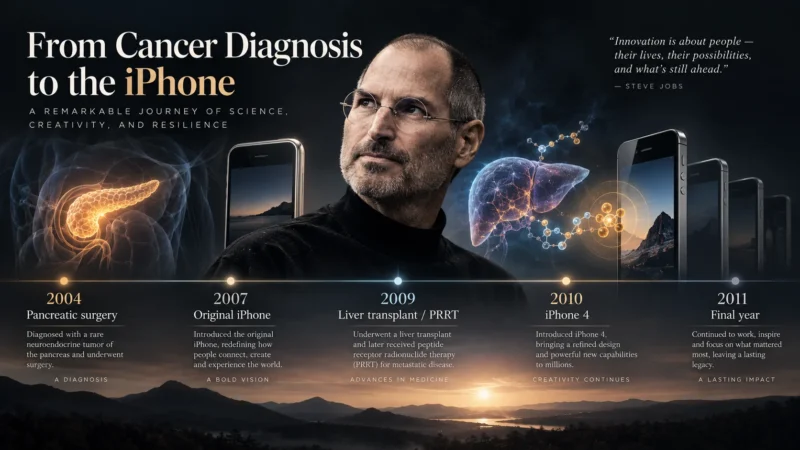
Steve Jobs and Apple: From a Small Computer Company to a Global Technology Giant
Jobs’ cancer story unfolded during one of the most consequential periods in Apple’s history. Apple was founded in 1976, with Jobs and Steve Wozniak becoming central figures in the emerging personal-computer industry. The Apple II helped establish the company, while the Macintosh introduced a new generation of consumers to graphical personal computing. Jobs left Apple in 1985 but eventually returned after Apple acquired NeXT. By 1997, he was again leading the company.

Photo: Depositphotos
What followed became one of the most famous corporate transformations in modern history. The iMac helped redefine Apple’s computer business. The iPod, introduced in 2001, transformed portable music. Then came iTunes, the iPhone, the App Store, and the iPad. Remarkably, several of Apple’s most influential products appeared after Jobs had already been diagnosed with cancer.
The iPhone Arrives While Jobs Is Living With Cancer
On January 9, 2007, Steve Jobs introduced the original iPhone. Apple described it as the combination of a mobile phone, widescreen iPod, and internet communications device controlled through a multi-touch interface. The product ultimately became one of the defining technologies of the smartphone era. By the iPhone’s tenth anniversary in 2017, Apple said more than one billion iPhones had been sold.
What Was the Last iPhone Steve Jobs Personally Introduced?
The iPhone 4 was the final new iPhone personally unveiled by Steve Jobs. He presented it on June 7, 2010, introducing features including the Retina display, FaceTime, the A4 processor, and a redesigned glass-and-steel body. Apple sold more than 1.7 million iPhone 4 devices during its first three days on sale. The next generation arrived under very different circumstances. Apple announced the iPhone 4S on October 4, 2011. It introduced the A5 chip, an improved camera, iCloud integration, and Siri. Steve Jobs died the next day. Therefore, the iPhone 4 was the last iPhone Jobs personally introduced, while the iPhone 4S was the final iPhone announced during his lifetime.
From Steve Jobs’ iPhone to the iPhone 18
The original iPhone arrived in 2007, introducing Apple’s multi-touch smartphone concept. The iPhone 3G followed in 2008 with 3G connectivity and the expanding App Store ecosystem. The iPhone 3GS arrived in 2009 with faster performance and video recording. In 2010, Jobs introduced the iPhone 4, bringing the Retina display and FaceTime. The iPhone 4S, announced in 2011, introduced Siri. The iPhone 5 followed in 2012 with a larger display and LTE connectivity. In 2013, the iPhone 5s introduced Touch ID and a 64-bit mobile processor. Apple moved into larger-screen phones with the iPhone 6 and 6 Plus in 2014.

The iPhone X in 2017 marked another major redesign, replacing the traditional home button with Face ID and an edge-to-edge OLED display. In 2020, the iPhone 12 brought 5G and MagSafe. The iPhone 14 Pro introduced Dynamic Island in 2022, while the iPhone 15 moved the lineup to USB-C in 2023. The iPhone 16 generation expanded Apple’s focus on artificial intelligence in 2024, followed by the iPhone 17 generation in 2025.
As of September 2026, Apple’s newest Pro models are the iPhone 18 Pro and iPhone 18 Pro Max, which introduced the A20 Pro chip, new camera capabilities, and further AI integration. Apple has also announced the iPhone Duo, its first foldable iPhone, extending the product line even further from the 3.5-inch touchscreen device Jobs first introduced in 2007.
What Steve Jobs’ Cancer Story Can and Cannot Teach Us
Jobs’ cancer history is often compressed into a simple narrative. The medical reality is more nuanced. What is well documented is that he had a pancreatic neuroendocrine tumor, underwent pancreatic surgery in 2004, later received a liver transplant, reportedly received radionuclide treatment in Switzerland, developed metastatic disease, and ultimately died with metastatic pancreatic neuroendocrine cancer documented as the underlying cause.
What cannot be established from the public record is exactly how each treatment decision changed his eventual outcome. His story instead offers a more useful medical lesson: Tumor type matters. Calling every pancreatic malignancy simply “pancreatic cancer” can obscure enormous differences in biology and prognosis.
Current 5-year survival for localized pancreatic NET is approximately 91%, compared with approximately 44% for localized pancreatic cancer overall. Once distant spread has occurred, those figures fall to approximately 19% for pancreatic NET and 3% for pancreatic cancer overall. At the same time, oncology has changed substantially since Jobs was diagnosed. PRRT, which he reportedly traveled to Europe to receive when it was not routinely available in the United States, is now incorporated into modern treatment recommendations for selected somatostatin-receptor-positive NETs.
A Life Defined by More Than Cancer
Steve Jobs underwent pancreatic cancer surgery in 2004. Three years later, he walked onto a stage and introduced the iPhone. He subsequently underwent a liver transplant, returned to Apple, introduced the iPad, and personally unveiled the iPhone 4. By August 2011, his health no longer allowed him to continue as Apple’s CEO. He died six weeks later. Fifteen years after his death, both sides of his legacy continue evolving.
The iPhone he introduced has progressed from a 3.5-inch touchscreen device to an ecosystem of smartphones incorporating advanced cameras, artificial intelligence, satellite connectivity, and foldable hardware. Meanwhile, treatment of the rare cancer he lived with has also evolved from surgery and relatively limited systemic options toward somatostatin-receptor imaging, targeted drugs, modern chemotherapy combinations, and PRRT.
Steve Jobs’ story therefore remains relevant to oncology for a reason that is less sensational than many retellings suggest. He did not simply have “pancreatic cancer.” He had a rare pancreatic neuroendocrine tumor and understanding that distinction changes almost everything about how his diagnosis, treatment, and prognosis should be interpreted.
You Can Also Read Former U.S. Senator Ben Sasse and Stage IV Pancreatic Cancer: When Power Gives Way to Human Fragility by OncoDaily

Written by Aharon Tsaturyan, MD, Editor at OncoDaily Intelligence Unit
FAQ
What type of cancer did Steve Jobs have?
Steve Jobs had a pancreatic neuroendocrine tumor (pNET), a rare cancer arising from hormone-producing cells of the pancreas. It is biologically different from pancreatic ductal adenocarcinoma, the most common form of pancreatic cancer.
Did Steve Jobs have pancreatic cancer?
Yes, but not the most common type. Jobs had a pancreatic neuroendocrine tumor, historically called an islet-cell tumor, rather than conventional pancreatic adenocarcinoma.
How rare was Steve Jobs’ cancer?
Pancreatic neuroendocrine tumors account for only a small proportion of pancreatic tumors, making Jobs’ diagnosis considerably rarer than pancreatic adenocarcinoma.
What is the survival rate for pancreatic neuroendocrine tumors?
Survival depends strongly on stage and tumor biology. Current U.S. data show approximately 91% 5-year relative survival for localized pNET, 64% for regional disease, and 19% for distant metastatic disease.
Did Steve Jobs delay cancer treatment?
Biographical and media reports indicate that Jobs delayed surgery for a period after diagnosis while exploring alternative approaches. However, public information is insufficient to determine whether that delay directly caused his cancer to spread or affected his ultimate survival.
Why did Steve Jobs need a liver transplant?
Jobs underwent a liver transplant in 2009. His cancer was later documented as metastatic pancreatic neuroendocrine cancer, and the liver is a common site of spread for pancreatic NETs. The full medical rationale for his transplant was not publicly disclosed.
Did Steve Jobs receive radiation therapy?
Jobs was widely reported to have received peptide receptor radionuclide therapy (PRRT) in Switzerland. PRRT is a targeted form of radioligand therapy that delivers radiation to neuroendocrine tumor cells expressing somatostatin receptors.
Why is pancreatic cancer often diagnosed at an advanced stage?
Early pancreatic cancer often causes few or nonspecific symptoms, and the pancreas lies deep within the abdomen. There is also no routine screening program for average-risk adults, so many pancreatic cancers are detected only after they have spread.
Can pancreatic cancer be prevented?
There is no guaranteed way to prevent pancreatic cancer. Risk may be reduced by avoiding tobacco, maintaining a healthy weight, limiting excessive alcohol use, and managing certain health conditions. People with strong family histories or inherited cancer syndromes may benefit from specialist surveillance.
What was the last iPhone Steve Jobs introduced?
The iPhone 4 was the last iPhone Steve Jobs personally unveiled, in June 2010. The iPhone 4S was announced on October 4, 2011, one day before Jobs died.
What was the first iPhone ever released?
The original iPhone was introduced by Steve Jobs on January 9, 2007, and went on sale on June 29, 2007. It featured a 3.5-inch touchscreen and combined a phone, iPod, and internet device in one product.
What was the last iPhone Steve Jobs personally introduced?
The iPhone 4 was the last iPhone Steve Jobs personally unveiled, in June 2010. The iPhone 4S was announced on October 4, 2011, during Jobs’ lifetime, but Tim Cook led that launch.
What was the last iPhone released during Steve Jobs’ lifetime?
The iPhone 4S was announced on October 4, 2011. Steve Jobs died the following day, on October 5, 2011.