
Dutch supermodel Lara Stone has revealed that she is undergoing treatment for breast cancer at the age of 42. Announcing her diagnosis on October 31, 2026, the final day of Breast Cancer Awareness Month, Stone described the news as a major shock but expressed gratitude that the disease had been detected early. Her public statement also carried an important message: people should pay attention to changes in their breasts and avoid postponing medical appointments.
Known internationally for her work with leading fashion houses, Stone rarely discusses her private life publicly. This time, however, she explained that sharing her experience might encourage someone else to take their health seriously. While she has confirmed her breast cancer diagnosis and ongoing treatment, Stone has not disclosed the cancer’s stage, molecular subtype, or specific treatment regimen. Her announcement has nevertheless brought renewed attention to breast cancer in women in their early 40s, the importance of symptom awareness, and the role of timely diagnosis.

Photo: Depositphotos
What Did Lara Stone Say About Her Breast Cancer Diagnosis?
On October 31, 2026, Lara Stone shared an Instagram post announcing that she had recently been diagnosed with breast cancer and was receiving treatment. She described the diagnosis as a “huge shock”, while emphasizing how grateful she felt that the cancer had been discovered early. In her message, Stone explained that she does not usually share personal details about her life online. However, she wanted to use her platform to encourage others to examine their breasts and arrange medical appointments they may have been delaying. Her announcement included a clear reminder: “Please don’t ignore changes to your body.”
The post was shared on the final day of Breast Cancer Awareness Month, when healthcare organizations worldwide promote breast health education, screening awareness, and early medical assessment of concerning symptoms. Stone’s statement did not provide a detailed clinical history. She did not explain how the cancer was discovered, whether she had experienced symptoms, or which diagnostic tests had confirmed the disease. Her central message was therefore not about the specifics of her treatment, but about the importance of recognizing changes and taking appropriate action.
Who Is Lara Stone?
Lara Stone is a Dutch supermodel who became one of the most recognizable faces in international fashion during the late 2000s and early 2010s. Born on December 20, 1983, in Geldrop, Netherlands, Stone began modeling as a teenager and later established an international career. She has appeared in campaigns for major fashion houses, including Calvin Klein, Prada, Chanel, and Versace, and has featured on the covers of prominent fashion publications. Her distinctive appearance and editorial work helped make her a leading figure in the fashion industry.
Stone was previously married to British comedian and author David Walliams, with whom she has a son. She later married British property developer David Grievson, and the couple welcomed another son in 2023. Although her professional life has been highly visible, Stone has generally maintained a degree of privacy around her family and personal circumstances. This makes her decision to publicly discuss her breast cancer diagnosis particularly significant. Rather than announcing the news through a formal interview, she chose a direct message to her followers, focusing on health awareness rather than the personal details of her illness.
What Is Known About Lara Stone’s Breast Cancer Diagnosis?
As of November 6, 2026, publicly available information about Lara Stone’s diagnosis remains limited. She has confirmed three important facts: she has breast cancer, she is currently receiving treatment, and she is grateful that the disease was found early. However, several clinical details remain unknown.
Although Lara Stone has publicly confirmed her breast cancer diagnosis, several important clinical details remain undisclosed. The 42-year-old supermodel announced her diagnosis on October 31, 2026, confirming that she is undergoing treatment and expressing gratitude that the cancer was detected early. However, she has not revealed the exact date of diagnosis, the cancer’s stage according to the TNM or AJCC classification systems, or its molecular characteristics, including estrogen receptor (ER), progesterone receptor (PR), and HER2 status. She has also not specified whether her treatment involves surgery, chemotherapy, radiotherapy, endocrine therapy, or targeted therapy, and no information about her prognosis has been made public.
Importantly, Stone’s description of early detection should not be interpreted as confirmation of a specific cancer stage. Although identifying breast cancer early is generally associated with better treatment outcomes, the stage and prognosis depend on several factors, including tumor size, lymph node involvement, possible distant spread, and tumor biology. Without these details, it would be inappropriate to speculate about the severity of her disease or the treatment she is receiving.
Although early detection is generally associated with better outcomes, the phrase does not establish whether a patient has stage 0, I, II, or another stage of breast cancer. Similarly, the fact that Stone is receiving treatment does not establish whether she is undergoing surgery, chemotherapy, radiotherapy, endocrine therapy, or targeted treatment. These decisions depend on the tumor’s characteristics, extent of disease, and individual clinical circumstances. Without further information from Stone or her representatives, drawing conclusions about her cancer subtype or prognosis would be inappropriate.
Why Is Early Detection Important in Breast Cancer?
Early detection is one of the most important factors influencing breast cancer management and outcomes. Breast cancer develops when abnormal cells in breast tissue begin growing uncontrollably. Over time, some tumors may invade surrounding tissue, spread to nearby lymph nodes, or metastasize to distant organs. When cancer is identified before extensive spread, treatment is often more likely to achieve long-term disease control or cure. The National Cancer Institute’s Surveillance, Epidemiology, and End Results (SEER) program provides an important illustration of how survival differs according to disease extent.
According to the National Cancer Institute’s Surveillance, Epidemiology, and End Results (SEER) database, breast cancer survival rates vary considerably depending on how far the disease has spread at diagnosis. Among patients diagnosed between 2016 and 2022, the five-year relative survival rate was 100.0% for localized breast cancer, meaning the disease had not spread beyond the breast. For regional breast cancer, involving nearby lymph nodes or surrounding tissues, the rate was 87.5%, while patients with distant or metastatic breast cancer had a five-year relative survival rate of 33.8%. Across all stages combined, the five-year relative survival rate was 91.9%.
These statistics highlight the importance of early detection and timely treatment. However, five-year relative survival rates represent population-level outcomes and do not predict an individual patient’s prognosis. Survival also depends on tumor biology, molecular subtype, age, overall health, and response to treatment. Since Lara Stone has not disclosed her cancer stage or molecular characteristics, these figures cannot be used to estimate her personal prognosis. Source: National Cancer Institute, SEER, 2016–2022.
Localized disease refers to cancer confined to the breast, while regional disease involves spread to nearby lymph nodes or structures. Distant disease indicates metastasis to organs or tissues elsewhere in the body. These statistics demonstrate why early diagnosis matters, but they should be interpreted carefully. Five-year relative survival is a population-level measure, not a prediction of an individual patient’s prognosis. Survival also depends on age, tumor biology, treatment response, and other factors. Importantly, these figures cannot be applied directly to Lara Stone because her exact cancer stage and subtype are unknown.
What Are the Early Warning Signs of Breast Cancer?
Breast cancer does not always cause noticeable symptoms, particularly in its early stages. Some tumors are detected through screening mammography before they become large enough to be felt, while others are identified after a person notices an unusual change in their breast. According to the National Cancer Institute (NCI) and the American Cancer Society (ACS), common warning signs include a new lump or thickened area in the breast, chest, or underarm; unexplained changes in breast size or shape; and skin abnormalities such as dimpling, puckering, thickening, redness, or an orange-peel appearance.
Changes to the nipple, including new inversion, altered positioning, persistent irritation, or unusual discharge, particularly spontaneous or bloody discharge, may also require medical evaluation. Other possible symptoms include persistent breast swelling, even without a detectable lump, and unusual or ongoing breast or underarm discomfort. However, most breast changes are not caused by cancer. Benign cysts, hormonal fluctuations, infections, and other noncancerous conditions can produce similar symptoms.
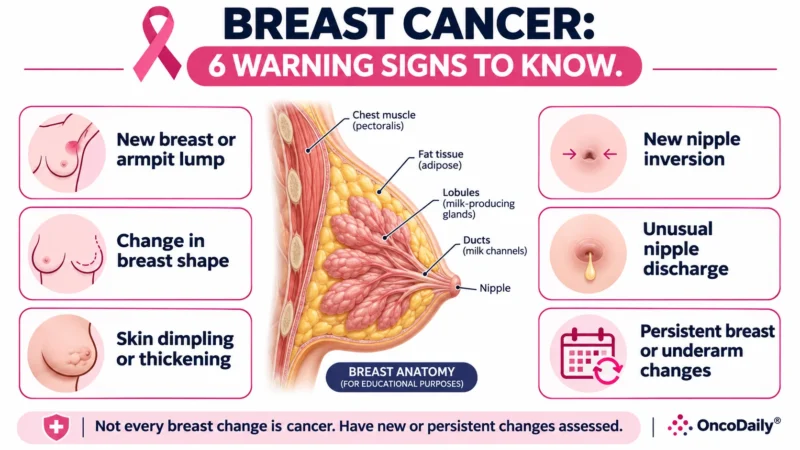
Because it is not possible to reliably distinguish benign from malignant changes through appearance or touch alone, any new, persistent, or concerning symptom should be assessed by a qualified healthcare professional. Lara Stone has not publicly disclosed whether she experienced any of these symptoms before her breast cancer diagnosis.
How Often Should Women Check Their Breasts?
Lara Stone’s announcement emphasized the importance of checking for changes in the breasts. This reflects the concept of breast self-awareness, which encourages people to become familiar with the normal appearance and feel of their breasts. Breast tissue naturally changes over time because of hormonal fluctuations, menstruation, pregnancy, breastfeeding, aging, and other factors. Understanding these normal variations may make unusual changes easier to recognize.
Breast awareness does not require a complicated examination technique or a rigid schedule. Instead, individuals can pay attention to changes while dressing, showering, or going about their usual activities. The breast, chest, nipple, and underarm areas should all be considered. However, it is important to distinguish breast awareness from formal breast cancer screening. Routine breast self-examination has not been shown to reduce breast cancer mortality when used as a stand-alone screening strategy.
Therefore, breast awareness should complement, rather than replace, recommended screening and clinical assessment. A person who discovers a concerning change should seek medical evaluation even if they recently had a normal screening mammogram. Likewise, individuals without symptoms should follow the screening recommendations appropriate for their age, country, and risk profile.
When Should Women Start Breast Cancer Screening?
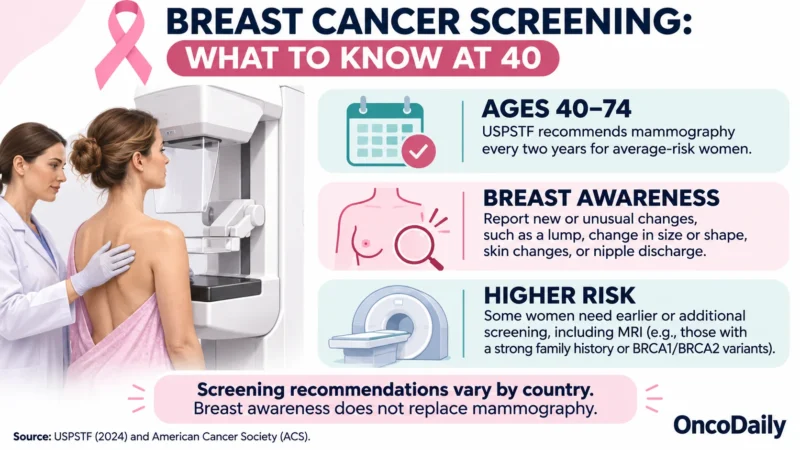
Breast cancer screening recommendations vary by country and medical organization. Mammography remains the principal screening method for detecting breast cancer in individuals without symptoms. A mammogram uses low-dose X-rays to identify abnormalities in breast tissue, including some cancers too small to be felt during a physical examination. Breast cancer screening recommendations vary by medical organization and country. According to the American Cancer Society (ACS), women aged 40–44 may choose to undergo annual mammography, while annual screening is recommended for women aged 45–54. From age 55 onward, women may switch to mammography every two years or continue annual screening. The US Preventive Services Task Force (USPSTF) recommends mammography every two years for women aged 40–74 at average risk of breast cancer.
In comparison, NHS England offers routine breast screening every three years, with initial invitations generally sent between ages 50 and 53 and screening continuing until age 71. These recommendations primarily apply to individuals at average risk. Women with a strong family history of breast cancer, inherited genetic mutations, or other significant risk factors may require earlier screening or additional imaging, such as breast MRI, based on an individualized risk assessment.
At age 42, Stone falls within the age range covered by some US screening recommendations, although routine NHS screening in England generally begins later. However, Stone has not disclosed whether her cancer was discovered through screening mammography, symptom evaluation, or another diagnostic process. Her situation should not be used to assume how her diagnosis occurred. Women with a strong family history of breast cancer, inherited pathogenic variants such as BRCA1 or BRCA2, previous chest irradiation at a young age, or other major risk factors may require individualized screening plans. Depending on their risk, these may involve breast MRI in addition to mammography.
Can Breast Cancer Develop Before Age 45?
Yes. Although breast cancer is more commonly diagnosed in middle-aged and older adults, it can occur in women in their 20s, 30s, and early 40s. According to the American Cancer Society’s 2026 estimates, approximately 321,910 new cases of invasive breast cancer are expected among women in the United States during the year. An estimated 42,140 women are expected to die from the disease.
Breast cancer incidence has also been increasing gradually in the United States. Between 2013 and 2022, the rate of invasive breast cancer increased by approximately 1% annually overall. The increase was more pronounced among women younger than 50, at approximately 1.4% per year, compared with 0.7% annually among women aged 50 and older.
These figures indicate that breast cancer in younger women is an important public-health concern, although older adults continue to account for most diagnoses. Risk factors may include inherited genetic variants, family history, previous radiation exposure, reproductive and hormonal factors, alcohol consumption, and other characteristics. Nevertheless, many people diagnosed with breast cancer have no known hereditary predisposition. Being younger than the usual screening age does not mean that a persistent breast symptom should be dismissed.
How Is Breast Cancer Diagnosed?
When a concerning breast abnormality is identified, clinicians generally use a combination of clinical assessment, imaging, and tissue sampling to determine its cause. The diagnostic process may begin with a medical history and physical examination. Depending on the patient’s age, breast density, and the nature of the abnormality, imaging may include diagnostic mammography, ultrasound, or breast MRI. Ultrasound is particularly useful for distinguishing certain fluid-filled cysts from solid lesions and for evaluating palpable abnormalities. When imaging identifies a suspicious lesion, a biopsy is usually required to establish the diagnosis. A core needle biopsy allows a pathologist to examine tissue and determine whether malignant cells are present. If breast cancer is confirmed, additional pathological testing helps characterize the tumor.
This generally includes evaluation of estrogen receptors (ER), progesterone receptors (PR), and human epidermal growth factor receptor 2 (HER2). These biomarkers are important because breast cancer is not a single biologically uniform disease. Some tumors depend on hormonal signaling, others overexpress HER2, and some lack all three of these markers. Further investigations may be performed to determine disease extent, depending on the clinical findings and suspected stage. The precise tests used in Lara Stone’s diagnostic evaluation have not been publicly disclosed.
What Treatments Are Available for Breast Cancer?
Breast cancer treatment depends on the disease stage, molecular subtype, tumor characteristics, and the patient’s overall health and preferences. According to the National Cancer Institute, treatment frequently involves a combination of local and systemic approaches. Surgery is commonly used to remove localized breast tumors. Options may include breast-conserving surgery, also called lumpectomy, or mastectomy. The choice depends on tumor extent, anatomy, clinical circumstances, and patient preference. Radiotherapy may be recommended after surgery to reduce the risk of local or regional recurrence. It is commonly used after breast-conserving surgery and in selected patients after mastectomy.
Chemotherapy uses medications that target rapidly dividing cells. It may be administered before surgery to shrink a tumor or after surgery to reduce recurrence risk. Not every patient with breast cancer requires chemotherapy. Endocrine therapy is used for hormone receptor-positive breast cancers. Depending on menopausal status and clinical risk, treatment may involve tamoxifen, aromatase inhibitors, ovarian function suppression, or other endocrine approaches.
HER2-targeted therapy is important for patients whose tumors overexpress or amplify HER2. These treatments have substantially improved outcomes in HER2-positive breast cancer. Immunotherapy may be used in selected patients with triple-negative breast cancer, depending on the disease setting and treatment eligibility. Additional targeted treatments may be appropriate for patients with certain genetic or molecular alterations. The selection and sequencing of these treatments depend on detailed clinical information. No specific breast cancer treatment can currently be attributed to Lara Stone beyond her confirmation that she is undergoing therapy.
Why Does Breast Cancer Subtype Matter?
Breast cancer is classified not only by the location and extent of disease but also by the biological characteristics of the tumor. Three biomarkers are especially important in routine clinical practice: estrogen receptor, progesterone receptor, and HER2. Hormone receptor-positive tumors express estrogen receptors, progesterone receptors, or both. These cancers may respond to endocrine therapy, which blocks hormonal stimulation or reduces hormone production. HER2-positive breast cancer is characterized by HER2 overexpression or gene amplification. HER2-directed treatments have transformed the management of this subtype.
Triple-negative breast cancer lacks estrogen receptor and progesterone receptor expression and is HER2-negative. Chemotherapy is frequently important, while immunotherapy and other treatments may be appropriate in selected clinical settings. Tumor grade, proliferation, genetic alterations, and response to treatment also influence management. These differences help explain why two patients diagnosed with breast cancer at the same age and stage may receive very different treatment plans. They also explain why an individual prognosis cannot be determined from the words breast cancer or early detection alone. Stone has not publicly shared her receptor status or histological subtype, and any claims about the biological behavior of her cancer would therefore be speculative.
Does Early Detection Always Mean Breast Cancer Is Curable?
Early diagnosis generally improves the chances of successful treatment, but it does not guarantee a cure. Many patients diagnosed with localized breast cancer achieve excellent long-term outcomes, particularly when appropriate treatment is available and completed. However, recurrence risk depends on numerous clinical factors, including tumor size, lymph-node involvement, grade, molecular subtype, and treatment response. Some biologically aggressive tumors may recur despite being diagnosed at an early stage, while advances in systemic treatment have improved outcomes for many patients with more extensive disease. It is also important to recognize that screening involves both benefits and limitations.
Mammography can detect some cancers before symptoms develop, but it may miss certain tumors and can sometimes identify abnormalities that require additional testing despite ultimately being benign. Screening can also detect some cancers that would never have caused clinical harm, a phenomenon known as overdiagnosis. For these reasons, screening decisions should follow evidence-based recommendations and, where appropriate, individualized discussions with healthcare professionals. Stone’s expression of gratitude for early detection is understandable and consistent with an important public-health message. However, her personal prognosis cannot be established from the limited details she has shared.
How Can People Reduce Their Risk of Breast Cancer?
Not all breast cancers are preventable, and some important risk factors, including age and inherited genetic predisposition, cannot be modified. Nevertheless, research has identified several factors associated with breast cancer risk. Maintaining a healthy body weight, particularly after menopause, may help reduce risk. Regular physical activity is also associated with a lower risk of breast cancer and provides additional cardiovascular and metabolic benefits.
Limiting or avoiding alcohol consumption is another important preventive measure, since alcohol is an established breast cancer risk factor. Individuals considering menopausal hormone therapy should discuss potential benefits and risks with their healthcare professionals, particularly when treatment is expected to continue for an extended period. Breastfeeding, when possible and desired, is also associated with a modest reduction in breast cancer risk.
For individuals with a strong family history or suspected hereditary cancer syndrome, genetic counseling may help determine whether testing or enhanced surveillance is appropriate. However, even people who follow every recommended lifestyle measure can develop breast cancer. Prevention therefore involves reducing modifiable risks while maintaining awareness of symptoms and participating in appropriate screening.
How Has the Public Responded to Lara Stone’s Announcement?
Stone’s announcement attracted attention across international fashion and entertainment media. Coverage focused primarily on the unexpected diagnosis, her gratitude for early detection, and her decision to share a personal health update with followers. Friends, colleagues, and supporters responded with messages of encouragement. The announcement also highlighted the role public figures can play in drawing attention to health issues that might otherwise receive less public discussion.
Celebrity health disclosures can increase awareness, encourage conversations about screening, and prompt individuals to seek information about symptoms. However, their public-health value depends partly on whether the information shared alongside the personal story is medically accurate. Stone’s message was centered on recognizing changes and attending medical appointments. It should not be interpreted as an endorsement of a specific screening method, treatment, or diagnostic pathway.
What Can We Learn From Lara Stone’s Breast Cancer Announcement?
Lara Stone’s announcement offers an important opportunity to discuss breast awareness and the role of timely medical evaluation. Her experience reinforces several principles that are relevant regardless of age or personal risk. First, breast cancer can occur before the age at which routine screening begins in some healthcare systems. Second, becoming familiar with normal breast changes may help individuals recognize new or persistent abnormalities. Third, any concerning breast symptom deserves appropriate evaluation, even when a previous screening result was normal.
Finally, breast awareness and screening are complementary rather than interchangeable. Self-awareness may help identify symptoms, while screening mammography can detect certain cancers before they cause noticeable changes. Stone has chosen not to disclose extensive medical details, and that privacy should be respected. What she has shared is sufficient to communicate the purpose of her announcement: encouraging people to pay attention to their bodies and seek medical advice when something changes.
You Can Also Read Bianca Balti: The Supermodel’s Brave Battle with Ovarian Cancer by OncoDaily

Written by Aharon Tsaturyan, MD, Editor at OncoDaily Intelligence Unit
FAQ
Does Lara Stone Have Breast Cancer?
Yes. Dutch supermodel Lara Stone publicly confirmed her breast cancer diagnosis on October 31, 2026, at age 42. She announced the news on Instagram, describing the diagnosis as a major shock. Stone also confirmed that she was undergoing treatment and expressed gratitude that the cancer had been detected early.
What Type of Cancer Does Lara Stone Have?
Lara Stone has been diagnosed with breast cancer, but she has not publicly disclosed the specific subtype. Details such as estrogen receptor (ER), progesterone receptor (PR), and HER2 status remain unknown. These characteristics are important because they help determine treatment options and prognosis.
What Stage Is Lara Stone's Breast Cancer?
Lara Stone has not publicly revealed her breast cancer stage. Although she stated that the disease was detected early, this does not confirm a specific stage. Breast cancer staging depends on factors including tumor size, lymph node involvement, distant spread, and tumor biology.
What Breast Cancer Treatment Is Lara Stone Receiving?
Lara Stone confirmed that she was undergoing treatment when she announced her diagnosis in October 2026. However, she has not disclosed whether her treatment involves surgery, chemotherapy, radiotherapy, endocrine therapy, or targeted therapy. Her treatment plan remains private.
How Old Was Lara Stone When She Was Diagnosed With Breast Cancer?
Lara Stone was 42 years old when she publicly announced her breast cancer diagnosis on October 31, 2026. Her exact diagnosis date has not been disclosed. Although breast cancer is more common in older adults, it can also develop in women in their 20s, 30s, and early 40s.
What Are the First Signs of Breast Cancer?
Early signs of breast cancer may include a new lump in the breast or armpit, changes in breast size or shape, skin dimpling, nipple inversion, unusual nipple discharge, or persistent breast swelling. However, some early-stage cancers cause no noticeable symptoms and are detected through screening mammography.
Can Breast Cancer Be Cured If Detected Early?
Yes, many cases of early-stage breast cancer can be successfully treated with curative intent. According to the National Cancer Institute's SEER database, the five-year relative survival rate for localized breast cancer is approximately 100%. However, individual outcomes vary depending on tumor biology, stage, and response to treatment.
At What Age Should Women Start Breast Cancer Screening?
Screening recommendations vary by country and medical organization. The US Preventive Services Task Force recommends mammography every two years for average-risk women aged 40–74. The American Cancer Society allows women aged 40–44 to choose annual screening and recommends annual mammography from ages 45–54. Higher-risk individuals may need earlier screening.
Can You Have Breast Cancer Without a Lump?
Yes. Breast cancer can develop without a noticeable lump. Some tumors are detected through screening mammography before symptoms appear. Others may cause skin changes, nipple discharge, swelling, or changes in breast appearance. Any persistent or unusual breast changes should be evaluated by a healthcare professional.
How Can You Check Your Breasts for Signs of Cancer?
Breast self-awareness involves becoming familiar with the normal appearance and feel of your breasts, chest, and underarms. Look for unusual lumps, skin changes, nipple abnormalities, or persistent swelling. Breast awareness can help identify concerning changes, but it does not replace screening mammography or professional medical evaluation.