
Star Trek actor Jonathan Frakes has revealed that he was diagnosed with and treated for high-grade, non-muscle-invasive bladder cancer. He shared his experience on the November 21, 2026 episode of his podcast Dropping Names with Brent and Jonny, alongside former co-star Brent Spiner and urologic oncologist Dr. Ram Narayanan.
Frakes’ story began with an alarming but easily overlooked symptom: his urine turned pink. He sought medical care promptly, underwent cystoscopy, and was diagnosed before the cancer reached the bladder muscle allowing him to receive bladder-preserving treatment rather than more extensive surgery.
What Did Jonathan Frakes Reveal About His Cancer Diagnosis?
Frakes, 74, said the first sign occurred the night before a fan convention in Phoenix with Brent Spiner. He noticed that his urine was pink and initially wondered whether it could be related to something he had eaten. However, Spiner encouraged him to contact his doctor. His physician referred him to Dr. Ram Narayanan, section head of urologic oncology at the Disney Family Cancer Center.
Narayanan performed a cystoscopy, a procedure in which a small camera is inserted through the urethra to examine the urethra and bladder lining. Frakes described how the examination revealed a tumor in his bladder. The diagnosis was high-grade, non-muscle-invasive bladder cancer, meaning the cancer had not invaded the bladder’s muscular wall. This distinction was important because it allowed his medical team to pursue bladder-preserving treatment.
What Was Jonathan Frakes’ First Bladder Cancer Symptom?
The first symptom Frakes noticed was painless blood in his urine, a condition medically known as painless gross hematuria. Gross hematuria refers to blood that is visible to the naked eye. Urine may appear pink, red, or brownish, depending on the amount of blood present. Although the symptom can be alarming, it is not always associated with cancer. Blood in the urine can occur for several reasons, including urinary tract infections, kidney stones, bladder stones, prostate enlargement, trauma, and other noncancerous conditions. However, it can also be an early warning sign of bladder cancer or another urinary tract malignancy.
One particularly important feature is that bladder cancer-related hematuria may occur without pain. Patients may feel otherwise healthy and experience no additional symptoms. In some cases, the discoloration disappears, creating a false sense of reassurance. Nevertheless, visible blood in the urine should be evaluated promptly, even when it occurs only once. Frakes’ experience illustrates why an apparently minor symptom should not automatically be dismissed.
How Was Jonathan Frakes’ Bladder Cancer Diagnosed?
The diagnostic process began with cystoscopy, allowing his urologist to examine the bladder directly. During this examination, a suspicious tumor was identified. Frakes subsequently underwent blue-light cystoscopy, an enhanced imaging technique that helps clinicians identify bladder tumors and abnormal tissue.
What Is Blue-Light Cystoscopy?
Blue-light cystoscopy is an imaging-assisted procedure used to improve the visualization of certain bladder tumors. Before the examination, a special imaging agent is introduced into the bladder. Under blue light, malignant or suspicious tissue may fluoresce, making some abnormalities easier to identify than with conventional white-light cystoscopy alone. This can be particularly useful when detecting small lesions or carcinoma in situ, a flat form of high-grade bladder cancer. Blue-light cystoscopy may help clinicians identify additional tumor areas and improve the completeness of resection. However, pathological examination remains necessary to establish the diagnosis and determine the tumor’s characteristics.
What Is TURBT?
Bladder tumors are commonly diagnosed and initially treated through transurethral resection of a bladder tumor (TURBT). During this procedure, a surgeon introduces instruments through the urethra and removes visible tumor tissue from the bladder. The tissue is then examined by a pathologist to determine the histological diagnosis, grade, and depth of invasion. TURBT is essential for establishing whether bladder cancer is non-muscle-invasive or has invaded the muscular wall.
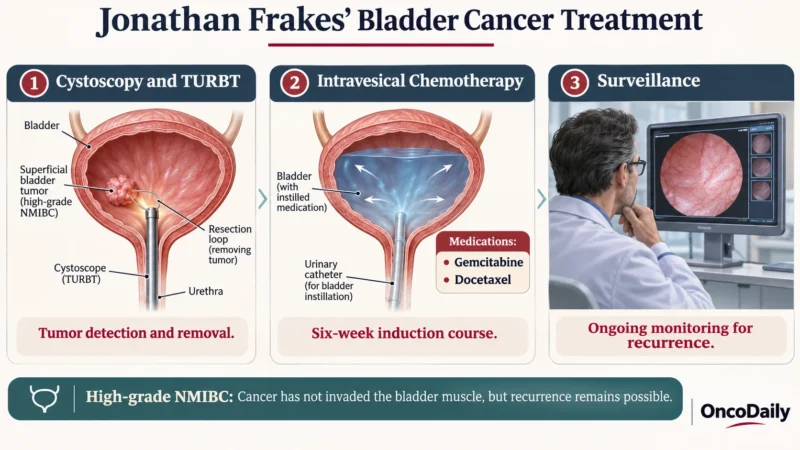
Frakes reported that his tumor-removal procedure occurred just three days after the initial cystoscopy. Following the procedure, Narayanan expressed optimism that the visible tumor had been successfully removed. However, removing the visible cancer does not eliminate the possibility of microscopic residual disease or future recurrence. That is why additional treatment and surveillance are often necessary, particularly for high-grade tumors.
What Does High-Grade, Non-Muscle-Invasive Bladder Cancer Mean?
High-grade, non-muscle-invasive bladder cancer is a malignancy that has not invaded the bladder’s muscular wall but has cellular characteristics associated with a greater risk of recurrence and progression. The terms high-grade and non-muscle-invasive describe different aspects of the disease. Tumor grade refers to how abnormal cancer cells appear under microscopic examination.
High-grade tumors generally behave more aggressively than low-grade tumors. Tumor stage describes how far the cancer has invaded the bladder wall. Non-muscle-invasive bladder cancer, or NMIBC, includes several categories.
Classification
- Ta -Noninvasive papillary carcinoma confined to the urothelial lining
- Tis -Carcinoma in situ, a flat, high-grade lesion
- T1-Tumor invading the lamina propria but not the muscularis propria
- T2-Tumor invading the bladder’s muscular wall
The distinction between non-muscle-invasive and muscle-invasive cancer is particularly important.
Many patients with NMIBC can be treated using TURBT and intravesical therapy, which delivers medication directly into the bladder. Muscle-invasive bladder cancer generally requires more intensive treatment, potentially involving radical cystectomy, systemic therapy, radiotherapy, or combined approaches. Importantly, not every patient with high-grade NMIBC can safely retain their bladder. Some high-risk or treatment-resistant cases may require radical cystectomy. The precise treatment strategy depends on tumor stage, grade, size, number of lesions, the presence of carcinoma in situ, and other risk factors.
Why Did Early Detection Matter in Jonathan Frakes’ Case?
Frakes’ medical team emphasized the importance of identifying the tumor before it invaded the bladder muscle. Muscle invasion is an important turning point in bladder cancer management because it substantially changes the potential treatment options. Patients with localized non-muscle-invasive disease can often undergo tumor resection followed by bladder-directed treatment. Once cancer invades the muscular wall, more extensive treatment may be required. For selected patients, this can include removal of the bladder, known as radical cystectomy.
Frakes’ diagnosis allowed him to receive treatment without immediate removal of the bladder. However, this outcome should not be interpreted as a guarantee that every bladder cancer detected early can be treated conservatively. Some high-grade tumors carry substantial risks of recurrence or progression even when initially diagnosed as non-muscle-invasive. Still, his experience demonstrates the potential benefit of prompt evaluation when visible hematuria occurs.
What Treatment Did Jonathan Frakes Receive for Bladder Cancer?
Following removal of the bladder tumors, Frakes underwent six weeks of bladder-directed treatment. Public reporting identifies the medications as gemcitabine and docetaxel. These are chemotherapy agents that can be administered sequentially into the bladder as intravesical treatment. This differs from conventional intravenous chemotherapy because the medications are delivered directly into the bladder through a catheter. The goal is to expose the bladder lining to anticancer drugs while limiting systemic exposure.
Frakes referred to his treatment as chemotherapy and immunotherapy, but gemcitabine and docetaxel are both cytotoxic chemotherapy agents. Intravesical BCG is an immunotherapy approach commonly used for high-risk NMIBC. His urologist explained that a shortage of BCG influenced the decision to use gemcitabine and docetaxel.
What Is Intravesical Gemcitabine-Docetaxel?
Sequential intravesical gemcitabine-docetaxel involves administering gemcitabine into the bladder, followed by docetaxel. The medications are generally retained for specified periods before being drained or voided. A commonly used induction schedule consists of weekly treatments for six weeks. The regimen has been investigated as a bladder-preserving approach for patients with non-muscle-invasive bladder cancer. It has particular relevance when BCG is unavailable, unsuitable, or has failed, although appropriate use depends on the patient’s risk category and current clinical guidance. Published studies have demonstrated encouraging disease-control results. A multi-institutional retrospective analysis of 276 patients treated with sequential intravesical gemcitabine-docetaxel reported:
- One-year recurrence-free survival of approximately 65%.
- Two-year recurrence-free survival of approximately 52%.
However, those findings should not be interpreted as an individualized prognosis for Frakes. Study populations, prior treatment exposure, tumor characteristics, and clinical circumstances can differ substantially.
Why Was BCG Not Used?
Intravesical bacillus Calmette-Guérin, commonly called BCG, is an established immunotherapy treatment for selected patients with high-risk non-muscle-invasive bladder cancer. BCG stimulates local immune activity within the bladder and can reduce the likelihood of recurrence and progression. For many patients with high-risk NMIBC, BCG induction followed by appropriate maintenance therapy has been a standard treatment approach.
However, BCG shortages have affected access in different healthcare settings. These shortages have encouraged greater interest in alternative intravesical regimens, including gemcitabine-docetaxel. Narayanan indicated that limited BCG availability contributed to Frakes’ treatment selection. The choice illustrates how treatment access can influence clinical decisions even when several potentially effective approaches exist.
Can High-Grade Bladder Cancer Return After Treatment?
Yes. High-grade non-muscle-invasive bladder cancer can recur after treatment, and some tumors can progress to muscle-invasive disease. Even when all visible cancer is removed, microscopic malignant cells or newly developing tumors may later be detected. The likelihood of recurrence depends on several factors, including tumor grade, stage, size, multiplicity, previous recurrence history, and response to intravesical treatment. Carcinoma in situ and high-grade T1 disease are particularly important considerations in risk assessment. Because recurrence is possible, treatment does not end with successful tumor removal. Patients generally require continued monitoring.
Why Is Surveillance Cystoscopy Necessary?
Cystoscopy remains a central component of follow-up after treatment for NMIBC. During surveillance, the urologist examines the bladder lining for evidence of recurrent disease. The frequency of cystoscopy depends on the patient’s risk category and treatment history. High-risk patients generally require closer follow-up than those with low-risk disease. Additional investigations may include urine cytology, imaging, or further tissue sampling when clinically indicated.
For some patients, surveillance continues for many years because recurrence can occur long after initial treatment. Frakes’ publicly disclosed history does not establish his exact surveillance schedule or whether maintenance intravesical therapy is planned. Therefore, it would be inappropriate to conclude that he is permanently cured based solely on his initial treatment response.
What Is the Prognosis for High-Grade Non-Muscle-Invasive Bladder Cancer?
The prognosis for NMIBC varies considerably. Many patients achieve prolonged disease control, particularly when appropriate resection, intravesical therapy, and surveillance are performed. However, high-grade disease carries a greater risk of recurrence and progression than low-grade NMIBC. The American Urological Association and Society of Urologic Oncology guideline reports that cancer-specific survival for high-grade NMIBC has historically ranged from approximately 70% to 85% at 10 years.
These figures represent broad estimates across different patient populations. They should not be interpreted as predictions for any individual. Risk stratification is essential because a small, completely resected high-grade tumor may carry a different prognosis from extensive T1 disease associated with carcinoma in situ. Frakes’ exact pathological stage has not been publicly established. Consequently, available information is insufficient to estimate his individualized long-term prognosis.
Did Jonathan Frakes Also Have a Prostate Problem?
Yes. During his urologic evaluation, Frakes also learned that he had substantial prostate enlargement. He described the enlargement humorously, comparing the size of his prostate to that of a small town. Following treatment for bladder cancer, he underwent an additional procedure to remove prostate tissue obstructing urinary flow. An enlarged prostate, often caused by benign prostatic hyperplasia, is common in older men. It can contribute to urinary frequency, urgency, difficulty initiating urination, and incomplete bladder emptying. Prostate enlargement may also cause hematuria in some circumstances.
However, there is no evidence in the public account that Frakes’ prostate enlargement caused his bladder cancer. The two conditions should be considered separate urologic findings. Importantly, prostate enlargement does not necessarily indicate prostate cancer.
How Common Is Bladder Cancer?
Bladder cancer is an important malignancy affecting the urinary system. It occurs more frequently in men than women and is particularly common among older adults. According to the AUA/SUO guideline, approximately 75% of newly diagnosed bladder cancers are non-muscle-invasive. This means many patients initially present with tumors that have not invaded the bladder muscle. However, outcomes vary according to stage and grade.
Patients with low-risk NMIBC may have relatively favorable outcomes but still experience recurrence. High-risk disease requires more intensive treatment and follow-up because of its greater potential for progression. The overall burden of bladder cancer reinforces the importance of recognizing urinary symptoms and seeking timely evaluation.
What Are the Risk Factors for Bladder Cancer?
Several factors are associated with increased bladder cancer risk. The most important modifiable risk factor is tobacco exposure. Chemicals in tobacco smoke can enter the bloodstream, be filtered by the kidneys, and accumulate in urine, where they may damage the bladder lining. Other established or recognized risk factors include:
- Older age and male sex.
- Occupational exposure to certain chemicals, including aromatic amines.
- Chronic bladder irritation or inflammation in specific settings.
- Previous pelvic radiation.
- Exposure to certain chemotherapy agents, particularly cyclophosphamide.
- Personal or family history of bladder cancer.
- Certain inherited susceptibility factors.
However, population-level risk factors do not explain the cause of every individual cancer diagnosis. No specific cause of Frakes’ bladder cancer has been established through the information publicly disclosed. His experience should therefore not be used to speculate about personal habits or exposures.
What Are the Early Warning Signs of Bladder Cancer?
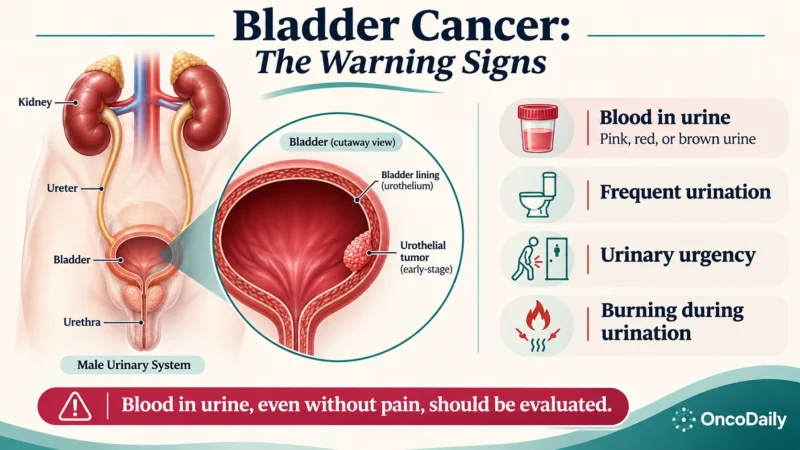
Visible blood in the urine is one of the most recognizable warning signs of bladder cancer. Other symptoms may include frequent urination, urinary urgency, burning during urination, and changes in normal urinary habits. These symptoms are not specific to bladder cancer. They can also occur with urinary tract infections, benign prostate enlargement, and other common conditions. Nevertheless, persistent or unexplained urinary symptoms warrant appropriate medical assessment. The absence of pain does not rule out a serious condition. Frakes’ experience is particularly important because his first symptom was a change in urine color rather than severe pain or obvious illness.
Can Bladder Cancer Be Detected Before Symptoms Appear?
There is currently no universally recommended routine bladder cancer screening program for the general asymptomatic population. Unlike some cancers for which established population-based screening programs exist, bladder cancer is often diagnosed after symptoms develop. Visible hematuria frequently prompts investigation. Evaluation may involve urinalysis, imaging, and cystoscopy, depending on the patient’s clinical circumstances and risk factors. Patients with particular occupational exposures, previous urothelial malignancies, or other specific risks may require individualized assessment. However, routine screening of all asymptomatic adults has not been established as a standard strategy. This makes symptom awareness particularly important.
What Does Jonathan Frakes’ Story Teach Us About Early Cancer Detection?
Frakes’ experience follows a clinically meaningful sequence. He noticed a change in his urine, discussed it with someone he trusted, and contacted a healthcare professional. He then underwent an appropriate urologic evaluation, received a diagnosis, and began treatment. The central lesson is not that every episode of hematuria indicates malignancy. Rather, it is that potentially important symptoms should be assessed instead of ignored. His experience also illustrates how treatment decisions may be influenced by disease characteristics and medication availability.
Although his tumor was high-grade, it had not invaded the bladder muscle, allowing treatment with tumor resection and intravesical therapy. Continued surveillance remains important because high-grade NMIBC can recur. By discussing his diagnosis publicly, Frakes has helped draw attention to a symptom that many patients may otherwise dismiss. As Brent Spiner emphasized during their conversation, people should seek medical evaluation when they notice concerning changes rather than allowing fear or embarrassment to delay care.
What Is Still Unknown About Jonathan Frakes’ Bladder Cancer?
Although Frakes shared important details, the publicly available information does not constitute a complete medical record. Several clinically relevant details remain unknown, including his exact pathological TNM stage, whether carcinoma in situ was present, and the number, size, and location of the tumors. The full histopathological report has not been disclosed. It is also unclear whether maintenance intravesical therapy is planned or what surveillance schedule his healthcare team has recommended. These missing details matter because high-grade NMIBC represents a heterogeneous group of cancers with different recurrence and progression risks. It would therefore be inappropriate to assign a precise prognosis or declare Frakes permanently cured without additional clinical information.
What Should Someone Do If They Notice Blood in Their Urine?
Anyone who notices visible blood in the urine should seek medical assessment promptly, even if the episode occurs only once and is not associated with pain.A clinician may recommend urine testing, imaging, cystoscopy, or additional examinations based on the patient’s history and findings. The underlying cause may be benign, but investigation is important because hematuria can sometimes be the first sign of urinary tract malignancy. The message from Frakes’ experience is straightforward: Blood in the urine is not a cancer diagnosis. It is a reason to seek medical evaluation.
You Can Also Read Ernie Hudson: How the Ghostbusters Star Survived Prostate and Rectal Cancer by OncoDaily

Written by Aharon Tsaturyan, MD, Editor at OncoDaily Intelligence Unit
FAQ
What type of cancer does Jonathan Frakes have?
Jonathan Frakes revealed that he was diagnosed with high-grade, non-muscle-invasive bladder cancer. This means the cancer had not invaded the bladder's muscular wall at the time of diagnosis.
What was Jonathan Frakes' first cancer symptom?
His first reported symptom was pink urine, indicating visible blood in the urine, known as gross hematuria. He did not report pain associated with the episode.
How was Jonathan Frakes' bladder cancer treated?
He underwent cystoscopy and tumor removal, followed by six weeks of intravesical treatment. Public reporting identifies the medications as gemcitabine and docetaxel.
Did Jonathan Frakes have his bladder removed?
No. According to his public account, his cancer was treated through bladder-preserving procedures and intravesical therapy. There is no report that he underwent radical cystectomy.
Is Jonathan Frakes cured of bladder cancer?
His public account describes treatment, but the available information does not establish a permanent cure. High-grade non-muscle-invasive bladder cancer can recur, making continued surveillance important.
Can blood in the urine be an early sign of bladder cancer?
Yes. Visible blood in the urine, particularly when painless, can be an early warning sign. However, hematuria can also result from noncancerous conditions and requires appropriate medical assessment.
What is the difference between high-grade and muscle-invasive bladder cancer?
High-grade describes the abnormal appearance and potentially aggressive behavior of cancer cells. Muscle-invasive describes the depth of tumor invasion into the bladder wall. A tumor can be high-grade without being muscle-invasive.
Why was Jonathan Frakes treated with gemcitabine and docetaxel?
According to the public account, a shortage of intravesical BCG influenced the selection of sequential gemcitabine-docetaxel treatment.