



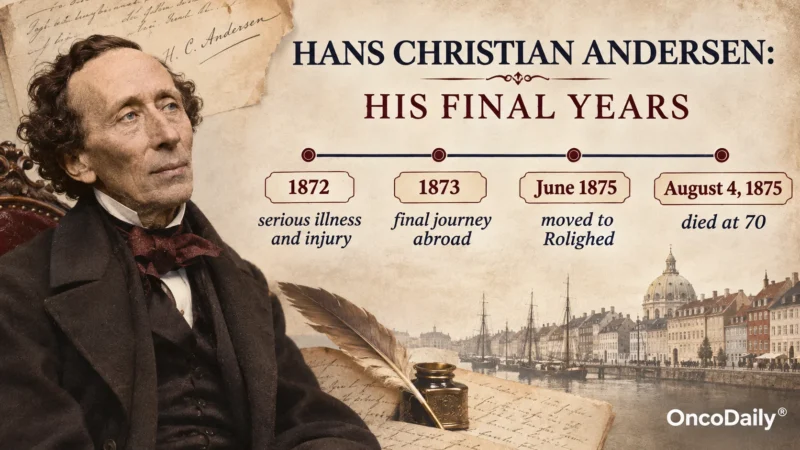
Hans Christian Andersen, the Danish writer whose fairy tales transformed children’s literature, died on August 4, 1875, at the age of 70. Best known for The Little Mermaid, The Ugly Duckling, The Snow Queen, and The Emperor’s New Clothes, Andersen spent his final years struggling with deteriorating health and an illness historically identified as liver cancer. His final chapter began with serious health problems in 1872 and ended at Rolighed, the Copenhagen home of his close friends, the Melchior family. Historical accounts, including Andersen’s personal diaries, reveal a more complicated medical history than the familiar summary of his death.
Photo: Depositphotos
Although liver cancer is consistently identified in historical biographies as his cause of death, the precise tumor type, stage, and underlying risk factors remain unknown. His story offers an opportunity to examine both the final years of a remarkable literary figure and how the diagnosis and treatment of liver cancer have changed over the past 150 years.
Who Was Hans Christian Andersen?
Hans Christian Andersen was born on April 2, 1805, in Odense, Denmark, into a family of modest means. His father worked as a shoemaker, and his mother was a washerwoman. Despite financial difficulties, Andersen developed an early interest in storytelling, theater, and literature, ambitions that eventually led him far beyond his hometown. At just 14, he moved to Copenhagen, hoping to establish himself as a performer. His early attempts at singing, dancing, and acting brought limited success, but he eventually found his voice as a writer. His literary breakthrough came in 1835, when he published his first collection of fairy tales alongside the novel The Improvisatore.
Unlike traditional fairy tales, Andersen’s stories often explored profound human experiences. His characters confronted loneliness, rejection, disability, ambition, sacrifice, and the desire to belong. These themes gave his work an emotional depth that resonated with both children and adults.
Among his most recognizable works are The Little Mermaid, The Ugly Duckling, The Princess and the Pea, Thumbelina, The Snow Queen, The Little Match Girl, and The Emperor’s New Clothes. By the later decades of his life, Andersen had achieved international recognition, traveled extensively throughout Europe, and established friendships with prominent literary figures, including Charles Dickens. His final years, however, presented challenges that fame and professional success could not overcome. As his health deteriorated, he became increasingly dependent on doctors, nurses, and close friends.
What Happened to Hans Christian Andersen in 1872?
In late 1872, Andersen experienced a serious fall from his bed, resulting in injuries that contributed to a prolonged deterioration in his health. Historical biographies identify the accident as an important event in his final years. However, the fall was not the only medical problem he experienced during this period. Accounts based on Andersen’s diaries reveal that he was already suffering from significant symptoms during 1872, including abdominal discomfort, chills, jaundice, and unusually dark stools.
A particularly revealing diary entry dated November 6, 1872, describes his anxiety after noticing stools that appeared nearly black and tar-like. He also reported abdominal pain and expressed concern that something was seriously wrong internally. Physicians later examined him, and historical records indicate that they did not interpret the discoloration as definite intestinal bleeding. Instead, one physician attributed the findings to bile.
The episode offers an unusually detailed glimpse into nineteenth-century medical practice. Andersen received dietary recommendations, medicines intended to relieve digestive symptoms, and supportive care. Although dark stools and jaundice can be associated with serious gastrointestinal or hepatobiliary disorders, these symptoms are not specific to liver cancer. There is insufficient evidence to establish that Andersen’s symptoms in 1872 were caused by the cancer that later took his life. His accident and medical complaints should therefore be considered separately rather than presented as proof that he already had advanced liver cancer.
How Did Hans Christian Andersen’s Health Decline?
The period between 1872 and 1875 was marked by recurring illness, reduced physical strength, and increasing concern about Andersen’s health. Despite his difficulties, he continued to travel and participate in social activities whenever possible. In 1873, he completed his final journey abroad, visiting Germany and Switzerland. He also maintained extensive correspondence with friends and acquaintances, although illness increasingly interrupted his literary and social activities.
Historical accounts describe digestive complaints, episodes of jaundice, respiratory symptoms, pain, and declining mobility during his final years. His personal writings also suggest that illness had a considerable psychological impact, including anxiety about suffering and death. Andersen received care from physicians who were respected in nineteenth-century Denmark. Among those mentioned in historical nursing accounts were Emil Hornemann and Theodor Collin. Treatments included dietary adjustments, medicines for digestive complaints, and methods intended to provide symptomatic relief. As his condition progressed, nursing assistance became increasingly important.
Records published by the Danish nursing profession describe how experienced deaconess nurses helped care for Andersen during his final illness. These details challenge the impression that Andersen simply withdrew from public life after his accident. His decline involved repeated periods of illness, attempts at recovery, medical consultations, and increasing dependence on others. By 1875, his condition had become severe enough that he could no longer live with the independence he had previously enjoyed.
What Type of Liver Cancer Did Hans Christian Andersen Have?
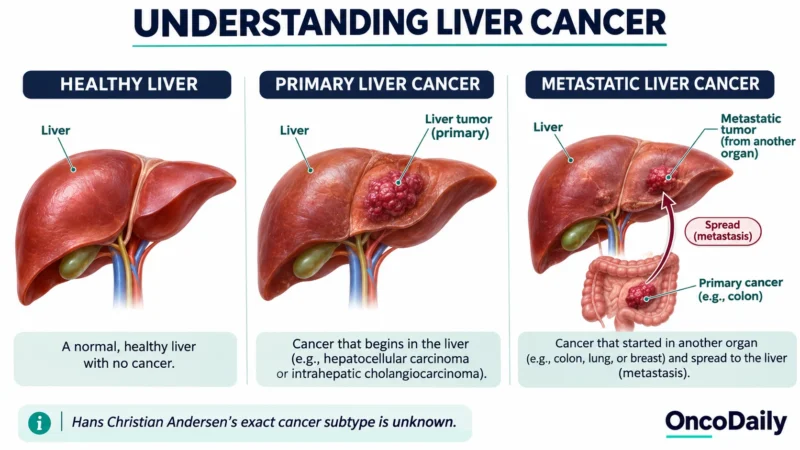
Historical accounts consistently report that Hans Christian Andersen died of liver cancer. However, the available evidence does not establish the precise type of malignancy. This distinction matters because the term liver cancer can describe several different conditions. Primary liver cancer originates within the liver itself. The most common primary liver malignancy in adults is hepatocellular carcinoma (HCC), which develops from hepatocytes, the principal functional cells of the liver.
Another important form is intrahepatic cholangiocarcinoma, which arises from the bile ducts located inside the liver. Secondary or metastatic liver cancer occurs when a malignancy originating elsewhere in the body spreads to the liver. Common primary sites include the colon, rectum, pancreas, stomach, breast, and lungs. In modern oncology, these diagnoses are distinguished through imaging, laboratory investigations, clinical evaluation, and, when appropriate, tissue examination.
For Andersen, no sufficiently detailed modern pathological documentation is available to establish whether his reported liver cancer was hepatocellular carcinoma, cholangiocarcinoma, or metastatic disease. It would therefore be inaccurate to state that he definitely had hepatocellular carcinoma or to assign a particular cancer stage. The medically responsible conclusion is that Andersen’s death was historically attributed to liver cancer, but the exact diagnosis cannot be retrospectively confirmed.
What Are the Symptoms of Liver Cancer?
Liver cancer can develop without noticeable symptoms, particularly during its early stages. When symptoms emerge, they are often nonspecific and may resemble those associated with other liver or gastrointestinal conditions. Common symptoms and clinical findings include unexplained weight loss, reduced appetite, persistent fatigue, and discomfort or pain in the upper-right abdomen. Some patients experience nausea, early satiety, or a feeling of abdominal fullness. As the disease progresses, additional symptoms may develop, including jaundice, which causes yellowing of the skin and eyes, and abdominal swelling associated with enlargement of the liver or fluid accumulation, known as ascites.
Dark urine and pale stools may also occur when normal bile flow is disrupted. However, these symptoms can arise from several noncancerous conditions, including hepatitis, gallstones, and other disorders affecting the liver or bile ducts. Advanced disease may be associated with worsening liver function, malnutrition, bleeding complications, and a substantial decline in physical performance.
These symptoms are important when considering Andersen’s medical history, but they cannot be used to reconstruct his cancer stage. For example, his historical episodes of jaundice and abdominal complaints may suggest hepatobiliary dysfunction, but they are not sufficient to establish that his malignancy was present at that time. According to the National Cancer Institute, liver cancer symptoms can overlap with those of chronic liver disease, making clinical evaluation and appropriate investigations essential.
What Causes Liver Cancer?
Modern research has identified several important risk factors for primary liver cancer, particularly hepatocellular carcinoma. One of the strongest is chronic hepatitis B or hepatitis C infection. Both viruses can cause long-term liver inflammation and damage, increasing the likelihood of malignant transformation over time. Cirrhosis, regardless of its underlying cause, is another major risk factor. Cirrhosis involves progressive replacement of healthy liver tissue with scar tissue and can develop after years of chronic liver disease.
Excessive alcohol consumption is an established cause of chronic liver injury and cirrhosis. Metabolic dysfunction-associated steatotic liver disease (MASLD), particularly when associated with inflammation and fibrosis, is increasingly recognized as another important risk factor. Other factors include exposure to aflatoxins, certain hereditary metabolic conditions, and increasing age.
However, not all patients with liver cancer have known risk factors, and not everyone with chronic liver disease develops malignancy. In Andersen’s case, there is no adequate evidence to identify a specific cause for his reported cancer. It would be speculative to attribute his illness to alcohol, viral hepatitis, metabolic disease, or another exposure. His medical history belongs to a period before hepatitis viruses could be identified and before the modern distinction between many different forms of chronic liver disease. Consequently, the underlying cause of Andersen’s liver cancer remains unknown.
How Was Liver Cancer Diagnosed in the Nineteenth Century?
During Andersen’s lifetime, physicians relied primarily on medical history, physical examination, observation of symptoms, and the limited laboratory and pathological techniques available at the time. Modern imaging did not yet exist. Computed tomography, magnetic resonance imaging, and the ultrasound examinations now routinely used in hepatology and oncology were developed many decades after Andersen’s death. Physicians could sometimes suspect serious liver disease based on jaundice, abdominal swelling, pain, or an enlarged liver. However, establishing the exact location and nature of an internal tumor was much more difficult.
The distinction between cirrhosis, primary liver cancer, metastatic cancer, and other abdominal diseases was often uncertain without postmortem examination. Today, liver cancer can be evaluated using ultrasound, particularly for surveillance in selected high-risk patients, followed by multiphasic contrast-enhanced computed tomography or magnetic resonance imaging when suspicious lesions are identified. Blood tests help assess liver function, while alpha-fetoprotein (AFP) may provide additional information in appropriate clinical settings. However, AFP is neither sufficiently sensitive nor specific to diagnose liver cancer on its own.
A biopsy may be necessary when imaging and clinical findings do not establish a diagnosis, although characteristic imaging findings can be sufficient for diagnosing hepatocellular carcinoma in certain high-risk populations. Additional investigations help determine disease extent and guide treatment decisions. Modern diagnostic methods can sometimes identify liver tumors before symptoms appear, creating opportunities for potentially curative treatment. These advances were unavailable to Andersen and his physicians.
Could Hans Christian Andersen’s Liver Cancer Have Been Treated Today?
Liver cancer treatment has changed dramatically since the nineteenth century. In Andersen’s era, physicians had no established curative treatments for advanced liver malignancies. Medical care focused largely on relieving symptoms, supporting nutrition, managing complications, and providing comfort. Today, treatment depends on whether the cancer originated in the liver or spread there from another organ, as well as the tumor’s size, number, location, underlying liver function, and the patient’s overall health. For selected patients with primary liver cancer, potentially curative options include surgical resection, thermal ablation, and liver transplantation.
Surgical resection involves removing the affected portion of the liver when sufficient healthy tissue can be preserved. Liver transplantation may be considered in carefully selected patients, particularly those with hepatocellular carcinoma arising in the setting of cirrhosis. Local treatments, including transarterial chemoembolization (TACE) and radioembolization, may be used in appropriate patients when surgery is not suitable. Systemic therapies have also transformed treatment for unresectable or advanced hepatocellular carcinoma.
Modern approaches include immune checkpoint inhibitors, antiangiogenic therapies, and molecularly targeted agents. Examples of immunotherapy-based regimens used for eligible patients with advanced hepatocellular carcinoma include atezolizumab plus bevacizumab and durvalumab plus tremelimumab. These treatments work through different mechanisms. Immune checkpoint inhibitors help the immune system recognize and attack cancer cells, while antiangiogenic treatments interfere with pathways involved in the formation of blood vessels supporting tumor growth.
The choice of treatment depends on tumor characteristics, liver function, bleeding risk, other medical conditions, and current clinical guidelines. These advances have improved the outlook for selected patients, particularly when cancer is identified early. Nevertheless, it is impossible to determine whether Andersen would have been eligible for surgery, transplantation, immunotherapy, or another modern treatment. Without knowing his exact cancer type, stage, and liver function, any prediction about how modern medicine might have changed his outcome would be speculation.
How Common Is Liver Cancer Today?
Although Andersen died more than 150 years ago, liver cancer remains a major global public health challenge. According to the International Agency for Research on Cancer’s GLOBOCAN 2022 estimates, approximately 866,136 new cases of liver and intrahepatic bile duct cancer and 758,725 related deaths occurred worldwide in 2022. These malignancies ranked sixth worldwide in cancer incidence and third in cancer-related mortality.
The substantial number of deaths relative to diagnoses reflects the challenges associated with liver cancer, including late detection, underlying chronic liver disease, and limited access to potentially curative treatment in many settings. The geographical distribution of liver cancer also varies considerably. Higher disease burdens occur in several regions of East and Southeast Asia and sub-Saharan Africa, where chronic hepatitis B infection and other established risk factors contribute to disease incidence.
In the United States, the National Cancer Institute’s SEER estimates for 2026 indicate approximately 42,340 new cases and 30,980 deaths from liver and intrahepatic bile duct cancers combined. Although vaccination against hepatitis B, treatment of viral hepatitis, surveillance in appropriate high-risk populations, and advances in cancer therapy have improved prevention and care, liver cancer remains one of the leading causes of cancer mortality worldwide. These statistics concern contemporary populations and should not be interpreted as evidence about Andersen’s particular diagnosis.
What Is the Survival Rate for Liver Cancer?
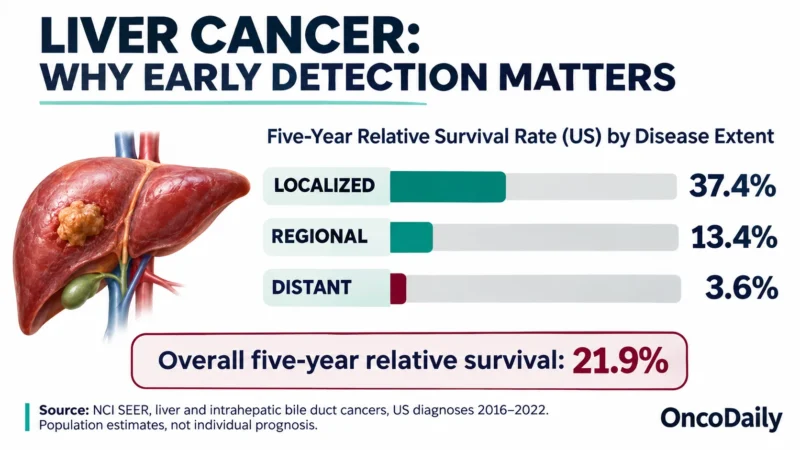
Survival depends strongly on the extent of the disease at diagnosis, the type of cancer, underlying liver function, and available treatment. According to the National Cancer Institute’s SEER database, the five-year relative survival rate for liver and intrahepatic bile duct cancer combined was approximately 21.9% among patients diagnosed in the United States between 2016 and 2022. However, outcomes vary substantially according to how far the malignancy has spread when it is diagnosed.
For patients diagnosed with localized disease, the five-year relative survival rate was approximately 37.4%. This decreased to around 13.4% for regional disease and 3.6% for distant-stage disease. These differences highlight the importance of identifying cancer before it spreads beyond the liver. Five-year relative survival compares survival among people diagnosed with cancer with that expected among people of similar demographic characteristics in the general population. The figures are population-level estimates rather than predictions for individual patients. They also include different malignancies and patient groups, which may have substantially different outcomes.
Treatment advances, particularly surgery, transplantation, locoregional treatment, and newer systemic therapies, continue to create opportunities for improved survival in selected patients. Nevertheless, modern survival figures cannot be applied retrospectively to Andersen, whose precise diagnosis and disease extent are unknown.
How Did Hans Christian Andersen Spend His Final Months?
By June 1875, Andersen had become increasingly frail and dependent on care. On June 12, he moved to Rolighed, the country residence of his friends Moritz and Dorothea Melchior, in the Østerbro district of Copenhagen. The estate’s name translates approximately to “tranquility,” and it became the setting for his final weeks. The Melchior family had been part of Andersen’s social circle for years and provided him with companionship and practical support as his condition worsened.
His declining health gradually limited his ability to engage in activities that had defined his life: traveling, writing, corresponding with friends, and participating in social gatherings. Historical accounts describe a gradual loss of strength and increasing difficulty with everyday activities. One particularly revealing detail concerns his diary. A historical study of Andersen’s final years records that on June 19, 1875, he stopped writing his diary entries himself and began dictating them to members of the Melchior family.
For a man whose life had been devoted to recording observations, emotions, and stories, losing the ability to write independently represented a significant change. His care during this period reflected the possibilities and limitations of nineteenth-century medicine.
There were no cancer-directed treatments comparable to modern chemotherapy, immunotherapy, or liver-directed interventions. The people around him could offer nursing assistance, medical attention, symptom relief, and companionship, but little could be done to reverse a progressive malignancy. These final weeks also illustrate the importance of supportive care, a principle that remains central to modern oncology.
When and Where Did Hans Christian Andersen Die?
Hans Christian Andersen died on August 4, 1875, at approximately 11:05 a.m., at Rolighed, the Melchior family’s residence in Copenhagen. He was 70 years old. Accounts based on historical correspondence and diaries describe his final days as a period of profound physical weakness and dependence on his caregivers. His death was attributed to liver cancer, although the specific form of the disease was not documented in a way that can be reliably translated into a modern oncology diagnosis. Andersen’s funeral took place on August 11, 1875, at Copenhagen Cathedral, also known as the Church of Our Lady.
The ceremony was a major national event. Denmark’s king and crown prince attended, reflecting Andersen’s standing as one of the country’s most celebrated cultural figures. He was buried at Assistens Cemetery in Copenhagen, where his grave remains an important place of remembrance.
Did Hans Christian Andersen Make a Special Request for His Funeral?
One of the most widely repeated anecdotes about Andersen’s final days concerns a request he reportedly made about the music at his funeral. According to later biographical accounts, Andersen wanted the music to accommodate the short steps of the children he expected would accompany his coffin. The story is often interpreted as a final expression of his connection with young readers. Although the anecdote has appeared in numerous biographies and educational accounts, the precise wording and circumstances are less securely documented than the basic facts of his death and funeral.
It is therefore best presented as a traditional biographical account rather than an independently verified final statement. Even with that qualification, the story illustrates how strongly Andersen became associated with childhood and the imaginative worlds he created. His funeral was not simply the farewell of a successful writer. It marked the loss of a figure whose work had become part of Denmark’s cultural identity.
How Does Andersen’s Story Reflect the History of Cancer Care?
Andersen’s final illness occurred during a period when physicians were beginning to understand cancer as a pathological disease, but most of the diagnostic and therapeutic techniques familiar today did not yet exist. The inability to identify the exact nature of his liver malignancy illustrates one of the central limitations of nineteenth-century medicine. Today, imaging can characterize liver tumors, pathology can distinguish different cancer types, and molecular testing can sometimes identify features relevant to treatment.
Multidisciplinary teams involving medical oncologists, hepatologists, surgeons, interventional radiologists, and palliative care specialists can develop individualized treatment plans. Modern care also recognizes that patients need support beyond anticancer treatment. Pain management, nutritional support, emotional care, and assistance with daily functioning are essential parts of comprehensive oncology care.
Palliative care is particularly important because it focuses on preventing and relieving suffering while supporting patients and their families throughout serious illness. It may be provided alongside cancer-directed treatment and is not limited to the final stages of life. In Andersen’s time, much of this care was provided through a combination of physicians, charitable nursing institutions, family friends, and household caregivers. His final months therefore highlight both the limitations of historical cancer treatment and the enduring importance of compassionate support.
How Is Hans Christian Andersen Remembered Today?
More than 150 years after his death, Hans Christian Andersen remains one of the world’s most influential literary figures. His stories have been translated into numerous languages and adapted into films, theatrical productions, ballets, operas, and animated works. The Royal Danish Library preserves extensive collections of his manuscripts, correspondence, diaries, and other literary materials, allowing historians and readers to explore his life in remarkable detail. His birthday, April 2, is celebrated internationally as International Children’s Book Day, reflecting his lasting contribution to literature for young readers.
Andersen’s influence extends beyond children’s entertainment. His stories repeatedly explore vulnerability, suffering, exclusion, resilience, and the search for acceptance. Themes that appeared throughout his writing also resonate with his own life, including his difficult childhood, struggles for recognition, emotional complexity, and final experience of serious illness. His literary legacy did not disappear with his death. Instead, his stories continued to reach new generations, becoming part of the shared cultural imagination of readers around the world.
You Can Also Read Walt Disney and Lung Cancer: The Final Illness Behind the Magic by OncoDaily

Written by Aharon Tsaturyan, MD, Editor at OncoDaily Intelligence Unit
FAQ
What Was Hans Christian Andersen's Cause of Death?
Hans Christian Andersen died of liver cancer on August 4, 1875, in Copenhagen, Denmark. Historical accounts identify liver cancer as his cause of death, although the exact type of malignancy remains unknown.
How Old Was Hans Christian Andersen When He Died?
Hans Christian Andersen was 70 years old when he died. He was born on April 2, 1805, in Odense, Denmark, and died on August 4, 1875.
What Type of Cancer Did Hans Christian Andersen Have?
Andersen's illness was historically described as liver cancer. However, available medical documentation does not establish whether he had hepatocellular carcinoma, bile duct cancer, or cancer that had spread to the liver from another organ.
When Did Hans Christian Andersen Become Ill?
Andersen experienced significant health problems during the early 1870s, including digestive complaints and a serious fall in 1872. His condition deteriorated over the following years, but the exact date his cancer developed is unknown.
Where Did Hans Christian Andersen Die?
Hans Christian Andersen died at Rolighed, the Copenhagen residence of his friends Moritz and Dorothea Melchior. He spent his final weeks there while receiving care.
What Are the Early Symptoms of Liver Cancer?
Early liver cancer may cause no noticeable symptoms. Possible warning signs include unexplained weight loss, fatigue, loss of appetite, upper abdominal discomfort, and nausea. Jaundice and abdominal swelling may occur as the disease progresses.
Can Liver Cancer Be Cured?
Some liver cancers can be cured when diagnosed at an appropriate stage. Potentially curative treatments include surgery, liver transplantation, and local ablation. Treatment eligibility depends on cancer type, extent, and liver function.
What Is the Survival Rate for Liver Cancer?
According to NCI SEER data, the five-year relative survival rate for liver and intrahepatic bile duct cancers combined is approximately 21.9% in the United States for diagnoses from 2016 to 2022. Survival varies considerably with disease extent and treatment.
Could Hans Christian Andersen's Cancer Have Been Treated With Modern Medicine?
Modern medicine offers imaging, surgery, transplantation, immunotherapy, and targeted treatments that were unavailable in Andersen's lifetime. However, without knowing his precise cancer type, stage, or liver function, it is impossible to determine which treatments he could have received.