Actress Constance Zimmer has revealed that she was diagnosed with ductal carcinoma in situ (DCIS), commonly described as Stage 0 breast cancer, in March 2026. The Entourage and Love Story: John F. Kennedy Jr. & Carolyn Bessette actress underwent breast-conserving surgery, ultimately requiring three surgical procedures over three consecutive weeks, followed by radiation therapy. When Zimmer disclosed the diagnosis publicly in October 2026, she said she had been cancer-free for seven months.
Zimmer initially kept the diagnosis private while continuing to work and promote her projects. She later decided to speak publicly during Breast Cancer Awareness Month, saying she hoped her experience would encourage women to prioritize their health and not postpone screening or medical care.
Who Is Constance Zimmer?
Constance Zimmer has worked across television, film, voice acting, directing, and producing for roughly three decades, becoming particularly known for portraying complex and assertive characters. One of her best-known early roles was Dana Gordon on HBO’s Entourage. Zimmer began appearing in the series in 2005 and played the character across several seasons before reprising the role in the 2015 Entourage film.
She also appeared in Boston Legal, Grey’s Anatomy, The Newsroom, Agents of S.H.I.E.L.D., The New Adventures of Old Christine, and several other television productions. One of the defining roles of her career came with Quinn King in UnREAL. Her performance earned her a Primetime Emmy nomination in 2016 for Outstanding Supporting Actress in a Drama Series, as well as a Critics’ Choice Television Award. Zimmer later expanded her work behind the camera by directing episodes of the series.
She also portrayed journalist Janine Skorsky in House of Cards and later appeared in projects including Shameless, Condor, Big Sky, Good Trouble, and Harlan Coben’s Shelter. Zimmer has increasingly worked as a director and producer as well. In 2023, she directed and executive produced the television film Boy in the Walls. In 2026, she portrayed Ann Marie Messina, the mother of Carolyn Bessette, in Love Story: John F. Kennedy Jr. & Carolyn Bessette. Zimmer received an Emmy nomination in 2026 for her performance in the series. Behind those public appearances, however, she was also navigating a breast cancer diagnosis and treatment that she had chosen not to disclose at the time.
Constance Zimmer’s Breast Cancer Diagnosis
Zimmer said she learned of her diagnosis on March 13, 2026, while she was away from home. During a Zoom call, her doctor told her that she had ductal carcinoma in situ, or DCIS, which is commonly referred to as Stage 0 breast cancer. Zimmer later described her initial reaction as one of “pure shock and fear.” She shared the news with her husband, director Russ Lamoureux, and their daughter, Colette. At the time, Zimmer was also involved in promoting Love Story: John F. Kennedy Jr. & Carolyn Bessette. She chose to continue working while privately going through medical appointments, surgery, and treatment. Months later, she decided to share the experience publicly.
What Is Stage 0 Breast Cancer?
Ductal carcinoma in situ (DCIS) is a non-invasive breast condition in which abnormal cells are confined within the milk ducts and have not spread into the surrounding breast tissue. Because the abnormal cells remain within the ducts, DCIS is commonly classified as Stage 0 breast cancer. It is different from invasive breast cancer, in which malignant cells have crossed beyond the duct or lobule and entered surrounding breast tissue. DCIS is not a single biologically uniform condition. Some DCIS lesions may remain stable for long periods, while others may progress to invasive breast cancer.
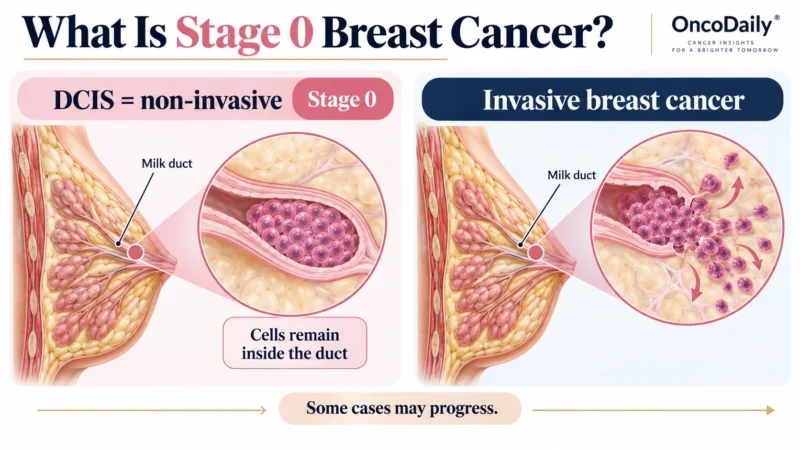
Doctors cannot yet reliably predict which individual lesions will progress. This uncertainty is one reason management decisions depend on multiple factors, including the size and extent of the lesion, nuclear grade, surgical margins, hormone-receptor status, imaging findings, age, and the patient’s overall risk profile.
Zimmer Initially Faced the Possibility of a Mastectomy
Zimmer has said that after receiving the diagnosis, she initially believed she might require a mastectomy, an operation that removes the breast. She later consulted breast surgeon Dr. Kristi Funk and chose a lumpectomy, also known as breast-conserving surgery. A lumpectomy removes the abnormal area together with a margin of surrounding tissue while preserving most of the breast. Zimmer ultimately underwent three surgeries over three consecutive weeks.
She has not publicly disclosed the detailed pathology findings or explained the exact reason that multiple procedures were required. It would therefore be inappropriate to assume that the additional surgeries were related to margins or another specific surgical issue. Zimmer has said that the cancer was successfully removed while preserving her breast.
Why Did Constance Zimmer Receive Radiation Therapy?
Zimmer also underwent radiation therapy after surgery. Radiation is frequently recommended after breast-conserving surgery for DCIS because it can reduce the risk of another breast event occurring in the treated breast. A pooled analysis of four randomized trials involving 3,729 women with DCIS found that radiation after breast-conserving surgery reduced the 10-year risk of an ipsilateral breast event from 28.1% to 12.9%. These events included both recurrent DCIS and invasive breast cancer.
The result should not be interpreted to mean that every patient experiences exactly the same reduction in risk. Decisions about radiation are individualized according to factors such as age, lesion characteristics, surgical margins, recurrence risk, and patient preferences. Zimmer has not publicly disclosed her radiation dose, number of treatment sessions, treatment schedule, or specific radiation technique.
Why Is DCIS Usually Treated If It Is Stage 0?
The term Stage 0 can make DCIS sound clinically insignificant, but the biology is more complicated. DCIS itself has not invaded surrounding breast tissue. The concern is that some untreated lesions may eventually progress to invasive breast cancer. Because clinicians cannot yet reliably determine which individual cases will progress, most patients have traditionally been offered treatment intended to prevent local recurrence and future invasive disease.
Management may include breast-conserving surgery, radiation therapy, mastectomy in selected cases, and endocrine therapy for hormone receptor-positive DCIS. At the same time, breast oncology is increasingly investigating whether some carefully selected low-risk cases can be managed less aggressively. The COMET randomized clinical trial enrolled 957 women with selected low-risk DCIS and compared active monitoring with guideline-concordant care. At two years, invasive cancer in the same breast had been diagnosed in 4.2% of women assigned to active monitoring compared with 5.9% of those receiving guideline-concordant care.
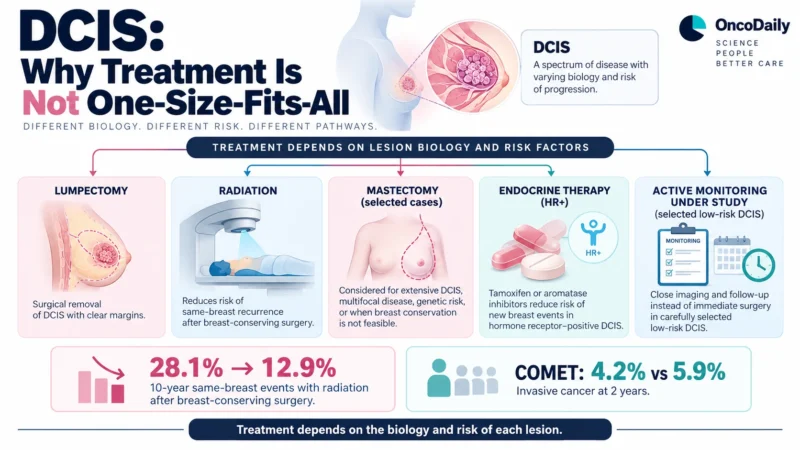
These findings are important, but they do not establish that active monitoring is appropriate or safe for every person with DCIS. The study involved a carefully selected low-risk population, and longer follow-up is needed to understand longer-term outcomes. The broader direction of research is toward more individualized treatment: identifying which patients are most likely to benefit from intervention while reducing unnecessary treatment for those at very low risk.
What Is the Prognosis for DCIS?
The overall prognosis after a diagnosis of DCIS is excellent. The National Cancer Institute reports that more than 98% of people diagnosed with DCIS are alive five years after diagnosis. That statistic describes outcomes across a population and cannot predict the course of disease for an individual patient. The challenge with DCIS is therefore not simply treating cancer. It is balancing the prevention of future invasive disease against the possibility of overtreating lesions that might never have progressed.
Is Constance Zimmer Cancer-Free?
Zimmer has said that she is now cancer-free. When she publicly disclosed her diagnosis in October 2026, Zimmer said she had been cancer-free for seven months. That description reflects Zimmer’s own account of her medical status rather than an independently verified medical assessment. She shared photographs and videos from different points in her treatment and described experiencing emotions ranging from “pure shock and fear” to “pure joy and gratitude.” Zimmer also contrasted her treatment experience with her later public appearances, describing the journey as going from “hospital gowns to Emmy glamour.” Her story illustrates how someone can continue appearing publicly and professionally while privately navigating a significant medical diagnosis.
What Has Constance Zimmer Not Revealed?
Several important medical details about Zimmer’s DCIS remain private. She has not publicly disclosed:
- the size or nuclear grade of the DCIS
- estrogen- or progesterone-receptor status
- detailed surgical margin information
- whether endocrine therapy was recommended
- her detailed radiation schedule
- her long-term surveillance plan
It is also not clear from the information she has shared whether the DCIS was initially detected during routine screening or through another diagnostic pathway. These details can significantly influence treatment recommendations and recurrence-risk estimates. For that reason, Zimmer’s treatment course should not be viewed as a template for every person diagnosed with DCIS.
Why Early Detection Matters
DCIS is frequently detected through breast imaging before a person develops noticeable symptoms. Mammography can identify abnormalities such as calcifications that may lead to further imaging and biopsy, allowing DCIS to be detected before invasive disease develops. At the same time, widespread screening has introduced an important clinical challenge: identifying which early lesions are likely to become harmful and which may never progress during a person’s lifetime.
Zimmer has said that one reason she decided to share her diagnosis was to encourage women not to delay looking after their health. Breast cancer screening recommendations vary according to age, country, family history, genetic risk, previous breast findings, and other individual factors. Screening decisions should therefore be based on appropriate medical guidance rather than celebrity experiences or social-media recommendations alone.
Why Constance Zimmer’s Story Matters
Zimmer’s disclosure brings attention to a breast condition that is common but frequently misunderstood. Stage 0 does not mean “nothing.” DCIS is non-invasive and carries an excellent prognosis, but a diagnosis can still involve difficult treatment decisions, repeated surgery, radiation therapy, uncertainty, and significant emotional strain. At the same time, emerging research is challenging the idea that every case of DCIS should necessarily receive the same intensity of treatment. Studies such as COMET are investigating whether carefully selected women with low-risk disease may eventually be able to avoid immediate surgery without increasing their short-term risk of invasive cancer.
Zimmer’s experience also demonstrates how little may be visible from the outside. While continuing her career, promoting Love Story: John F. Kennedy Jr. & Carolyn Bessette, and receiving professional recognition for her work, she was privately navigating surgery and radiation therapy.
By choosing to discuss that experience publicly, Zimmer has created an opportunity to talk not only about breast cancer awareness, but also about the complexities of early detection, DCIS, treatment decisions, and the rapidly evolving effort to personalize breast cancer care. Her story should not determine how another patient approaches DCIS. But it may encourage more people to seek appropriate screening, ask questions about their diagnosis, and understand that even within “Stage 0” breast cancer, treatment decisions are highly individual.
You Can Also Read Vanessa Trump’s Breast Cancer Diagnosis: Surgery, Treatment Updates, and What Remains Unknown by OncoDaily

Written by Aharon Tsaturyan, MD, Editor at OncoDaily Intelligence Unit
FAQ
What type of breast cancer did Constance Zimmer have?
Constance Zimmer said she was diagnosed with ductal carcinoma in situ (DCIS), commonly called Stage 0 breast cancer. DCIS means abnormal cells are confined within the breast ducts and have not invaded surrounding breast tissue. EW.com
Is Constance Zimmer cancer-free now?
Zimmer said that she was cancer-free when she publicly disclosed her diagnosis in October 2026 and stated that she had been cancer-free for seven months. This reflects her own account of her medical status.
What is Stage 0 breast cancer?
Stage 0 breast cancer usually refers to DCIS, in which abnormal cells are present inside the milk ducts but have not spread into nearby breast tissue. It is considered non-invasive and has an excellent prognosis. Национальный институт рака
Is DCIS really cancer?
Terminology varies. DCIS is commonly called non-invasive breast cancer or Stage 0 breast cancer, although the National Cancer Institute describes it as a non-invasive condition or precancer because the abnormal cells have not invaded surrounding tissue. Национальный институт рака
Can Stage 0 breast cancer become invasive?
Yes. Some DCIS lesions can eventually progress to invasive breast cancer, although doctors cannot reliably predict which individual lesions will do so. This uncertainty is one reason most DCIS has traditionally been treated. Национальный институт рака
How was Constance Zimmer’s breast cancer treated?
Zimmer said she underwent a lumpectomy, ultimately had three surgeries over three consecutive weeks, and then received radiation therapy. She initially thought she might need a mastectomy but pursued a breast-conserving approach. The Daily Beast
Why is radiation used after a lumpectomy for DCIS?
Radiation after breast-conserving surgery can reduce the likelihood of another event in the same breast, including recurrent DCIS or invasive breast cancer. It is commonly recommended after lumpectomy, although treatment is individualized. Национальный институт рака
What is the survival rate for Stage 0 breast cancer?
The prognosis for DCIS is excellent. Mayo Clinic reports a 10-year survival rate greater than 98% for people diagnosed with DCIS without accompanying invasive breast cancer. Mayo Clinic
Does everyone with DCIS need surgery?
Surgery remains the usual treatment for DCIS, but researchers are studying whether some carefully selected low-risk patients can be safely managed with active monitoring. This approach is not appropriate for every case and requires specialist evaluation. Национальный институт рака
Can DCIS come back after treatment?
Yes. DCIS can recur in the same breast, and a subsequent breast cancer can sometimes be invasive. Recurrence risk varies according to factors such as grade, margins, treatment received, and individual tumor characteristics.